Would free university increase or decrease higher education participation rates in Australia?

In a previous post I argued that Australia’s practice of charging fees for higher education reflects its broader patterns of taxation and public funding of social services.

But we have had free higher education before, 1974-1988. For a government already spending over $600 billion a year the cost of free higher education is not beyond the feasible range. I estimate costs at $4.6 to $5.9 billion a year on status quo numbers of student places in public universities. The range reflects uncertainties about how domestic students currently paying full fees would be handled. The $4.6 billion transitions currently Commonwealth supported students to free, while the $5.9 billion fully compensates universities for lost fee revenue.

Of the arguments for free higher education the one that people find most intuitive is that it would increase higher education participation. People consume more when prices go down. But somebody is paying – the government on behalf of taxpayers – and so how they would respond is the key variable in whether the number of students would go up or down.

Debt aversion

Supporters of free higher education often make demand-side arguments, that fees or loans are a deterrent to higher education participation, especially to people from disadvantaged backgrounds.

As someone with working class origins free higher education advocate Duncan Maskell says he would not have gone to university if he had to take out a loan. Occasional school student surveys have picked up similar sentiments. But the ‘debt aversion’ hypothesis has always had trouble distinguishing between sensible prudence around taking out debt that probably is not worth it (good debt aversion), and over-caution in taking out debts that would probably lead to significant long-term benefits (bad debt aversion).

Read More »

Why do Australian university students pay fees?

University of Melbourne VC Duncan Maskell secured some not always entirely positive media coverage today for his call to make university education free for domestic students.

University education is free or very cheap for students in some European countries and was also free in Australia between 1974 and 1988.

Why do countries differ on university fees?

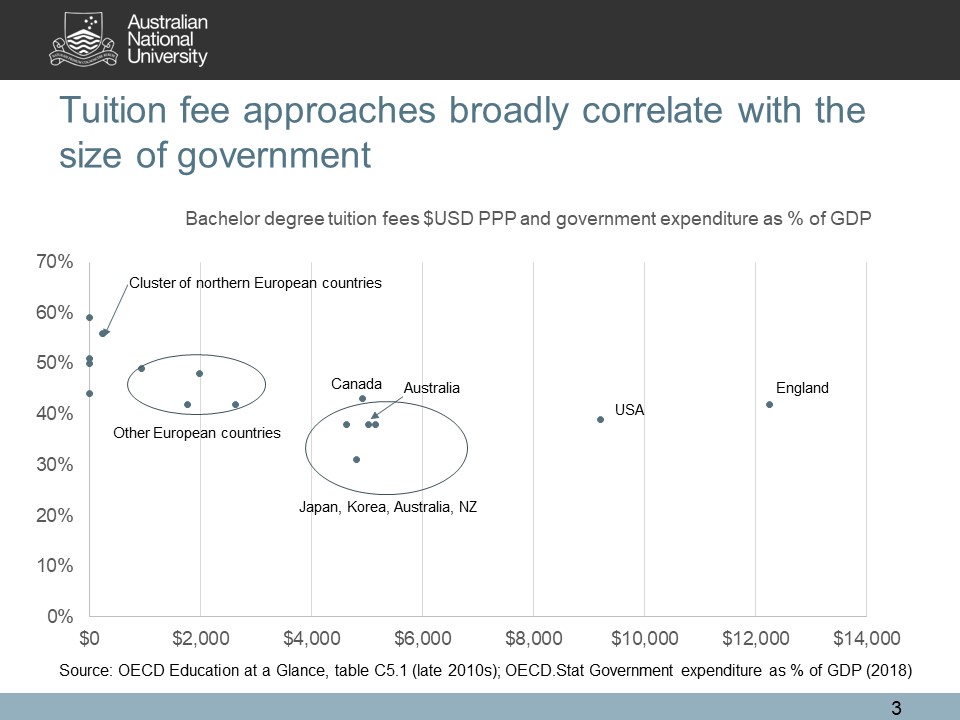
My theory of why countries differ on this issue draws loosely on the work of Julian Garritzmann. We observe broad coherence between higher education finance systems in each country and their overall tax and social service/benefits systems. The chart below shows patterns in the OECD. Australia is in a cluster of countries in our region with government expenditure below 40 per cent of GDP and quite similar fees in $USD purchasing power parity terms. The countries with free higher education tend to have governments that consume more than 50 per cent of GDP.

Read More »

Are mini-demand driven systems a good idea?

In their second submissions to the Universities Accord review Universities Australia and Innovative Research Universities both call for extending the existing demand driven system for regional and remote Indigenous students to all Indigenous students.

Mini-demand driven systems support increasing enrolments from a target population, or potentially in a target course, without risking (from a government perspective) a major cost escalation under a full demand driven system.

Although I support a return to full demand driven funding I doubt that mini-demand driven systems are a good idea.

The risks of restricted-use funds

From a government perspective the attraction of mini-demand driven systems is their apparent pursuit of some desirable outcome at low cost. Only funding for the estimated additional student places is likely to be ‘new’ money.

If so, in the transition to a new mini-demand driven system each university would lose from its overall maximum block grant amount estimated funding for current students meeting the mini-demand driven criteria – in the UA/IRU case, probably the Commonwealth contribution value of their existing student load of Indigenous students living in metropolitan areas.

As a result, ‘old’ money that could once be used flexibly for any domestic student could after the clawback only be used for about four per cent of the population.

If in practice the university attracts fewer Indigenous students than expected, or these students enrol in subjects valued at less in Commonwealth contribution terms than forecast, then the university is left with stranded resources. It has student funding that is theoretically available but in practice cannot be used.

Read More »

The 20,000 equity places that nearly weren’t allocated and that will probably never be delivered

At the 2022 election Labor promised up to 20,000 new student places in skills shortage areas for members of equity groups. The minister announced high-level allocations last October. The funding agreements implementing the promise for 2023 were published last month, providing additional but not complete detail. This a multi-year program and the current 2021-2023 funding agreements do not include 2024 commencing places.

This post describes the available information on student place allocation, highlighting the policy and legal flaws in distributing funding this way. The policy’s problems are exacerbated by the Job-ready Graduates Commonwealth contribution changes.

Allocations by funding cluster

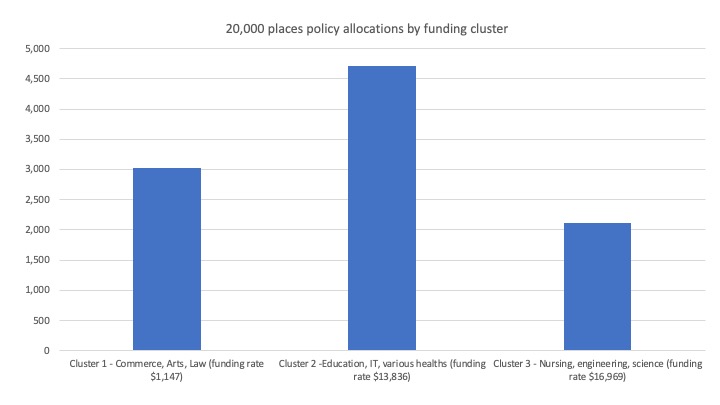
When universities received their allocations many were surprised by student places they had not requested. These were in funding cluster 1, the law, commerce and most humanities cluster. Just over 30 per cent (3,026) of the 9,851 places allocated in this round are in cluster 1.

The Department of Education’s manoeuvre can be seen in the funding agreements, an example below, which are prescriptive about the use of cluster 2 and 3 places, following information in funding applications, but not cluster 1. Instead, another clause says ‘these [cluster 1] places are to be delivered in line with a separate agreement between the Provider and the Department.’ To stay consistent with the original guidelines the cluster 1 courses need to be in skills shortage fields. Accounting and auditing are on the skills shortage list, although universities could also find other ‘relevant industry needs or shortages’.

Read More »

Urban prospective students and regional student places: the Job-ready Graduates growth mismatch

In an earlier post I looked at how Job-ready Graduates could produce fewer total student places than originally forecast. This post examines the geographic distribution of those places. Both posts draw on my first submission to the Universities Accord review.

Job-ready Graduates ‘growth’ funding is based on campus location (‘growth’ in quotation marks because it is off a reduced base). Regional campuses get 3.5 per cent annual funding growth, with 2.5 per cent for metropolitan campuses in high growth areas, and 1 per cent for other campuses. Higher growth rates for regional campuses reflect concern about lower university participation rates for people from regional areas.

Growth funding is for coming increases in the school leaver population, which will translate into increased demand for higher education. My submission uses 2021 Census data to see where the school leavers of the mid-2020s to 2030 are located, and how this aligns with higher education policy.

City/rest of state growth rates

Full regional classifications are not yet included in the publicly available 2021 Census data, so the chart below uses a greater capital city/rest of state classification. The age groups cover the young people who will finish Year 12 and seek university entry from mid-decade through to 2030. It compares their numbers to those of people the same age at the 2016 Census, who reached/will reach university age in the first half of the 2020s.

Overall the population of 9 to 16 year olds was in 2021 13.5 per cent higher than in 2016 in the greater capital city areas and 7.8 per cent higher in rest of state areas. Population growth is significant in both categories, but larger in the cities that will get a smaller funding increment.

The chart also shows variations by specific year of age, with growth rates most aligned in the 11-to-14-years age groups.

Note: Citizens only. Source: ABS Census 2016 and 2021, TableBuilder Pro
Read More »

Inflation and student places under Job-ready Graduates

Earlier this week I made my first submission to the Universities Accord review. One issue the submission covers is whether Job-ready Graduates policies can meet demand from the so-called Costello baby boom birth cohort. This post looks at how large variations in Commonwealth contribution rates and misaligned systems of indexation could affect overall growth in student places. A subsequent post looks at the geographic distribution of places.

The relative value of Commonwealth contributions

Job-ready Graduates combines a fixed maximum basic grant amount (MBGA) for higher education courses (all CSP coursework except medical places and places for regional Indigenous bachelor degree students) with Commonwealth contributions that vary between disciplines. The maximum funding a university can receive for higher education courses is the lesser of their full-time equivalent places delivered multiplied by the relevant Commonwealth contributions or the MBGA amount in its funding agreement.

This system creates trade-offs between opportunities for students, which are maximised by focusing on the courses with the lowest Commonwealth contributions, and meeting skills needs, with skills shortage occupations typically requiring graduates from courses with higher Commonwealth contributions.

Trade-offs were already a feature of the pre-JRG funding system, but JRG exacerbated them as the chart below shows. One new place in a funding cluster 4 course (medicine, dentistry, agriculture) costs 24.6 places in funding cluster 1 course (business, law, most humanities and social sciences). Under the pre-JRG system the highest funding cluster was 10.9 times the lowest funding cluster; still high, but a less extreme trade-off than under JRG.

We don’t yet have 2021 enrolment data to see where enrolments are moving by discipline. A move towards the higher Commonwealth contribution fields will consume more of the available funding, leaving less money to finance additional student places.

I don’t believe this is an immediate major issue. System capacity may be down on 2020 JRG projections but so is domestic demand, due to a strong labour market and flat or falling numbers of school leavers with an ATAR in the big states. But increased school leaver numbers due to a larger birth cohort will push demand up again in the mid-2020s.

Read More »

The public-private balance: A failed rationale for setting student contributions

A previous post on the reasons given by government for setting student contributions, like this post based on a new paper of mine, listed five rationales used for implemented policies: course costs, private benefits, public benefits, increasing resources per student place, and incentivising course choices.

A sixth rationale has repeatedly been considered but never become policy, the idea that the distribution of benefits between public and private should drive the distribution of costs between public and private, as represented by the government and students. This post explains where this idea came from and why it has always been rejected.

Origins in the justification for HECS

As my earlier post noted, the public-private benefits idea first appeared in the Wran report that led to HECS. Its logic was not explained, but I think it was a corollary of the private benefits argument – that if students should pay for their higher education because they received private benefits then it seemed to follow that the government, on behalf of the public, should pay for the benefits they received. This is a normative argument about who should pay rather than an empirical claim that public subsidies produce public benefits.

The Wran report did not recommend this approach because calculating private and public benefits was too hard.

The balance metaphor

As part of the 1996 Budget the Howard government, with Amanda Vanstone as minister, introduced private benefits as a rationale for specific course contributions. Conceptually, however, this was quite different to the private-public benefits idea. The Vanstone version was the private benefits of a course relative to the private benefits of other courses, rather than the Wran private benefits of a course as a proportion of all benefits private and public or, at a system level, overall higher education private benefits as a proportion of all benefits.

Read More »

The five student contribution rationales since 1989

In a new paper published by the U of M’s Centre for the Study of Higher Education I chronicle the history of student contribution rationales – the reasons the government gave for HECS rates and then student contributions.

I argue that five rationales have been used: private benefits, course costs, increasing resources per student place, incentivising course choices and public benefits.

A key turning point is the 1996 Budget, when the government abandoned a flat HECS charge across all disciplines and introduced differential HECS. This required a more complex set of justifications than previously. The government’s arguments had to explain not just why students should pay compared to the previous free higher education system, but also why they should pay more for some courses than others.

The Wran report

The HECS system was recommended in a 1988 review chaired by former NSW Premier Neville Wran. It introduced four concepts that were subsequently influential in thinking about how to charge for higher education: private benefits, public benefits, a balance between private and public benefits, and course costs.

Read More »

Bonded scholarships for nursing students in Victoria

The Victorian government has announced an incentive program for nursing and midwifery students. For 2023 and 2024, students enrolling in nursing and midwifery ‘will receive $9,000 while they study and the remaining $7,500 if they work in Victorian public health services for two years.’

In a quote provided to the media, Premier Daniel Andrews says “If you’re in Year 12 and you’ve been thinking about studying nursing or midwifery – go for it. We’ve got your HECS fees covered.”

Are student contributions covered?

Student contributions (‘HECS fees’) for a 3 year nursing course are about $12,000 on current student contributions, so the initial $9,000 assistance while studying will not cover them in full.

Student contribution reform may start in 2024. Increasing the current $4,000 student contribution band that includes nursing is a plausible outcome, to reduce the debt burden of arts students. If so, that will increase the gap between the scholarship and student contributions.

On any scenario, nursing students who complete their degree will need to pay student contributions upfront or incur a HELP debt.

Read More »

The legal and bureaucratic problems of the government’s 20,000 additional student places policy

Last week the government’s announced the details of how it will meet its election promise of 20,000 additional student places. Many of these details create legal and bureaucratic problems for the government and universities.

General lack of statutory authority

The program guidelines, unsurprisingly given Labor’s election promise, refer explicitly to the allocation of the 20,000 places. While unexceptional in historical policy terms this is not how things work for public universities (‘Table A providers’) under the Job-ready Graduates version of the Higher Education Support Act 2003.

Section 30-10 of HESA 2003, as cut-and-pasted below, does not give the minister the power to allocate student places to Table A institutions except in the case of designation. Only medicine is currently designated. For higher education courses, covering every course except medicine, the unit of allocation is dollars rather than student places.

Read More »