How can the government steer teaching enrolments to ‘quality’ courses? And what could go wrong?

The communique from last Friday’s education ministers meeting stated, in part, that:

The Teacher Education Expert Panelwill focus on strengthening the link between performance and funding of ITE [Initial Teacher Education]. This will include but not be limited to advising on how Commonwealth supported places for teaching should be allocated based on quality and other relevant factors. [Emphasis added.]

This post examines how the government might go about doing this and the problems it would face.

Discipline-level funding under Job-ready Graduates

An initial problem is that the government does not allocate Commonwealth supported places to teaching.

Under section 30-10 of the Higher Education Support Act 2003 the government has no power to allocate student places except for ‘designated courses’, of which more below.

Education is not designated. It is funded under a block grant for ‘higher education courses’. Dollars rather than places are the unit of allocation and the entity that receives the allocation is a higher education institution, not a course or discipline. Recipient universities are free to distribute these dollars between courses according to their own priorities.

With its COVID-19 short courses the previous government bypassed the restriction on allocating student places by allocating dollars to specific courses instead. Using the funding agreements to quarantine dollars for education would, however, be a bad move. It is inconsistent with the apparent legislative intent, which is for university flexibility except in the case of designation. We need to restore full operation of the rule of law in higher education policy. Without amending HESA 2003 that means designation.

Read More »

Inflation and higher education

The return of inflation has led to questions about what this means for students, graduates and higher education institutions. This post lists some of the implications.

Indexation of HELP debt

HELP debt is indexed each 1 June. It is based on a two year period of CPI data ending in the March quarter of 2022 (I am not sure why it is two years). Because inflation March 2020 to March 2021 was lower than inflation March 2021 to March 2022 indexation for 2022 was 3.9 per cent, rather than the 5.1 per cent it would have been on a one year CPI cycle. The downside of this reprieve is that after inflation comes down again indexation will still exceed the recent average.

I said at last week’s Universities Australia conference that increased indexation will affect the politics of HELP debt. The big increase in the number of HELP debtors and total HELP debt over the last 15 years occurred at a time of mostly low inflation. Annual indexation rarely attracted much comment. This year there was much more media and social media coverage.

CPI is well above bank interest rates, giving people who can afford to repay early an incentive to do so. Indeed, low bank interest rates may help explain why voluntary HELP repayments have grown in recent years.

Read More »

A few notes on the future of higher education policy

Labor went to the 2022 election with few specific policies on higher education, but with general plans for a different style of policymaking. The teal MPs have a few things to say about higher education. If Labor gets a clear House of Representatives majority, however, the opinions of the yet-to-be-determined Senate crossbench will be more important than those of lower-house teals in the passage of higher education legislation.

Additional student places

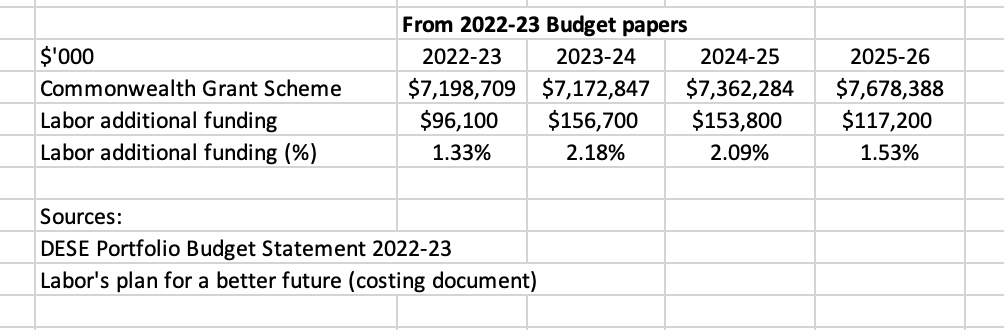
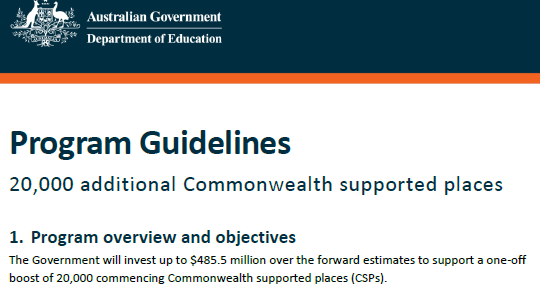
Labor’s main specific election promise was ‘up to’ 20,000 more student places. As I wrote when the policy was announced, the ‘up to’ is an important caveat, because under Job-ready Graduates the government allocates dollars rather than places. The same number of dollars can convert into lots of places in arts or business courses with low Commonwealth contributions, or relatively few places in courses with high Commonwealth contributions.

Labor’s costings document also indicates that this money for extra places appears to be temporary, starting to decline before the full impact of demand from the ‘Costello baby boom’ cohort is felt. It may also be too little to offset the inflation impact on Commonwealth-supported places. Commonwealth contributions are indexed to CPI, so as contribution values go up universities need to deliver fewer student places to get each $1 million of Commonwealth Grant Scheme funding.

Read More »

University offers under Job-ready Graduates

In an earlier post I looked at how university applicants responded to COVID-19 and the new Job-ready Graduates student contributions. In this post I look at how universities responded, based on the offers statistics released yesterday. All the numbers are for domestic undergraduate applicants only.

The incentives faced by universities

In the lead up to 2021 university offers university leaders made various statements about trying to meet expected extra domestic demand, as COVID cut job and travel alternatives to study. But universities also faced, and face, a difficult finanacial situation. They are simultaneously being hit by the Job-ready Graduates policy, which reduces their per student funding in many fields, and by the loss of international student revenue, with the borders now closed to new international students since March 2020. These events compromise university capacity to fund domestic undergraduate student places that do not cover their own costs

Capacity aside, Job-ready Graduates creates complex incentives. By funding at average teaching costs it creates an economies of scale model. That’s one reason why we see the closure of low enrolment subjects and courses. If there is no longer any profit on some courses that may also disincline universities from expanding. On the other hand, if universities want to maintain a course then driving up enrolments may the key to it, by spreading fixed or semi-fixed costs over larger numbers of students. And in the $14,500 student contribution fields – arts (with a few exceptions), business and law – there may be a de facto demand driven system.

Universities also need to consider a complex short-to-medium term negative effect caused by JRG only partially grandfathering pre-2021 students. The link has explanatory detail, but the practical consequence is that more of a university’s total Commonwealth teaching grant has to be spent on continuing students, leaving less money for new students.

Yet another complexity for universities is that COVID-19 made estimating student numbers more difficult. For admissions, the key risk was that offer acceptance rates would be higher than usual, and the university would end up with loss making ‘over-enrolments’ (enrolments that earn a student but not a Commonwealth contribution). This created an incentive to be cautious about offer levels.

Read More »

How much the government paid for Centre Alliance’s Senate vote, and other updates from the funding agreements

This post updates one I wrote in April, including new information from revised university funding agreements posted on DESE’s website.

South Australian university Senate special deals

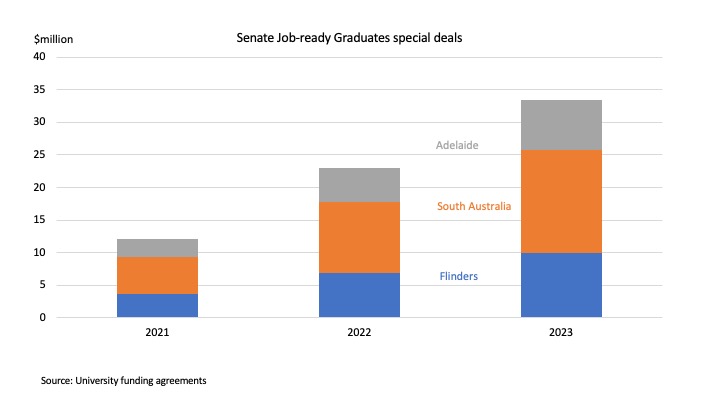
The updated funding agreements let us see how much the government paid to get Centre Alliance Senator Stirling Griff to vote for Job-ready Graduates, which is $68.6 million for South Australian universities over the 2021-2023 funding agreement period. Unlike much of the other additional money in the funding agreements, these increases are ongoing rather than temporary.

I am not sure what criteria were used in dividing the money between the South Australian universities. In 2021 Adelaide gets 1.9 per cent more than it presumably would have otherwise, Flinders 2.7 per cent, and the University of South Australia 3.1 per cent.

More short course places allocated

In my earlier post the allocated short courses fell short of the announced budget value of $252 million. Now they slightly exceed it at $258.7 million, divided between 256 undergraduate certificates valued at $102.9 million and 491 graduate certificates worth $155.8 million. My updated spreadsheet of short courses is here.

Read More »

Would universities have received JobKeeper under more favourable rules?

In 2020 the Australian government JobKeeper policy provided eligible employers and employees with a wage subsidy, which was designed to sustain employment during a COVID-related shock to the Australian economy.

Public universities were eligible for JobKeeper, but its regulations were changed several times to reduce the chance that they would qualify. I assessed the merits of the government’s university JobKeeper decisions in a previous post. No university received JobKeeper directly, although some benefited from it via their subsidiaries.

With most university annual reports now published I can partially investigate the effects of the government’s university JobKeeper decisions. As at 6 July 2021 I have 2020 financial results for 32 public universities. I am missing the South Australian universities, the University of Canberra, the University of Tasmania, and Charles Sturt University.

Time period of revenue loss

For all organisations JobKeeper eligibility involved comparing revenue in 2020 with the same period in 2019. Most organisations could choose a month or quarter, but for universities it was changed to the six month period from 1 January 2020. In my previous post, I rated this as the least defensible government university JobKeeper decision.

Early on, before the six month period was introduced, some universities thought that they could qualify (eg Sydney and La Trobe in April).

The original one month comparison option, starting with a calendar month that ends after 30 March 2020, seemed to create opportunities for some universities. Government payments arrive in fortnightly instalments, while fees are paid around due dates. In particular months international student fees received for the next semester may be a large percentage of all university income. A big drop in fee revenue in one of those months might have triggered the revenue decline threshold that made an employer eligible for JobKeeper assistance (the relevant level is discussed below).

At least at Sydney, most first semester 2020 student fee due dates were prior to 30 March (I could not find La Trobe’s dates). And Sydney is one of the ‘China universities’ affected by a border closure to China from 1 February 2020. The ‘India universities’ are unlikely to have had a March trigger month, as Indian students mostly arrived before the international borders closed completely to routine travel on 20 March 2020.

Read More »
How defensible were the government’s JobKeeper decisions for public universities?

The Australian Government’s JobKeeper program was intended as a temporary scheme to keep people in jobs during COVID lockdowns and business restrictions. It was originally scheduled to run until late September 2020. With some more limited extensions it finished at the end of March 2021. The government made several decisions that reduced the chance that a public university would qualify for JobKeeper support. This post evaluates those decisions from a public policy perspective. A subsequent post assesses how the various decisions affected public university JobKeeper eligibility.

In the rush to implement JobKeeper, the public university aspects were not well implemented or explained. University hopes were raised only to be dashed, feeding a sense of persecution as well as cutting off potential funding. I will argue, however, that the final policy position reached by the government, except for the time period for comparing 2019 and 2020 cash flows, was not wrong in principle.

More importantly, JobKeeper was never the right response to the higher education sector’s COVID-related problems. It was a short-term program aimed at helping employers maintain staff through domestic lockdowns and restrictions on activity. Regulations affecting the day-to-day activities of people in Australia were, and remain, very disruptive to universities but are not leading to a major loss of income. The financial problem is an international border closure that will last for more than two years. This will cause significant continuing revenue losses from international students into the mid-2020s.

The eventually announced extra government money for research and temporary new student places were more like what is needed. My critique of the government’s higher education response to COVID is that these policies were only announced late in 2020, and largely terminate before borders are predicted to re-open. Additional assistance for 2022 should be arranged.

Read More »

Can performance penalties reduce university maximum basic grant amounts?

The current university funding agreements change the nature of performance funding. Previously performance funding was configured as a reward scheme, providing additional funds in exchange for meeting performance-related criteria. Now it is a penalty scheme, deducting money from teaching grants if universities don’t meet performance criteria. The performance benchmarks are assumed to align with the pre-Job-ready Graduates performance funding policy, but this has not been publicly confirmed.

This post explores whether a performance deduction from teaching grants is legally permissible under the Higher Education Support Act 2003. It is clearly not the kind of performance incentive envisaged by HESA 2003, and there are grounds for thinking that a court might find that it is partially or entirely invalid.

The maximum basic grant amount and the performance penalty

The most important grant provision in HESA 2003 is the maximum basic grant amount (MBGA) for higher education courses. This establishes the maximum amount the government will pay from the Commonwealth Grant Scheme (CGS) for Commonwealth supported student places in coursework courses, other than demand driven enrolments for regional and remote bachelor-degree Indigenous students and medical courses. The total value of this grant for 2021 is about $6.8 billion.

Under HESA 2003 each university is to be paid the lesser of the higher education courses MBGA, as set out in their funding agreement, or the total Commonwealth contribution value (relevant discipline funding rates * full-time equivalent students) of student places delivered. Any enrolments above the cap are funded at the student contribution rate only.

The funding agreements include total MBGA amounts for the next three years. The example below is from Macquarie University’s funding agreement, but all agreements have the same or similar formats.

Another clause in the funding agreements, however, purports to take away an element of the MBGA in the event of poor performance. The example below is again Macquarie but all other other agreements have the same format.
Read More »

The Budget and higher education

The Commonwealth Budget has triggered confusion about higher education funding. How much does the government spend? Has there been a cut or not?

The Budget documents understate government higher education expenditure

The only summary statement of higher education expenditure in the Budget documents is in Budget Paper No. 1, which reports spending on the higher education ‘sub-function’ (sub- of education generally).

But what is in the higher education sub-function? I’ve collated as much information as I can from the Budget papers and I think it means grants administered under the Higher Education Support Act 2003. I can’t exactly replicate it but my numbers are very close – slightly less in every year. I lack expenditure on the Indigenous Student Success Program, which HESA 2003 funds but PM&C rather than DESE administers.

The ‘higher education sub-function’ significantly understates Commonwealth assistance for higher education. As the top line in grey in the chart below shows, using numbers from Budget Statement No. 4 on agency resourcing, it doesn’t even cover money flowing under HESA 2003 itself. The difference is money lent through the HELP loan scheme. Although the Budget papers don’t specifically quantify HELP lending this is likely to become the single largest source of funding for higher education, as international student revenues collapse and the Commonwealth Grant Scheme stagnates.

Read More »

New allocations of money and student places in the university funding agreements

Update 7/7/21: Some of the data in this post has been updated here.

———————————————————————-

Last month I wrote an overview and critique of the new university funding agreements. This post looks at new allocations of funding for student places, while a subsequent post will look at total funding allocations. Not all my numbers match previously announced total funding for the relevant program, so that is a caveat on both posts.

Under Job-ready Graduates universities are free of sub-bachelor and postgraduate student places being allocated by funding cluster, but the funding agreements show that universities have significant additional work to do in applying for and reporting on a range of small programs.

Numbers of universities getting different allocations

Job-ready Graduates introduced several new or substantially revised pots of money. Not all universities receive each of these. As the chart below shows, programs driven by criteria or formulas set out in legislative instruments (NPILF and transition funding) or the legislation itself (demand driven funding for Indigenous students from regional and remote areas) benefit the largest number of universities. Apart from the general grants for higher education courses (sub-bachelor through to masters coursework, except medicine), the ministerial/departmental discretion programs benefit fewer universities.

Short courses funding

According to the funding agreements, 27 of the 37 public universities have received once-off 2021 funding for undergraduate certificate and/or graduate certificate short courses. When a university’s funding agreement reported $0 for short courses I cross-checked against CourseSeeker with its ‘short course’ filter on and found three more universities. I am not sure whether this is because those universities adopted the ‘short course’ brand without a specific funding allocation, or because their funding agreements are yet to be updated, or because CourseSeeker is wrong. My adding up of the value of funding agreement short courses gets me to $213 million, out of the $252 million allocated for 2020-21 in the October 2020 Budget.
Read More »