A cap-and-trade system for international student places

In an earlier post I argued that the government’s plans to cap international student numbers, including by education provider and course, would cause actual enrolments to fall well below the official maximum number.

This is due to the inherent weaknesses of bureaucratic systems of student place allocation. Even when meeting demand is a goal the limited information held by central planners, and the long time lags between allocations and enrolments, will cause student places to remain unused.

This post proposes a partial remedy to this problem, a cap-and-trade system for international student places.

Read More »

The legal detail of the government’s plans to cap international student numbers

In an earlier post I criticised the government’s plans to cap international students by education provider and course.

This post goes through the capping legal detail of the Education Services for Overseas Students Amendment (Quality and Integrity) Bill 2024, which if passed would amend the Education Services for Overseas Students Act 2000.

The amending bill contains other provisions on education agents and education providers designed to limit misconduct in the international student market. This post does not cover these provisions, but Tracy Harris discusses them here.

In this summary, unless specified otherwise, the sections mentioned refer to the amending bill but use the section number as it would appear, if passed, in a revised compilation of the ESOS Act 2000. I also refer to the bill’s explanatory memorandum, which explains the intent behind some provisions. It can be downloaded from the bill’s webpage. The Parliamentary Library’s bills digest is also helpful.

Italicised phrases other than section headings highlight powers that give the minister wide discretion. I see this as a significant problem over-and-above the direct consequences of capping.

On what can international student enrolment limits be imposed?

Read More »

What’s new in university and NUHEP funding agreements, part 2: Inappropriate use of the agreements to create a new equity program

In a previous post on the new funding agreements, I looked at the 2024 Commonwealth Grant Scheme funding for higher education courses and designated courses, along with the amended rules for course closures. In this post I look at a novel funding agreement section, which creates a new equity program financed by under-spends on the Commonwealth Grant Scheme. This program has legal and policy flaws. I also examine some paperwork problems with the agreements for non-university higher education providers and private universities.

What usually happens if universities under-enrol?

Due to weak student demand some, quite possibly many, higher education institutions will under-enrol in 2024 – that is, take Commonwealth-supported students valued at less than the maximum funding they can receive for higher education courses according to the funding agreements – this year a $7.24 billion pot of money.

By law, under-enrolment results in CGS grants being reduced – higher education providers are paid the lesser of the value of student places (on an EFTSL * relevant Commonwealth contribution formula) or their higher education courses maximum basic grant amount: section 33-5(2) of the Higher Education Support Act 2003 for Table A institutions and section 33-5(7), using the terminology of ‘total basic grant amount’ for other higher education providers receiving CGS funding.

Under section 164-10(1A) of HESA 2003 any overpayment is recovered by reducing grants paid to the under-enrolled provider or as a debt to the Commonwealth. Clause 4 of the funding agreements reiterates this requirement.

Read More »

What’s new in university funding agreements, part 1: Commonwealth Grant Scheme funding and course closure rules

The 2024 university and NUHEP funding agreements were released earlier this month. These documents are the legal basis of most funding from the Commonwealth Grant Scheme, the main tuition support program. I have created a spreadsheet with institution-level funding, available here.

Overall funding levels

Any total CGS comparison with 2023 is approximate at this point, as we don’t yet have estimated payments for demand driven funding – 2024 is the first year that metropolitan as well as regional Indigenous bachelor-degree students are financed on this basis. This creates disruptions to the time series for two of the three main CGS pots of money – demand driven and ‘higher education courses’, which covers all Commonwealth supported students except Indigenous bachelor-degree students and medical students.

Higher education courses are by far the largest CGS category. In 2024 maximum higher education courses funding will be $7.24 billion, $452.2 million or 6.7% more than in 2023.

Table A providers (i.e. each government-created university plus ACU and Notre Dame) get 99.5% of this money, while nine other providers get the remaining $34.3 million.

For designated courses, currently medicine only, the 2024 total is $413.97 million up 8.1% on 2023.

Read More »

The revised support for students policy

The draft support for students guidelines received significant negative feedback from the higher education sector. As I wrote in a couple of blog posts, the guidelines interfered in matters of academic judgment and interacted with existing regulations in ways that create duplication and confusion.

Academic judgment

I’m glad to say that the interference in academic judgment provisions have been removed in the enacted support for students guidelines.

Regulatory overlap

The support guidelines explanatory statement discusses their relationship with the higher education threshold standards, which are administered by TEQSA. It says that the threshold standards set the ‘minimum’ requirements while the support for students policy, which is administered by the Department of Education, sets ‘additional, complementary requirements on providers to support their students.’

Read More »

The complex rules around admitting, funding and supporting higher education students

[Update 18/12/2023: Some parts of this post have been revised as the enacted student support guidelines replaced the draft guidelines. The revisions are noted in the text.]

The support for students policy discussed in a previous post adds to an already complex system for admitting, funding and supporting higher education students. Universities have strongly argued against additional bureaucratic processes in areas covered by existing regulation. This is a positive sign – a much better strategy than taking under-funded nuclear submarine student places – and I hear that the final support for students guidelines will be at least somewhat better than the draft guidelines.

The content below is my attempt to understand how all the different rules in this space overlap, interact and potentially contradict each other. While the support for students parts may change soon (the legislation operates from 1 January 2024 [Update 18/12/2023: Now delayed until 1 April 2024]), some existing rules look redundant to me. A warning: this post contains mind-numbing details and distinctions.

Initial admission to a course

The most general rules apply on admission to a course, with TEQSA responsible for enforcement. These protect high-risk students and appear in the higher education threshold standards. They require that:

“Admissions policies, requirements and procedures are … designed to ensure that admitted students have the academic preparation and proficiency in English needed to participate in their intended study, and no known limitations that would be expected to impede their progression and completion”: Part A, section 1.1.

Order of funding priority

For Commonwealth supported students selection decisions must, in the “provider’s reasonable view” be made on “merit”: section 19-35(2) of the Higher Education Support Act 2003. The provider can, however, take into account “educational disadvantages that a particular student has experienced”: section 19-35(3).

As I noted last year, this requirement is in tension with university practices and government policies on admitting members of equity groups in preference to other applicants. The equity group categories are only proxies for educational disadvantage; membership does not say anything certain about a “particular student”.

Read More »
The 20,000 equity places that nearly weren’t allocated and that will probably never be delivered

At the 2022 election Labor promised up to 20,000 new student places in skills shortage areas for members of equity groups. The minister announced high-level allocations last October. The funding agreements implementing the promise for 2023 were published last month, providing additional but not complete detail. This a multi-year program and the current 2021-2023 funding agreements do not include 2024 commencing places.

This post describes the available information on student place allocation, highlighting the policy and legal flaws in distributing funding this way. The policy’s problems are exacerbated by the Job-ready Graduates Commonwealth contribution changes.

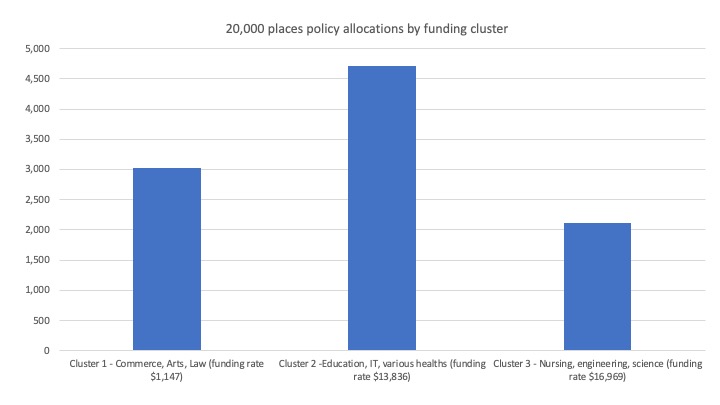
Allocations by funding cluster

When universities received their allocations many were surprised by student places they had not requested. These were in funding cluster 1, the law, commerce and most humanities cluster. Just over 30 per cent (3,026) of the 9,851 places allocated in this round are in cluster 1.

The Department of Education’s manoeuvre can be seen in the funding agreements, an example below, which are prescriptive about the use of cluster 2 and 3 places, following information in funding applications, but not cluster 1. Instead, another clause says ‘these [cluster 1] places are to be delivered in line with a separate agreement between the Provider and the Department.’ To stay consistent with the original guidelines the cluster 1 courses need to be in skills shortage fields. Accounting and auditing are on the skills shortage list, although universities could also find other ‘relevant industry needs or shortages’.

Read More »

Bonded scholarships for nursing students in Victoria

The Victorian government has announced an incentive program for nursing and midwifery students. For 2023 and 2024, students enrolling in nursing and midwifery ‘will receive $9,000 while they study and the remaining $7,500 if they work in Victorian public health services for two years.’

In a quote provided to the media, Premier Daniel Andrews says “If you’re in Year 12 and you’ve been thinking about studying nursing or midwifery – go for it. We’ve got your HECS fees covered.”

Are student contributions covered?

Student contributions (‘HECS fees’) for a 3 year nursing course are about $12,000 on current student contributions, so the initial $9,000 assistance while studying will not cover them in full.

Student contribution reform may start in 2024. Increasing the current $4,000 student contribution band that includes nursing is a plausible outcome, to reduce the debt burden of arts students. If so, that will increase the gap between the scholarship and student contributions.

On any scenario, nursing students who complete their degree will need to pay student contributions upfront or incur a HELP debt.

Read More »

The legal and bureaucratic problems of the government’s 20,000 additional student places policy

Last week the government’s announced the details of how it will meet its election promise of 20,000 additional student places. Many of these details create legal and bureaucratic problems for the government and universities.

General lack of statutory authority

The program guidelines, unsurprisingly given Labor’s election promise, refer explicitly to the allocation of the 20,000 places. While unexceptional in historical policy terms this is not how things work for public universities (‘Table A providers’) under the Job-ready Graduates version of the Higher Education Support Act 2003.

Section 30-10 of HESA 2003, as cut-and-pasted below, does not give the minister the power to allocate student places to Table A institutions except in the case of designation. Only medicine is currently designated. For higher education courses, covering every course except medicine, the unit of allocation is dollars rather than student places.

Read More »

How can the government steer teaching enrolments to ‘quality’ courses? And what could go wrong?

The communique from last Friday’s education ministers meeting stated, in part, that:

The Teacher Education Expert Panelwill focus on strengthening the link between performance and funding of ITE [Initial Teacher Education]. This will include but not be limited to advising on how Commonwealth supported places for teaching should be allocated based on quality and other relevant factors. [Emphasis added.]

This post examines how the government might go about doing this and the problems it would face.

Discipline-level funding under Job-ready Graduates

An initial problem is that the government does not allocate Commonwealth supported places to teaching.

Under section 30-10 of the Higher Education Support Act 2003 the government has no power to allocate student places except for ‘designated courses’, of which more below.

Education is not designated. It is funded under a block grant for ‘higher education courses’. Dollars rather than places are the unit of allocation and the entity that receives the allocation is a higher education institution, not a course or discipline. Recipient universities are free to distribute these dollars between courses according to their own priorities.

With its COVID-19 short courses the previous government bypassed the restriction on allocating student places by allocating dollars to specific courses instead. Using the funding agreements to quarantine dollars for education would, however, be a bad move. It is inconsistent with the apparent legislative intent, which is for university flexibility except in the case of designation. We need to restore full operation of the rule of law in higher education policy. Without amending HESA 2003 that means designation.

Read More »