Will the ‘Costello baby boom’ have a weaker demographic effect on higher education than expected?

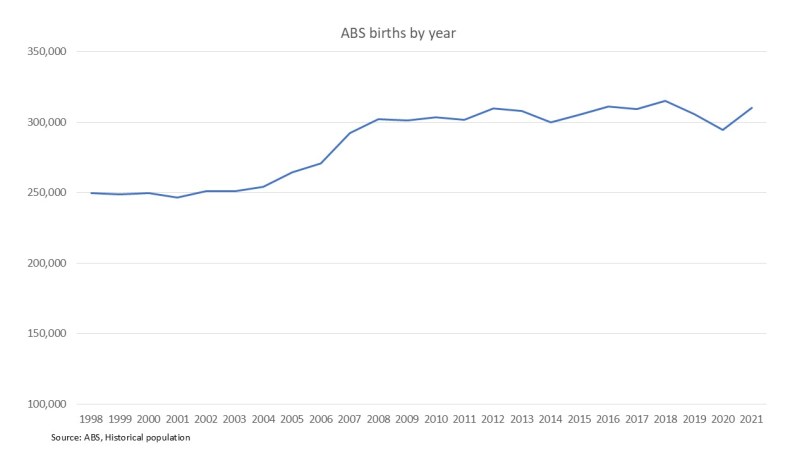
Since the late 2010s I have promoted the idea that the so-called ‘Costello baby boom’ cohorts will arrive at university age from the mid-2020s, increasing school leaver demand for higher education. As the chart below shows, annual births go from around 250,000 in the early 2000s to around 300,000 later in the decade.

Demographers are sceptical of how much effect mid-2000s pro-family policies had, but former Treasurer Peter Costello’s line that ‘if you can have children it’s a good thing to do – you should have one for the father, one for the mother and one for the country..’ was sufficiently memorable that this baby boom has his name attached to it.

As these cohorts approach university age this post takes another look at the data.

Read More »

Can migration policy alone manage international student numbers?

My paper on international student policy – new migration controls and proposed enrolment caps – is published by the ANU Migration Hub today. Some key points appear in The Conversation.

Compared to what I have already written on caps – how actual enrolments will fall below the caps and why even the government’s own agencies doubt the policy’s feasibility and fear its consequences – this paper explores the cumulative consequences to date of migration policy changes.

These consequences are already significant for vocational education and some higher education providers. This raises the question of how necessary the caps are to achieve the government’s policy goal of bringing down net overseas migration.

The policy timeline

Since October 2023 we have witnessed one of the great policy backflips of Australian political history. The Albanese government has turned from supporting the revival of international education – granting a record number of student visas in 2022-2023, extending the temporary graduate visa – to pulling almost every policy lever short of shutting the industry down to reduce international student numbers. International education now keeps political company with live sheep exports, fossil fuels, and vapes retailing.

Read More »

How much difference will stopping student visa applications from people on visitor visas make?

The bad news for international education keeps coming. On Wednesday the government announced that onshore visitor visa holders would no longer be able to apply for a student visa. It also announced a 1 July 2024 implementation date for the ban on temporary graduate visa holders applying for a student visa. The temporary graduate visa policy was announced last December.

How big is the visitor visa change?

The government’s media release says that 36,000 onshore visitor visa holders applied for a student visa in the financial year to May 2024. However the number of visas granted will be much lower than that. As of the end of April 2024 13,733 primary applicant student visas had been granted to onshore visitor visa holders in 2023-24. Secondary visa holders – partners and children – take the number to 17,729.

These numbers are for all levels of education. Higher education primary applicants are about a quarter of the total for this time period. In 2023-24 up to April 3,332 higher student visas grants were made for primary applicants, with secondary applicants taking the total to 4,742.

Read More »

A cap-and-trade system for international student places

In an earlier post I argued that the government’s plans to cap international student numbers, including by education provider and course, would cause actual enrolments to fall well below the official maximum number.

This is due to the inherent weaknesses of bureaucratic systems of student place allocation. Even when meeting demand is a goal the limited information held by central planners, and the long time lags between allocations and enrolments, will cause student places to remain unused.

This post proposes a partial remedy to this problem, a cap-and-trade system for international student places.

Read More »

The legal detail of the government’s plans to cap international student numbers

In an earlier post I criticised the government’s plans to cap international students by education provider and course.

This post goes through the capping legal detail of the Education Services for Overseas Students Amendment (Quality and Integrity) Bill 2024, which if passed would amend the Education Services for Overseas Students Act 2000.

The amending bill contains other provisions on education agents and education providers designed to limit misconduct in the international student market. This post does not cover these provisions, but Tracy Harris discusses them here.

In this summary, unless specified otherwise, the sections mentioned refer to the amending bill but use the section number as it would appear, if passed, in a revised compilation of the ESOS Act 2000. I also refer to the bill’s explanatory memorandum, which explains the intent behind some provisions. It can be downloaded from the bill’s webpage. The Parliamentary Library’s bills digest is also helpful.

Italicised phrases other than section headings highlight powers that give the minister wide discretion. I see this as a significant problem over-and-above the direct consequences of capping.

On what can international student enrolment limits be imposed?

Read More »

Limits on international student numbers could reduce enrolments to well below the official cap

I am not opposed to changing international student migration rules and education provider requirements to moderate problems long associated with international education, including “dodgy” colleges, inadequate student preparation, student poverty, student exploitation and “permanently temporary” migration.

Multiple steps towards minimising these problems have already been announced or taken, with increased financial requirements for a student visa added last week. Most changes announced before last Saturday are justifiable.

But capping international student numbers including down to a course level, as announced over the weekend, is a bad move.

The caps will face all the problems I have identified with bureaucratic allocation of domestic student funding. Because numbers will be allocated between universities and courses according to a politician or bureaucrat’s view of where students should enrol, rather than where students want to enrol, actual enrolments are likely to be well below the capped level.

Read More »

Reducing the number of ‘permanently temporary’ former international students

While I agree with the goals of today’s big migration policy changes, they will make life more difficult for universities relying on migration-motivated international students. In most cases, former international students will be able to stay in Australia on temporary graduate visas for less time than now. Other options for remaining in Australia, such as returning to a student visa, will become more difficult.

These policy changes aim to reduce temporary migrant numbers. The pressure temporary migrants place on accommodation and other services made this an urgent policy and political issue. But prior to this there were also significant concerns about temporary migrants themselves, in their vulnerability to labour market exploitation and prolonging their time in Australia in the often false hope of eventual permanent residence, as ‘permanently temporary’ migrants. The Parkinson migration review, released in March this year, set out an agenda for change.

Future policy on permanent residence is still under development, with some signals discussed below. Whether the number of former international students getting PR will go down remains to be seen. But clearer rules will mean PR aspirants can cut their losses at an earlier point. Fewer will delay important career and family events and decisions due to uncertainty about their long-term country of residence.

Shorter-stay temporary graduate visas

In September 2022 the government announced its decision to add two years to the sub-class 485 temporary graduate visa for graduates with degrees in areas of ‘verified skill shortages’. In the critique I wrote at the time I was ‘far from convinced that a 485 time extension is a good or ethical policy’, and so I am glad that this policy will be abolished.

As the chart below from the migration plan shows, they will also cut the base time period for a masters by coursework from three years to two years, and for a PhD from four years to three years. The regional extension, however, will remain.

Read More »
Mapping Australian higher education 2023 – official release

Update 20/12/2025: More recent data here.

Mapping Australian higher education 2023 is now available from the ANU Centre for Social Research and Methods website.

Update 30/10/2024: There is a later version of Mapping 2023’s data here.

Update 26/10/23: A reader has pointed out that list of FEE-HELP NUHEPs is incomplete. A column of names from the original Excel file was omitted during production. The full list is available here. This list also includes three non-FEE-HELP providers registered by TEQSA since the pdf version was finalised. A corrected version of Mapping with the full list of NUHEPs, as of mid-2023, is here.

If anyone has noticed other errors please let me know.

Higher education participation rates by time of migration and language spoken at home

Some 2021 Census is now available on the ABS TableBuilder site, allowing additional analysis of the social and personal characteristics of higher education students. This posts looks at migration status and language spoken at home, previous strong predictors of higher education participation rates.

Year of arrival

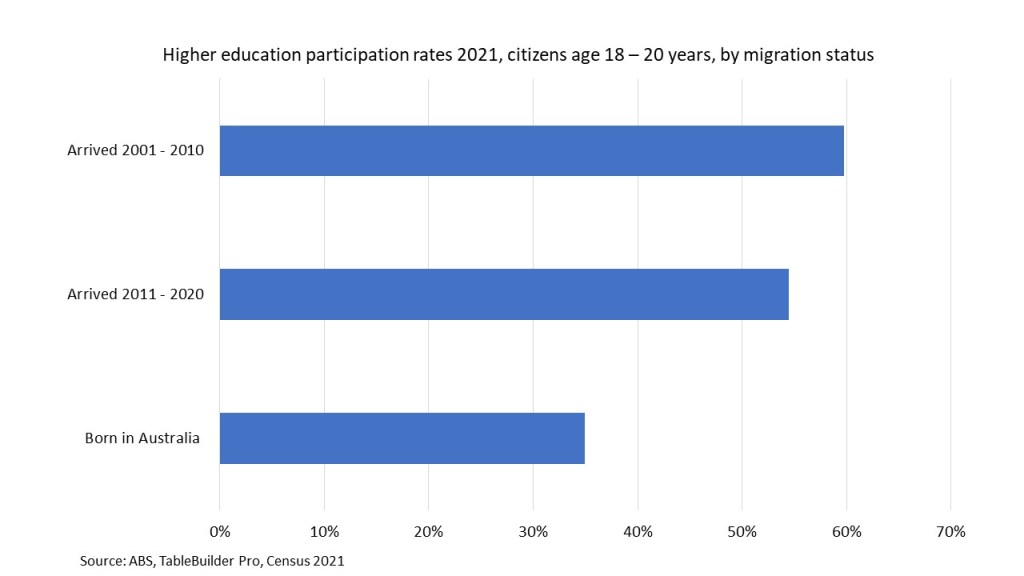
In 2021 migrants who had taken out citizenship were significantly more likely than people born in Australia to be enrolled in university in the post-school 18 to 20 years old age bracket. The participation gap was 19 percentage points for migrants in the decade prior to the 2021 census, 54 per cent participation compared to 35 per cent for young adults who were born in Australia. Migrants who arrived as younger children have a higher participation rate again, at 59 per cent.

Language spoken at home

Read More »

Extending the 485 visa by two years will exacerbate the problems of Australia’s temporary migration program

migration should not simply be about bringing in workers in to fill gaps, it should be about helping people put down roots, to join in the life of our country towns and suburbs. To make a home, to raise a family, to join our Australian family – strengthening our economy and our great multicultural society.”

Prime Minister Anthony Albanese, Jobs and Skills Summit, 2 September 2022

The rise of temporary migration

Thirty years ago Anthony Albanese’s statement would have restated migration orthodoxy. Australia rejected the ‘guest worker’ model of Germany or Singapore or the Gulf states. Most long-term migrants were permanent residents on arrival, with pathways to citizenship. While over time policy moved from assimilation to multiculturalism, the expectation that most ‘join our Australian family’ was a constant.

But from the mid-1990s temporary multi-year visa migration became more common. Major categories included international students, skilled workers and later temporary graduate visas. Working holiday visas and the long-standing open border with New Zealand also increased non-tourist resident numbers. Their total population peaked at 1.7 million in 2019 but fell to 1.2 million during COVID border closures before starting to recover.

Permanent migration is now typically a two step process. In 2018-19, before COVID, 68 per cent of primary applicants for skilled migration were already in Australia; the 85 per cent in 2020-21 will probably come down with reopened borders. Including partner and family migrants 65 per cent of permanent migrants were onshore applicants in 2020-21.

The problems of temporary migration

Temporary migrants freely choose Australia, but life is not easy for them. They are vulnerable to exploitation in the labour market. They pay taxes but are ineligible for most government benefits (although from mid-2021 they did get disaster payments.) Temporary migrants could never vote and have had other political rights reduced.

Read More »