The last university over-enrolment crackdown – some possible lessons

As announced last year, the government plans to crack down on so-called ‘over-enrolments’ – enrolling additional students on a student-contribution only basis once all a university’s Commonwealth Grant Scheme allocation has been used.

When a proposed new funding system is in place, from 2027, student contribution-only places will only be possible in a buffer zone above a university’s Australian Tertiary Education Commission allocation. 2% and 5% buffers have both been suggested. Currently over-enrolled universities will receive some additional funding to bring over-enrolments within their official allocation of places. However, this will not in all cases reduce over-enrolments to the permitted range. Significantly over-enrolled universities need to moderate student intakes in 2026 to bring their medium-term enrolments down.

Not many current Department of Education staff were there the last time a minister thought reducing over-enrolments might be a good idea. The story is worth telling.

Brendan Nelson and over-enrolment

From November 2001 to January 2006 the education minister was Brendan Nelson, a Liberal. Nelson was worried about the quality implications of significant over-enrolments. The first reference I can find to Nelson’s concern is in a media release from December 2001, a month into his term.

Read More »

Why is demand for mature-age undergraduate education shrinking?

I have an article in The Conversation this morning on why demand for undergraduate higher education has been weak in recent years. I looked at school leavers in this July 2025 post. This post expands on the issue of mature age demand.

Applications

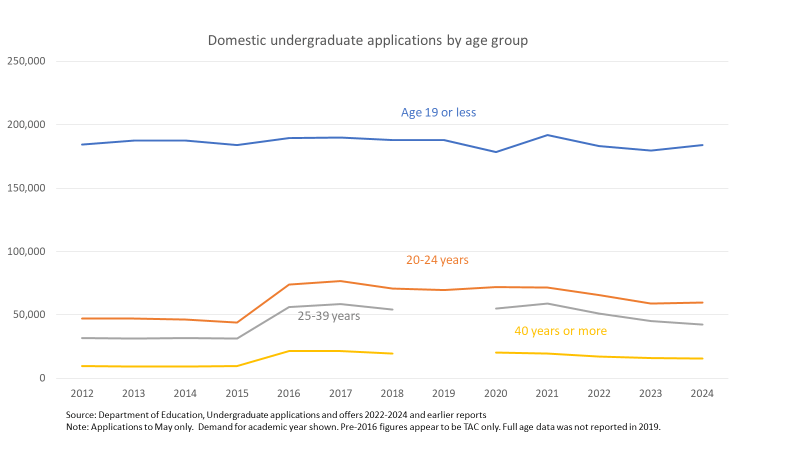
Demand from school leavers is soft but in 2024 was down only 3% on its 2017 peak. But demand from 20-24 year olds is down over the same period by 22% and for the 25 years + age group it is down by 27%. In absolute numbers, demand from school leavers fell by 6,057 applications compared to 44,545 fewer applications from mature age applicants.

Commencing enrolments

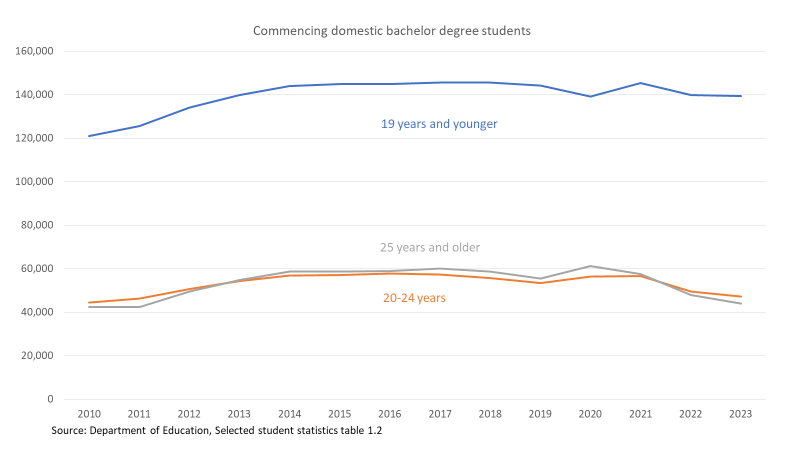
For commencing bachelor degree enrolments 2017 to 2023, unsurprisingly given the applications data, demand has also fallen by the most in the older demographics.

School leaver commencing enrolments are down 4% while the figures are 18% for the 20-24 years group and 27% for the 25+ group. Overall 6,216 fewer school leavers but 26,276 fewer mature age students.

Counter-cyclical enrolment patterns

An applications/enrolment spike in the COVID lockdown years provided evidence for one side of the counter-cyclical theory of enrolments – that more people study when jobs are hard to find. Weak labour markets reduce the ‘opportunity cost’ of education, such as forgone work and wages.

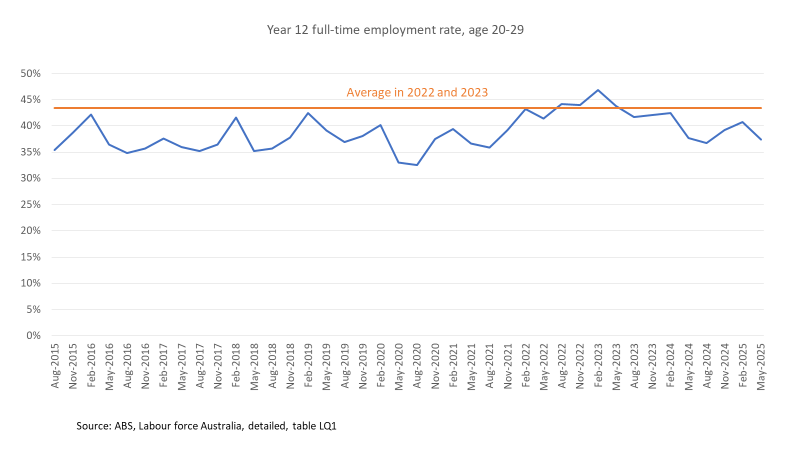
Conversely strong labour markets increase the opportunity cost of study. On average this is especially so for older people, due to their wage premium from previous labour market experience. With a strong labour market since 2022 economic theory predicts that, all other things being equal, enrolments will decline.

In the chart below we can see full-time employment for 20-29 year olds who have completed Year 12 but have no degree was at its lowest level in 2020, in the 2015-2025 period for which we have education levels in the labour force survey. In the initial post-COVID lockdown period, however, we can see that it was much easier than it had been in the 2010s to get a full-time job with a Year 12 qualification only.

The 2020s has provided evidence in favour of the counter-cyclical theory of higher education enrolments.

But does a cyclical theory of enrolments fully explain declining mature-age commencements?

Read More »

Despite an increase in applications for the 2024 academic year, school leaver interest in higher education remained below mid-2010s levels

University applications statistics for 2022 to 2024 were finally released late last week, giving us another data source on demand for higher education.

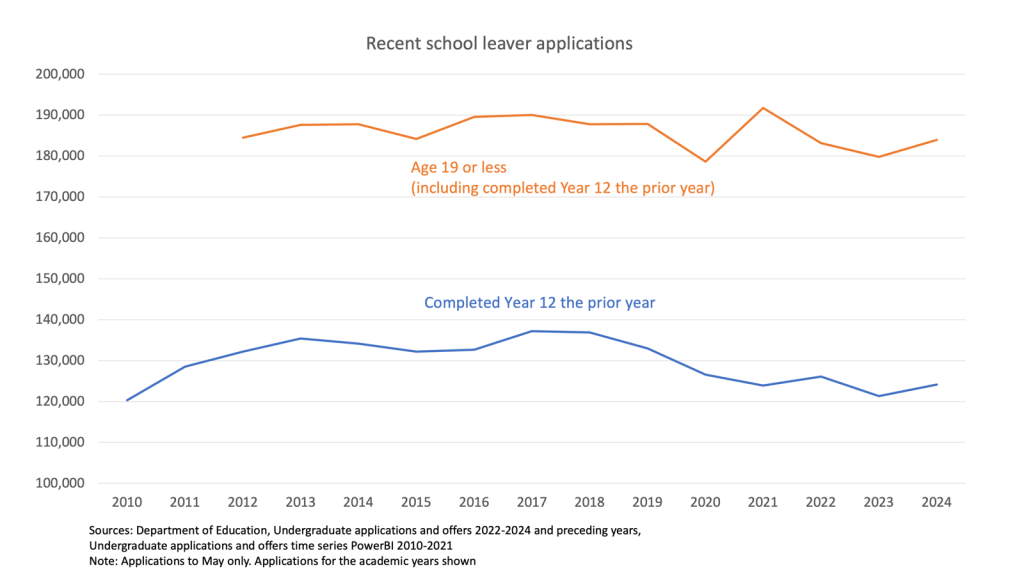
This post focuses on recent school leavers. The chart below shows that applications for this group were up in 2024 on 2023, but that the slump in applications since the late 2010s remained evident – other than the spike for academic year 2021, which is only apparent for teenagers who finished school prior to 2020. This is consistent with people deciding to sit out the COVID recession at university.

That COVID spike meant that in 2021 an unusually large share – 35% – of the 19 and under applicant group were not people who had finished school the year before. This share was 32.5% in each of 2023 and 2024, higher than any year 2012 to 2020, when it averaged 28.4%. This could mean that we are seeing more young people delaying higher education. This data source does not, however, distinguish between people who delayed applying until one or two years after finishing school, and people who enrolled but reapplied to change university and/or course.

Read More »

What explains delays in attrition?

I was quoted at the weekend in a Herald-Sun article about attrition from Victorian universities. The journalist wanted to know how much HELP debt students typically have on drop-out, but unfortunately this data is not regularly published (it should be of course).

But based on some old Grattan analysis, which had actual data to the mid-2010s, the fact that first year is the most common year for attrition, and the strong link between part-time study and attrition, I thought that the typical $$$ figure may not be too high.

That said, average or median HELP debt on dropping out may have increased at a faster rate than indexation in the early 2020s. This is due to students spending more time enrolled before dropping out.

Read More »

Mapping Australian higher education 2023 – data update March 2025

Update 20/12/2025: More recent data here.

—————————————————————————————————

I won’t have the capacity to produce another edition of my Mapping Australian higher education report in the foreseeable future, but I am extending the life of the October 2023 edition by updating the data behind the charts.

Mapping‘s chart data is the only publicly-available source of long-term time series data on many higher education topics, especially on financial matters.

I had been waiting on the 2023 university finances report before releasing another chart data update. That finally happened yesterday. Despite a record 27 universities reporting deficits, in the aggregate there was a small surplus, after a loss overall in 2022.

2023 had some weak numbers for the two main Commonwealth student programs, the Commonwealth Grant Scheme and HELP. Several factors were behind this: temporary COVID places coming out of the system, Job-ready Graduates reductions in total funding rates for some courses, and weak domestic demand. These programs trended up in 2024 and 2025, as seen in the chart below, although high CPI-driven indexation was a significant factor.

The updated chart data is available here.

Where are the young people who are not at university?

Earlier this month I wrote a post showing that higher education enrolments at age 19 years, and the domestic participation rate at age 19, were down in 2023 compared to 2022.

This post explores possible reasons for this downward trend.

The teenage job market

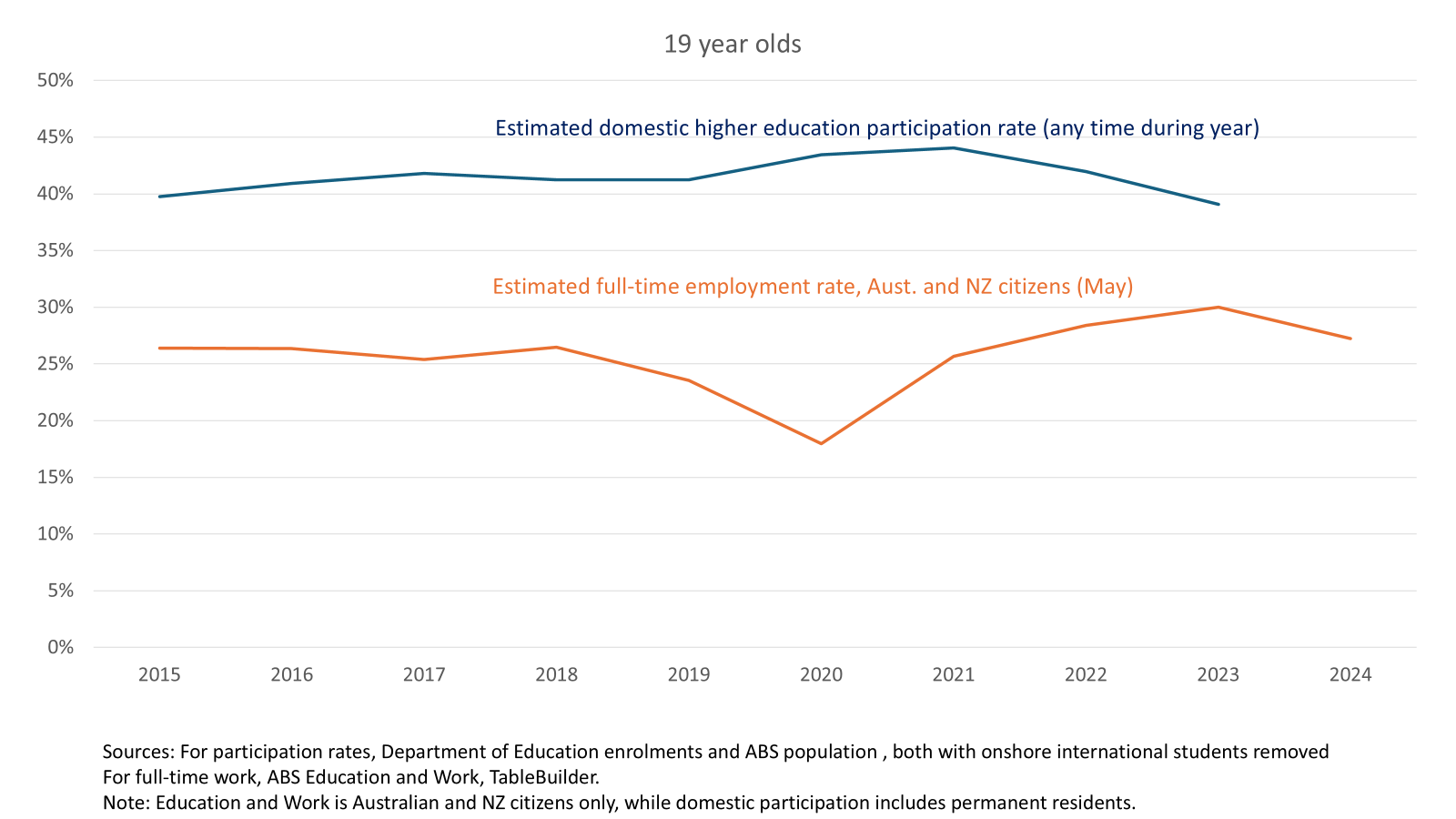
One explanation of declining enrolments at age 19 is higher education’s counter-cyclical relationship with the labour market. At the margins, some people prefer work to study, but study when work is not available. The higher education participation and full-time employment rates in the chart below match this theory. Higher education participation increased after COVID-related full-time job losses in 2020 and then decreased as job opportunities returned.

Education and Work TableBuilder supports analysis of smaller sub-groups than the standard ABS data releases, but with an increased risk of rogue results. Broader 15-19 year old statistics, however, confirm 2023 as a very strong year for full-time teenage employment. Both sources show that teenage full-time jobs grew strongly post-COVID and then softened in 2024, while remaining good compared to the 2010s.

Read More »

The higher education participation rate at age 19 almost certainly fell in 2023 – but an exact rate cannot be calculated

Despite significant policy interest in higher education attainment rates, the preceding participation rates are rarely reported. The most readily available time series is in Mapping Australian higher education, at figure 5 of the 2023 edition. It reports the participation rate at age 19 years, the modal university student age. For the first time in decades, the Department of Education recorded a participation rate in their recent 2023 statistics release.

Unfortunately data issues mean participation figures are only estimates. This post discusses these data problems and compares participation rates using two different methodologies. Both point to participation in 2023 being lower than in all recent years.

Read More »

Will the ‘Costello baby boom’ have a weaker demographic effect on higher education than expected?

Since the late 2010s I have promoted the idea that the so-called ‘Costello baby boom’ cohorts will arrive at university age from the mid-2020s, increasing school leaver demand for higher education. As the chart below shows, annual births go from around 250,000 in the early 2000s to around 300,000 later in the decade.

Demographers are sceptical of how much effect mid-2000s pro-family policies had, but former Treasurer Peter Costello’s line that ‘if you can have children it’s a good thing to do – you should have one for the father, one for the mother and one for the country..’ was sufficiently memorable that this baby boom has his name attached to it.

As these cohorts approach university age this post takes another look at the data.

Read More »

Accord implementation proposals, part #2: The distribution of student places to universities and the folly of hard caps

An earlier post looked at the government’s plans for the Australian Tertiary Education Commission. This post examines the government’s proposals for setting the number of student places and distributing them between universities. This includes a hard institution-level cap on student places, so that universities would get zero funding for enrolments above their allocated level. This post explains why a hard cap is unnecessary and counter-productive.

Overall number of CSPs

The government will determine the total number of CSPs. For ‘fully funded’ places – places for which universities are paid both a Commonwealth and student contribution – this is similar to the current system of the government deciding on total CGS funding, other than the small demand driven system for Indigenous bachelor-degree students (which will be retained). However,

  • because universities will have flexibility in moving EFTSL between disciplines (discussed in a later post) the maximum dollar amount the government pays will be less predictable than now.
  • because of the first point and hard caps on student places at each university (discussed below) the maximum number of CSPs the system provides will be more predictable than now.

It is not clear whether ATEC will advise the government on the number of CSPs, as opposed to contextual factors such as demographics, demand, and skills needs.

And if ATEC does provide advice on system-level numbers, it is not clear whether this will be published or not. The consultation paper mentions the state of the sector report recommended by the Universities Accord final report, but this is framed as a ‘report on higher education outcomes’, not future higher education needs.

Former higher education commissions provided detailed public advice on likely student demand and the sector’s capacity to meet it. For an education minister there is a trade-off. Public and quality advice gives leverage in Cabinet when arguing for money and a semi-independent justification for the government’s overall policy direction. But if the minister does not get the money the sector, and opposition MPs, will use ATEC reports against the government.

Read More »

Did bachelor degree enrolments decline significantly between 2016 and 2022?

This is a post I started writing several months ago, before the Accord final report and other major higher education policy announcements pushed it aside. I have completed it as a companion to my census attainment post on data issues in higher education.

Late last year several media outlets, using data from the ABS Education and Work survey, reported declining bachelor degree enrolments. In November 2023, bachelor degree enrolments were said to be down 12 per cent between 2016 and 2022. Another newspaper rounded the drop to 13 per cent. In December 2023 bachelor degree enrolments were said to be at their lowest level since 2011.

This post explains why these media stories exaggerate enrolment decline. The most important reason is that Education and Work does not count offshore international students. But comparing Education and Work results with enrolment data shows that it typically undercounts onshore international students and overcounts domestic students, particularly those in bachelor degrees. It also has occasional rogue surveys that produce misleading comparison years.

Read More »