The Australian Tertiary Education Commission legislation – Part 2, Mission based compacts

An earlier post looked at the objectives of ATEC, as set out in legislation introduced yesterday. This post looks at mission based compacts, the key instrument of ATEC control over universities.

All legislative references, unless otherwise specified, are to the Universities Accord (Australian Tertiary Education Commission) Bill 2025.

Entering into mission based compacts is a function of ATEC: section 11(b).

Purpose of mission based compacts

Since the Universities Accord Final Report the term ‘mission based compact’ has been ambiguous. Whose mission will the compacts implement, the government’s mission or the university’s mission?

The ATEC bill tries to have it both ways. Section 28 describes the purpose of compacts as giving the ‘provider flexibility to pursue their goals and mission’ while also contributing to an ATEC statement of priorities for the sector, diversity in the system, and meeting the needs of the provider’s students and community.

The bill’s explanatory memorandum offers this passage of doublethink:

“Compacts will enable providers to demonstrate how their unique mission – the institution’s core purpose, values, and goals – aligns with national, state and local priorities, planning, and strategy, as well as industry engagement and innovations in learning and teaching. Informed by strategic priorities identified in the Statement of Strategic Priorities…”

How is a mission unique if it aligns with national priorities? All section 28 means, I think, is that universities can still pursue objectives not specified by ATEC, provided that these do not conflict with any requirements ATEC imposes. The extensiveness of those requirements will determine how much scope for independent action remains.

Read More »

Is the government introducing a de facto ban on new higher education providers?

Update 28/11/2025: Last night the Senate accepted Coalition amendments that exempt higher education providers and TAFEs from the requirement to offer courses to domestic students for two years before being eligible to offer courses to international students. So effectively the provision discussed in this post applies only to non-TAFE registered training organisations. As I noted in the original post, offering courses to domestic students for two years is much easier for RTOs than higher education providers. Large numbers of RTOs have already met the requirement and could move into international education.

While this is good news, enrolment caps the government will try again to legislate next year could prove another insurmountable obstacle to education providers of any kind entering the international market.

————————————————————————————————-

Last week Claire Field published an interesting overview of 15 new higher education providers since January 2024. But growth of this kind would become very difficult if the government’s ESOS amendment bill passes unamended. It would limit registration of new providers offering courses to international students. This post examines whether the proposed restriction would, in practice, be a de facto ban on new higher education providers.

Under the ESOS amendment bill providers could not offer courses to international students without first delivering courses to domestic students, but providers are generally not competitive in the domestic market without offering FEE-HELP loans. But to get access to FEE-HELP, providers must demonstrate experience in delivering higher education – in practice usually by teaching the international students the ESOS bill would stop them recruiting.

Legislative references are to ESOS Act 2000 section numbers, as they are or would be if the amendment bill passes unchanged.

The proposed changes

The ESOS amendment bill would give the minister the power to suspend, for up to 12 months, applications and processing of applications for course and provider registration: sections 14C to 14F.

To be registered on CRICOS to offer courses to international students the provider must have delivered courses for consecutive study periods over at least two years to domestic students in Australia: section 11(2).

This post focuses on the section 11(2) change by looking at how providers have entered the international and domestic markets in recent years.

Read More »

The education minister should not have the power to cancel ‘classes of courses’ for international students

Update 28/11/2025: Last night the Senate passed the ESOS amendment bill with Coalition amendments. While I still believe this provision counts as very poor public policy – for reasons exanded up in my Senate inquiry submission – the Coalition changes do improve things somewhat. These are noted in the text below.

—————————————————————————————————-

The government is having another go at its 2024 Education Services for Overseas Students (ESOS) legislation, reintroducing it earlier this month minus the enrolment caps that saw it blocked in the Senate last November.

This post draws on and adds to things I wrote last year about proposed ministerial powers to suspend and cancel ‘classes of courses’.

The amendments discussed in this post were partly why I regarded the 2024 ESOS amendment bill as the single worst piece of higher education related legislation to come before the Parliament in my career.

What took it beyond standard bad policy was its use of broad ministerial discretion with minimal constraints on how it is exercised. That creates rule of law problems, making it hard to know in advance what the rules are. If passed, the amendments could lead to some education providers being arbitrarily punished for the actions of others.

Legislative references are to the section numbers of the ESOS Act 2000, as they are or as they would be if the bill passes unamended.

A mass course cancellation power

The bill gives the education minister power to simultaneously suspend or cancel multiple ESOS course registrations at multiple providers: division 1AB. It does this by making the unit of regulation a ‘class of courses’ – the definition of which is discussed below.

This mass cancellation power differs from existing laws that give the ‘ESOS agency’ (TEQSA in higher ed, ASQA in VET) power to suspend or cancel the registration of specific courses or specific providers: sections 83 to 92. It also differs from the current power of the immigration minister to issue a ‘suspension certificate’ to a provider. This can be done in specified circumstances such as fraud in visa applications, students breaching visa conditions, and other visa issues: sections 97 to 103.

Read More »

Mapping Australian higher education 2023 – data update March 2025

Update 20/12/2025: More recent data here.

—————————————————————————————————

I won’t have the capacity to produce another edition of my Mapping Australian higher education report in the foreseeable future, but I am extending the life of the October 2023 edition by updating the data behind the charts.

Mapping‘s chart data is the only publicly-available source of long-term time series data on many higher education topics, especially on financial matters.

I had been waiting on the 2023 university finances report before releasing another chart data update. That finally happened yesterday. Despite a record 27 universities reporting deficits, in the aggregate there was a small surplus, after a loss overall in 2022.

2023 had some weak numbers for the two main Commonwealth student programs, the Commonwealth Grant Scheme and HELP. Several factors were behind this: temporary COVID places coming out of the system, Job-ready Graduates reductions in total funding rates for some courses, and weak domestic demand. These programs trended up in 2024 and 2025, as seen in the chart below, although high CPI-driven indexation was a significant factor.

The updated chart data is available here.

Update on Accord student funding policies

With a break between jobs and other things going on I did not comment in December on the Accord-related MYEFO student funding announcements. Compared to last year’s consultation papers, the announcements included a policy change on over-enrolments, more detail on how under-enrolments will be handled, and funding amounts.

Over-enrolments

One of the worst ideas in the June 2024 managed growth consultation paper was a hard cap on Commonwealth supported places. Currently the main CSP category has a soft cap – once a university enrols CSPs valued at its maximum basic grant amount it gets only the student contribution for additional students. These student contribution-only places are known as ‘over-enrolments’. Under a hard capped system over-enrolments would receive zero funding. I explained why hard caps are a bad idea in this post.

In its MYEFO summary the government backed off a little from the hard cap idea. Now universities ‘will continue to receive student contribution amounts for a small proportion of additional students’. The reason given was the practical difficulty of hitting a precise enrolment target. [Update: At a Senate estimates hearing on 27/2/25 the Department said that ‘the overenrolment buffer will be between two per cent and five per cent’.]

Read More »

Mapping Australian higher education 2023 – official release

Update 20/12/2025: More recent data here.

Mapping Australian higher education 2023 is now available from the ANU Centre for Social Research and Methods website.

Update 30/10/2024: There is a later version of Mapping 2023’s data here.

Update 26/10/23: A reader has pointed out that list of FEE-HELP NUHEPs is incomplete. A column of names from the original Excel file was omitted during production. The full list is available here. This list also includes three non-FEE-HELP providers registered by TEQSA since the pdf version was finalised. A corrected version of Mapping with the full list of NUHEPs, as of mid-2023, is here.

If anyone has noticed other errors please let me know.

How many jobs are there in higher education?

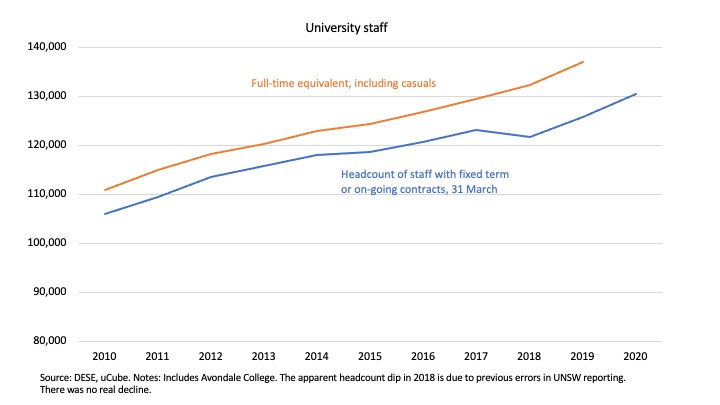
COVID-19 has been bad for jobs in higher education. Last October, the NTEU estimated that since March 2020 more than 12,000 jobs had been lost. According to Universities Australia in February 2021 at least 17,300 jobs were lost in 2020. But how many jobs were there to begin with?

This is a surprisingly difficult question to answer. The official DESE staff statistics give us a headcount as at 31 March each year of people employed on an on-going or fixed term contract at public universities and Bond, Notre Dame, University of Divinity and Avondale University College. At the end of March 2020 these institutions had just over 130,000 employees.

But as the chart below shows, the full-time equivalent count is always higher than the on-going or fixed term headcount, because it includes casuals. On a FTE basis, about 18 per cent of all staff are casuals, including nearly a quarter of academic staff. But DESE does not collect headcount data on casuals.

Casuals

While DESE does not provide a casual headcount, two datasets that include higher education providers, produced by the Australian Charities and Not-for-profits Commission and the Workplace Gender Equality Agency, include casual figures.

Read More »

How will the number of student places increase under the Tehan reforms?

Although I don’t support the Tehan plan to steer student demand to ‘national priority’ fields, from day one I have supported increasing the number of student places.

According to the Department’s discussion paper on the reforms, they will ‘support an additional 39,000 university places by 2023 and almost 100,000 places by 2030’. These additional places are needed to meet previously unexpected demand due to the COVID-19 recession and, from the mid-2020s, the ‘Costello baby boom’ cohort (although the former Treasurer perhaps should not get too much credit for them).

This post examines how student places for undergraduates might increase under the Tehan reforms. For general readers, the first section on major sources of additional places includes the key policy changes. Read on after that part if you need to know the detail of higher education policy.

Read More »

The university JobKeeper rules change again, with Bond and Torrens universities to benefit

And so we have another turn in the twists and turns of universities and JobKeeper.

The universities listed on Table B of the Higher Education Support Act 2003 – Bond, Notre Dame, Divinity and Torrens – will be exempted from one of the three rule changes designed to prevent universities getting JobKeeper.

They are still not counted as charities to get the lower 15 per cent decline in turnover threshold (not that Torrens is one anyway). They still have to count government grants in their revenue base. However, their revenue loss can be calculated over the month or quarter that applies to most enterprises, rather than the six months that applies to Table A universities.

In practice, I think this change is irrelevant to Notre Dame. In 2018, only 2 per cent of their revenue came from international students. Another 10 per cent came from up-front payments from domestic students. With their Commonwealth Grant Scheme and HELP funding guaranteed, there is a very low likelihood that Notre Dame will have the required 30 per cent decline in revenue.

Read More »

Some universities might still get JobKeeper, despite a planned second change of the rules to stop them being eligible

Update 2/5/20: The government has further changed the rules so that university income must be assessed over the six months from 1 January 2020.

———————————————————————————————————————————–

When I first wrote about universities and JobKeeper, at the end of March, I concluded that although they were included they were unlikely to meet the required revenue falls. Especially for the universities with $1 billion plus annual revenue, the required 50 per cent fall in revenue seemed like a financial disaster beyond what COVID-19 issues could trigger.

Since then, the universities and JobKeeper story has had many twists and turns. In early April, universities briefly hoped that they would only have to meet the 15 per cent decline in revenue required of charities (they are educational charities). But the JobKeeper legislative instrument specifically excludes institutions listed in Tables A and B of the Higher Education Support Act 2003, which cover all public and private universities.

This flips the normal funding biases of higher education. Generally, educational organisations that were publicly-funded before 1989 have privileged access to government subsidies. Now, for a brief time, the educational charities that are not in the pre-1989 group have easier access to public funding. They only have to show a 15 per cent decline in revenue, instead of 30 or 50 per cent for Table A and B institutions, depending on their revenue. In 2018, 41 non-university higher education providers were registered educational charities.*Read More »