Is the government introducing a de facto ban on new higher education providers?

Update 28/11/2025: Last night the Senate accepted Coalition amendments that exempt higher education providers and TAFEs from the requirement to offer courses to domestic students for two years before being eligible to offer courses to international students. So effectively the provision discussed in this post applies only to non-TAFE registered training organisations. As I noted in the original post, offering courses to domestic students for two years is much easier for RTOs than higher education providers. Large numbers of RTOs have already met the requirement and could move into international education.

While this is good news, enrolment caps the government will try again to legislate next year could prove another insurmountable obstacle to education providers of any kind entering the international market.

————————————————————————————————-

Last week Claire Field published an interesting overview of 15 new higher education providers since January 2024. But growth of this kind would become very difficult if the government’s ESOS amendment bill passes unamended. It would limit registration of new providers offering courses to international students. This post examines whether the proposed restriction would, in practice, be a de facto ban on new higher education providers.

Under the ESOS amendment bill providers could not offer courses to international students without first delivering courses to domestic students, but providers are generally not competitive in the domestic market without offering FEE-HELP loans. But to get access to FEE-HELP, providers must demonstrate experience in delivering higher education – in practice usually by teaching the international students the ESOS bill would stop them recruiting.

Legislative references are to ESOS Act 2000 section numbers, as they are or would be if the amendment bill passes unchanged.

The proposed changes

The ESOS amendment bill would give the minister the power to suspend, for up to 12 months, applications and processing of applications for course and provider registration: sections 14C to 14F.

To be registered on CRICOS to offer courses to international students the provider must have delivered courses for consecutive study periods over at least two years to domestic students in Australia: section 11(2).

This post focuses on the section 11(2) change by looking at how providers have entered the international and domestic markets in recent years.

Read More »

The Prac Payment that will go to Services Australia and the ATO, as well as students

Last year I was critical of how I thought the Commonwealth Prac Payments were going to work. These were to provide Austudy level payments, currently equivalent to $331.65 a week, for nursing, midwifery, social work and teacher education students while undertaking compulsory work placements. The payment starts on 1 July 2025 for students on income support and some working students.

Rather late in the day, the legal paperwork for its higher education version was completed last week. The vocational education diploma of nursing version paperwork was already available. The higher education version is administered by universities and funded through the ‘other grants’ provisions of the Higher Education Support Act 2003. The VET Prac Payment is administered by the Department of Employment and Workplace Relations, although the funding is authorised under the Social Security Act 1991.

Things I was concerned about that have not happened

Some of my Prac Payment concerns from last year were not realised in the policy as enacted. The Prac Payment has a means test but it is based solely on the student’s income, not family income. However family income has an indirect effect through eligibility for income support.

A policy goal is reduce the number of students who defer or withdraw from their course due to placement obligations, but students won’t need to prove that they are considering either of those things.

But in the Australian way of public policy, the Prac Payment is an underwhelming half-measure. The payment is low and will be further reduced by tax and by social security income tests. Many students won’t be eligible at all.

Read More »

Student visa applications withdrawn

The Department of Home Affairs does not routinely report statistics on withdrawn student visa applications. At my request, they supplied me with student visa applications withdrawn data for 2019, 2023 and 2024. 2019 is my pre-COVID, pre-migration policy change, comparison year.

As I expected, with a stable market and policy framework the proportion of visa applications that are withdrawn is quite low – equivalent to around 1% of applications lodged in 2019. I don’t know of any research into these withdrawn applicants, but perhaps their circumstances changed or they received a better offer from another country.

My hypothesis in making my data request was that the period of rapid change in international education policy from the later months of 2023 created new incentives to withdraw student visa applications.

Read More »

Are the government’s policies working to reduce international student numbers? Part 2, student visas granted

A previous post looked at demand from international students, as measured by student visa applications. By July 2024 all student deterrent policies announced to date were in place, so the last six months of 2024 could be used to assess initial policy impact.

That analysis found that demand for vocational education declined significantly, whether compared to 2023 or the more normal pre-COVID year of 2019. For higher education, demand was down on 2023. Compared to 2019, higher education demand in 2024 from migration-sensitive countries like India or Pakistan was well down, but demand from other important source countries increased or decreased only slightly.

Visa applications of course must be assessed by the Department of Home Affairs. Visas granted depend on visa processing levels and visa grant rates.

The visa grant analysis below is broadly consistent the first post’s applications analysis. Visa applications and grants in 2024 were both down on 2023. However, 2024 visa applications were up on 2019 but visa grants were down, reflecting fewer applications being processed and lower approval rates.

For both visa applications and grants vocational education has been hit hard. Higher education is more resilient overall, with visa applications and grants both up on 2019.

Due to unprocessed applications and unresolved appeals against visa application rejections, not all 2024 applications have been finalised. These could result in 2025 visa grants that exceed expectations created by recent application levels.

Less clear links between cause and effect

Drawing straightish lines between policy changes and policy consequences is harder for visa grants than applications. Delays between visa applications and processing complicate the analysis. By mid-2024 Home Affairs had a huge backlog – over 113,000 unprocessed applications – including many received prior to 23 March 2024 when significant rule changes came into effect. Because some old rules apply to applications received before policy change dates, different criteria can be used in the same processing month.

Read More »

Are the government’s policies working to reduce international student numbers? Part 1, student demand

From late 2023 to July 2024 the federal government implemented at least nine policies to reduce international student numbers. With full 2024 student visa data released late last week this is a good time to assess how well (or how badly, depending on your point of view) these policies are going.

This post looks at the demand side, how many student visa applications have been lodged. A subsequent post will look at the supply side, visas granted.

The main findings are that the government’s policies have worked to substantially reduce demand for vocational education overall and from migration-sensitive countries in higher education, such as India and Pakistan. However 2024 Chinese higher education applications were down only slightly on 2023 and remain up on 2019. The impact on other traditional higher education source countries such as Malaysia, Singapore and Hong Kong was also muted (all slightly up or down).

Overall demand

As can be seen in the chart below, in 2024 the Department of Home Affairs received 429,691 student visa applications. This was down 20% on 2023, but still above 2019, the last full year before COVID migration restrictions distorted supply and demand.

Read More »

Where are the young people who are not at university?

Earlier this month I wrote a post showing that higher education enrolments at age 19 years, and the domestic participation rate at age 19, were down in 2023 compared to 2022.

This post explores possible reasons for this downward trend.

The teenage job market

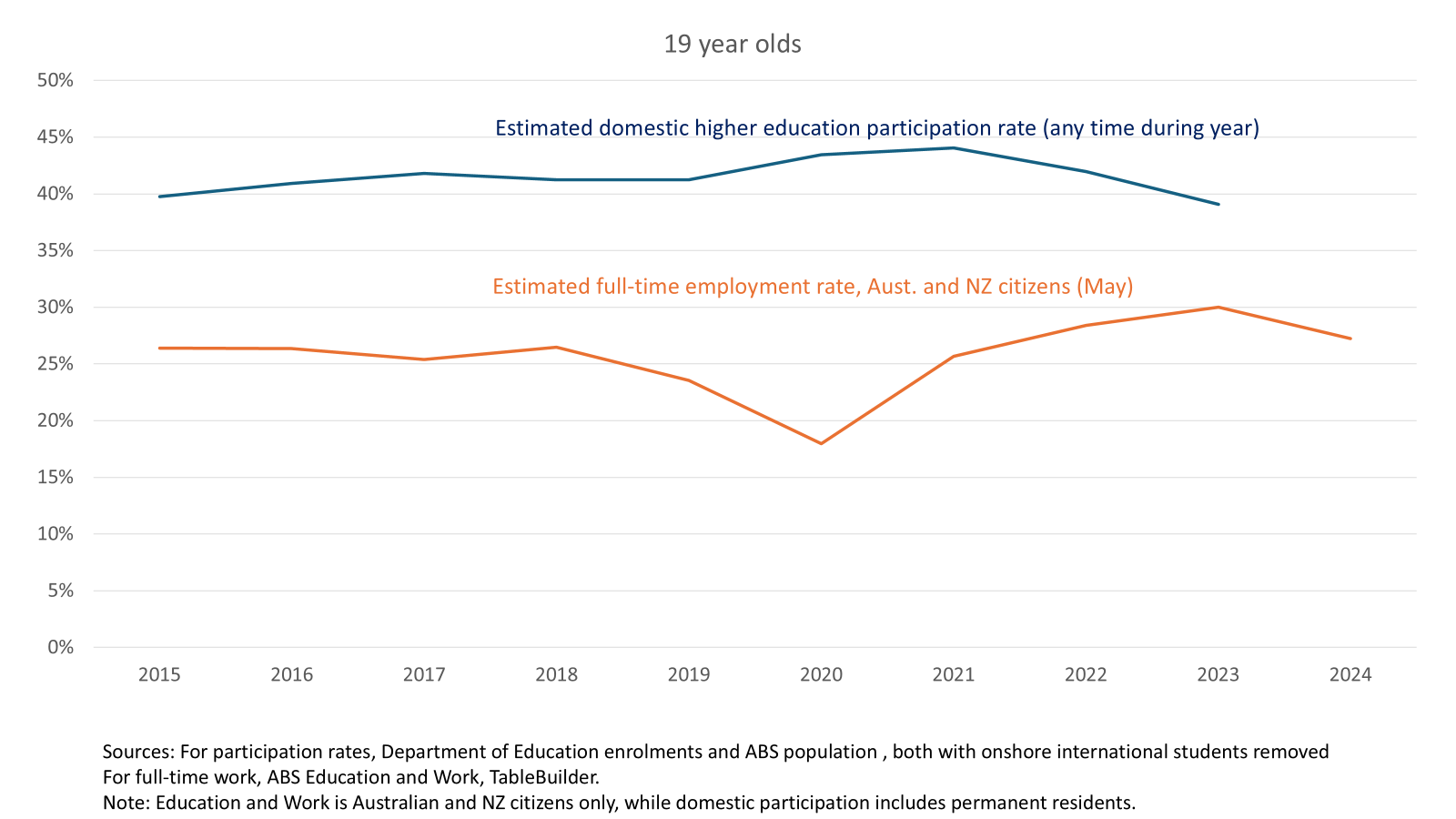
One explanation of declining enrolments at age 19 is higher education’s counter-cyclical relationship with the labour market. At the margins, some people prefer work to study, but study when work is not available. The higher education participation and full-time employment rates in the chart below match this theory. Higher education participation increased after COVID-related full-time job losses in 2020 and then decreased as job opportunities returned.

Education and Work TableBuilder supports analysis of smaller sub-groups than the standard ABS data releases, but with an increased risk of rogue results. Broader 15-19 year old statistics, however, confirm 2023 as a very strong year for full-time teenage employment. Both sources show that teenage full-time jobs grew strongly post-COVID and then softened in 2024, while remaining good compared to the 2010s.

Read More »

How much difference will stopping student visa applications from people on visitor visas make?

The bad news for international education keeps coming. On Wednesday the government announced that onshore visitor visa holders would no longer be able to apply for a student visa. It also announced a 1 July 2024 implementation date for the ban on temporary graduate visa holders applying for a student visa. The temporary graduate visa policy was announced last December.

How big is the visitor visa change?

The government’s media release says that 36,000 onshore visitor visa holders applied for a student visa in the financial year to May 2024. However the number of visas granted will be much lower than that. As of the end of April 2024 13,733 primary applicant student visas had been granted to onshore visitor visa holders in 2023-24. Secondary visa holders – partners and children – take the number to 17,729.

These numbers are for all levels of education. Higher education primary applicants are about a quarter of the total for this time period. In 2023-24 up to April 3,332 higher student visas grants were made for primary applicants, with secondary applicants taking the total to 4,742.

Read More »

Creating a better integrated education system – some notes on Rethinking Tertiary Education, a book building on the work of Peter Noonan

Peter Noonan was a rare person with expertise across vocational and higher education, and an even rarer person who made significant policy contributions to both. Sadly he passed away in 2022 at the age of 67.

Rethinking Tertiary Education, co-edited by Peter Dawkins, Megan Lilly and Robert Pascoe, with sixteen others as co-authors, is billed as ‘building on the work of Peter Noonan’, and does so by exploring ways of making the component parts of Australia’s formal education sector – especially higher education and vocational education, but also schools – work together more smoothly than now. Pascoe also contributes an interesting biographical chapter on Noonan.

For historical and political reasons the vocational and higher education systems in Australia have quite sharp dividing lines in the nature of the qualifications they deliver, how they are funded, how they are taught, and with some exceptions the occupations they support. The book also looks at school credentials, especially the idea that they don’t measure all they should.

Read More »

The Accord equity target that cannot, and perhaps should not, be achieved

The Universities Accord terms of reference asked the review panel to recommend higher education equity and attainment targets, and in their interim report they offer suggestions.

The general goal is equity group parity in higher education participation by 2035 (pp. 18, 20). There is some ambiguity about whether this applies for all equity groups. A few times only three of the main four – low SES, regional, and disability – are specifically mentioned for the 2035 target (pp. 9, 42, 43). For Indigenous students a target is referred to but not specified on p.43. The Indigenous contribution to the 2035 target is however, mentioned at pp. 40-41.*

Other potential equity groups such as first in family, care leavers, people from single parent families and children of asylum seekers may be added (p. 42)

The equity targets interact with an overall target of 55 per cent attainment by 2050. It is unclear whether this target is for people aged 25 to 34 years (pp. 9 & 36), employed persons (p. 33, distinguished from the 25 to 34 cohort), or all people/unspecified base (p. 22).

Whatever the exact 2050 target, it is well above current levels. Equity group parity is not just achieving the overall population participation and attainment rate now. It is chasing a rate that will, if other Accord policies work, be moving up.

This post discusses the practical obstacles to equity group targets that apply regardless of the precise targets set. It also questions whether a large increase in higher education participation would reliably be in the best interests of the additional students.

Read More »

The competitive education market for workers updating their skills

In 2019 I wrote a series of posts on declining participation in formal education and training by people already in employment. Falling enrolments ran counter to claims that technology-driven disruptions to work would make further education more necessary than in the past.

The 2019 blog posts identified nine sources of survey and administrative data that should be trending up if the workforce disruption analysis was right. All seven data sources on individuals were instead trending down, while two employer surveys respectively showed a small increase in informal training and a larger increase in online training.

Informal training is not or is poorly measured in the individual person surveys. If it is increasing while structured learning is decreasing then this may signal a change in how people educate themselves after their initial formal education.

Prompted by this week’s release of new data on one of my trend indicators – ATO self-education expense claims – this post updates my 2019 analysis. Most indicators show signs of recovery but on the latest available data three are still trending down.

Postgraduate education

Postgraduate coursework education returned to growth in 2019. Commencing on-campus numbers continued to decline but were offset by online commencements. People moving straight from undergraduate to postgraduate study complicate my analysis, as they are trying to start rather than advance their careers. On the publicly available data I cannot distinguish the two groups.

Postgraduate numbers for 2019 remain below their earlier peak, but I expect 2020 and especially 2021 to be growth years. This is partly because I see postgraduate education as counter-cyclical, with COVID labour market disruptions in 2020 encouraging further study. If this hypothesis is right data noise complicates analysis of longer-term trends, but convenient online postgraduate options are attracting students.

Read More »