Conflicting visions of higher education’s purposes

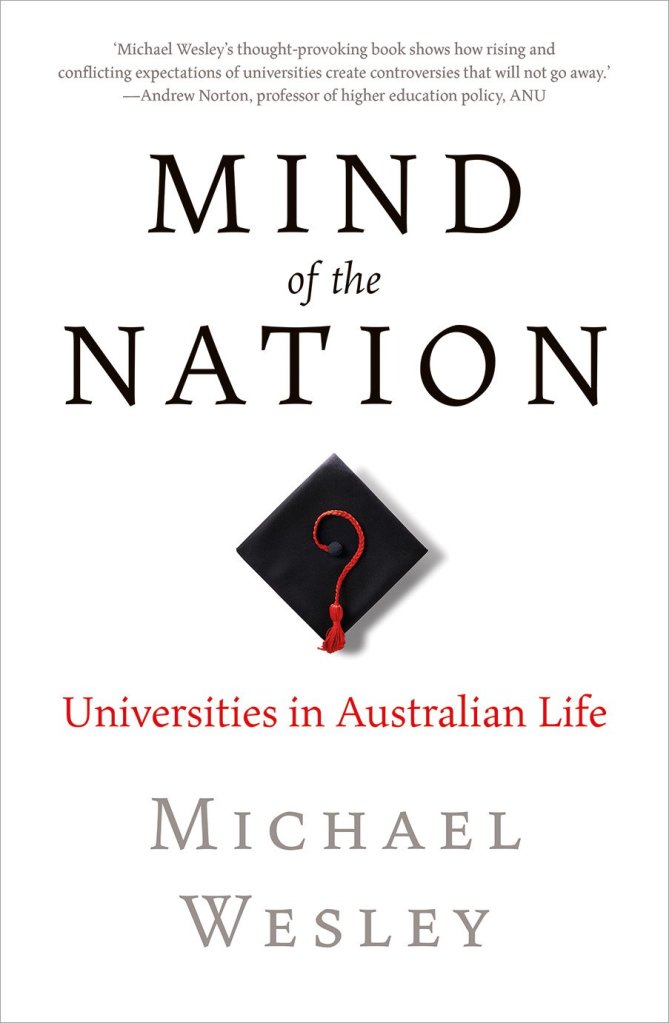
I blurbed Mind of the Nation, Michael Wesley’s new book on universities in Australian life, with the statement that it ‘shows how rising and conflicting expectations of universities create controversies that will not go away’. His book is about the cultural and political position of universities rather than higher education policy as such, although policy provides evidence of how politicians and voters see universities.

University administrators – Wesley is a deputy vice-chancellor – are at the centre of these controversies, blamed by all sides for whatever is wrong with universities. Mind of the Nation explores why universities receive so much critique and so little love or (from a university perspective) public funding, despite many successes and contributions: life-changing experiences for students, moving from an elite to a mass higher education system, creating a new export industry, large increases in research aimed at solving practical problems, and engagement with local communities.

Wesley asks why Australians admire the successes of their sporting teams, musicians and actors but not universities.
Read More »

Free higher education as income and consumption smoothing

The argument that free higher education would create additional higher education opportunities is empirically weak. History and international comparisons show that participation rates increase without it, and indeed due to budget constraints free higher education can lead to lower participation rates.

However there is another argument for free higher education which, while still contentious, has goals and likely outcomes that are consistent with each other.

Free higher education and income/consumption smoothing

The strongest argument for free (or cheaper) higher education is a better balancing of income and consumption over the life cycle. Needs are more consistent through life than income. Most people consume more than they earn when young and old and a large proportion earn more than they consume during their full-time working years. Smoothing these out is one of the principal functions of welfare states.

Compared to upfront fees or mortgage style student loans paid in instalments the HELP repayment system already has strong smoothing effects. It pushes the expense of higher education away from the years when full-time study limits scope for paid work. On low incomes no HELP repayment is required or repayments that are less than the minimum likely mortgage style loan repayment amount. On high incomes HELP repayments are more than the likely mortgage style loan repayment amount.

And higher education is already free for HELP debtors who persistently earn less than the first repayment threshold.

Read More »

Would free university increase or decrease higher education participation rates in Australia?

In a previous post I argued that Australia’s practice of charging fees for higher education reflects its broader patterns of taxation and public funding of social services.

But we have had free higher education before, 1974-1988. For a government already spending over $600 billion a year the cost of free higher education is not beyond the feasible range. I estimate costs at $4.6 to $5.9 billion a year on status quo numbers of student places in public universities. The range reflects uncertainties about how domestic students currently paying full fees would be handled. The $4.6 billion transitions currently Commonwealth supported students to free, while the $5.9 billion fully compensates universities for lost fee revenue.

Of the arguments for free higher education the one that people find most intuitive is that it would increase higher education participation. People consume more when prices go down. But somebody is paying – the government on behalf of taxpayers – and so how they would respond is the key variable in whether the number of students would go up or down.

Debt aversion

Supporters of free higher education often make demand-side arguments, that fees or loans are a deterrent to higher education participation, especially to people from disadvantaged backgrounds.

As someone with working class origins free higher education advocate Duncan Maskell says he would not have gone to university if he had to take out a loan. Occasional school student surveys have picked up similar sentiments. But the ‘debt aversion’ hypothesis has always had trouble distinguishing between sensible prudence around taking out debt that probably is not worth it (good debt aversion), and over-caution in taking out debts that would probably lead to significant long-term benefits (bad debt aversion).

Read More »

Why do Australian university students pay fees?

University of Melbourne VC Duncan Maskell secured some not always entirely positive media coverage today for his call to make university education free for domestic students.

University education is free or very cheap for students in some European countries and was also free in Australia between 1974 and 1988.

Why do countries differ on university fees?

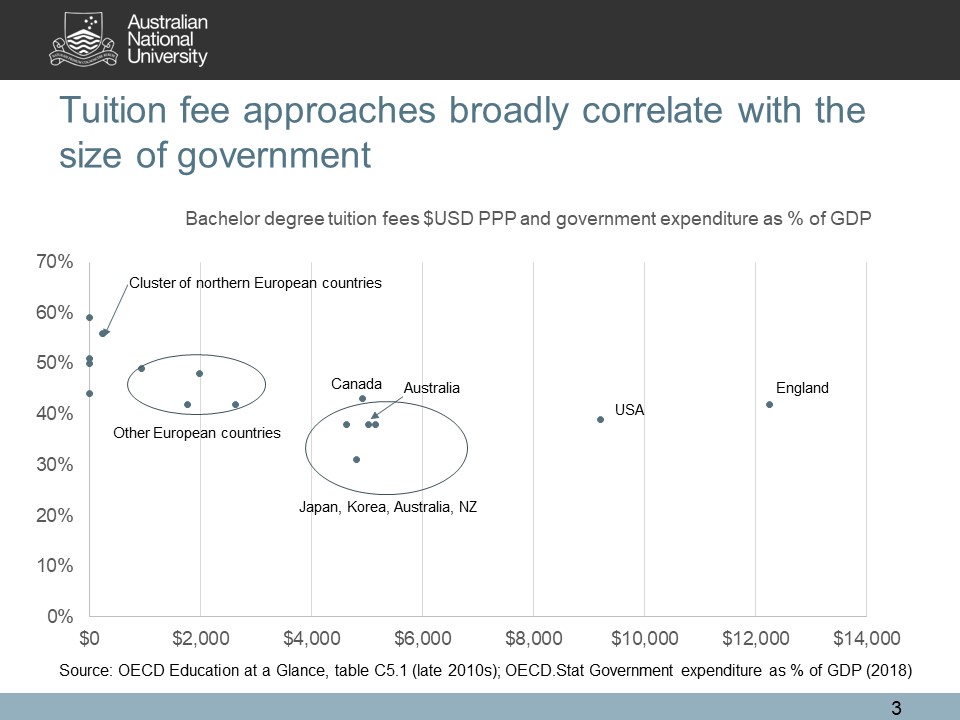
My theory of why countries differ on this issue draws loosely on the work of Julian Garritzmann. We observe broad coherence between higher education finance systems in each country and their overall tax and social service/benefits systems. The chart below shows patterns in the OECD. Australia is in a cluster of countries in our region with government expenditure below 40 per cent of GDP and quite similar fees in $USD purchasing power parity terms. The countries with free higher education tend to have governments that consume more than 50 per cent of GDP.

Read More »

Is the NTEU exaggerating student debt repayment times?

The NTEU has a new report out today forecasting some alarmingly long HELP debt repayment times, including over 40 years in some high student contribution courses. While I agree that this issue needs attention – and have proposed linking student contributions with expected repayment times to narrow the course-linked differences between them – I think the NTEU forecasts are much longer than will typically happen in practice.

The key problem is how the NTEU models expected graduate income. In their report they take starting salaries and then increase them each year by average wage growth over the last decade, 2.3 per cent on their figures.

However graduate incomes usually increase by much more than that. Indeed, the financial value of a degree is opportunities for continuing income growth when the wages of people without degrees tend to plateau after a decade or so in the labour force.

Graduate career wages

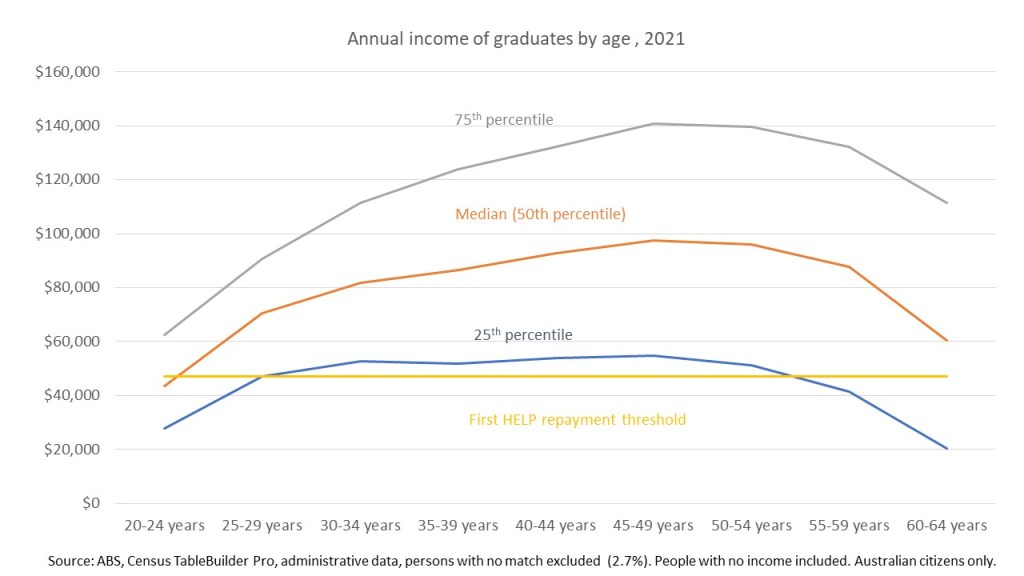
Recently the ABS added ATO and DSS derived income data to the Census dataset, allowing more detailed analysis of income than was previously possible. As the chart below shows for graduates at the median and 75th percentile income does not peak until age 45-49 years, after doubling between the early 20s and late 30s.

The next chart looks at median income by single year of age in the early career period when most HELP debt is repaid. Initial income levels look affected by people in jobs that don’t require degrees, but as professional careers start and graduates are promoted or switch to better jobs income increases rapidly.

Read More »

Time to change the timing of HELP debt indexation?

HELP debt indexation media attention has highlighted arcane aspects of student loan administration. One of these is that HELP debtors in repayment mode are indexed on debt they have already repaid.

To simplify – the processes outlined in division 140 of the Higher Education Support Act 2003 are convoluted – I will give the example of a graduate with no new HELP debt.

How HELP debt is indexed

HELP indexation occurs on 1 June each year, so it will next happen on 1 June 2023 at the controversially high rate of 7.1 per cent (see this earlier post on possible alternative ways of setting the indexation rate).

To calculate the amount to be indexed on 1 June 2023 the ATO:

i) takes the person’s HELP debt for the ‘immediately preceding financial year’, ie 1 July 2021-30 June 2022;

ii) subtracts any voluntary repayments made between 1 June in the immediately preceding financial year, ie 1 June 2022 and ending immediately before the next 1 June, ie 31 May 2023;

iii) subtracts any compulsory repayment amounts ‘assessed during that period’, ie between 1 June 2022 and 31 May 2023.

The trap is that HELP compulsory repayments for 2022-2023 will not be ‘assessed’ between 1 June 2022 and 31 May 2023, because the 2022-23 tax year does not finish until 30 June 2023. Instead, compulsory repayments for the 2021-22 tax year will be deducted.

The issue here is that by 1 June 2023 HELP debtors in the PAYG system will, in cash terms, already have paid about 90 per cent of what they will eventually owe for the 2022-23 tax year. Effectively, HELP debtors will be indexed on debt they have already repaid.

Read More »

Are mini-demand driven systems a good idea?

In their second submissions to the Universities Accord review Universities Australia and Innovative Research Universities both call for extending the existing demand driven system for regional and remote Indigenous students to all Indigenous students.

Mini-demand driven systems support increasing enrolments from a target population, or potentially in a target course, without risking (from a government perspective) a major cost escalation under a full demand driven system.

Although I support a return to full demand driven funding I doubt that mini-demand driven systems are a good idea.

The risks of restricted-use funds

From a government perspective the attraction of mini-demand driven systems is their apparent pursuit of some desirable outcome at low cost. Only funding for the estimated additional student places is likely to be ‘new’ money.

If so, in the transition to a new mini-demand driven system each university would lose from its overall maximum block grant amount estimated funding for current students meeting the mini-demand driven criteria – in the UA/IRU case, probably the Commonwealth contribution value of their existing student load of Indigenous students living in metropolitan areas.

As a result, ‘old’ money that could once be used flexibly for any domestic student could after the clawback only be used for about four per cent of the population.

If in practice the university attracts fewer Indigenous students than expected, or these students enrol in subjects valued at less in Commonwealth contribution terms than forecast, then the university is left with stranded resources. It has student funding that is theoretically available but in practice cannot be used.

Read More »

Should HELP debt be indexed at the lesser of CPI and another economic indicator?

On 1 June 2022 outstanding HELP debts were indexed, using a CPI-based formula, at 3.9 per cent. Someone whose HELP balance was $50,000 on 31 May owed $51,950 the next day.

There had been no change to indexation policy; CPI indexation has been in place since HECS was introduced more than 30 years ago. But the politics did change. A topic on which I previously received few media inquiries, and then only during the periodic doomed government attempts to impose a ‘real’ interest rate, suddenly became the subject journalists asked me about most often.

In a low inflation environment – indexation was 0.6 per cent in 2021 – public reaction to this annual increase in HELP debt was minimal. But higher indexation in 2022 revealed latent issues. With increasing average debt the same percentage indexation leads to larger absolute dollar increases. Huge growth in debtor numbers means that indexation affects more people than previously.

Calls to talkback radio programs suggest that the lower initial payment thresholds introduced since 2018-19 create a particular annoyance. At the current lowest threshold 1 per cent of income repayment rate debtors repay $500 or so, but high CPI indexation means that their total HELP debt still increases.

Policy responses

The Greens have a bill in the Parliament to remove indexation entirely. This is unlikely to happen, but even an organisation at the opposite end of the ideological spectrum as the Greens, the Productivity Commission, sees high CPI indexation as a problem. In their big 5-year productivity report last week they suggested that indexation could be a lesser of CPI and real wage growth (this concession made in the context of proposing higher student contributions to fund more student places).

Read More »

Is it helpful to have so many HELPs?

Last week the government introduced legislation to set up another HELP income-contingent loan (ICL) to assist with education-related expenses. If the bill passes, SY-HELP will lend students up to $23,600, which will be paid to their university to support student work on business start-up ideas. SY-HELP would join HECS-HELP, FEE-HELP, OS-HELP and SA-HELP.

[Update 31/3/223: SY-HELP has been rebranded START-UP HELP.]

Higher education students on student income support are also eligible for the Student Start-up Loan, which is legislatively separate from HELP but repaid in the same way.

Higher education students who have also enrolled in vocational education may have income contingent debt from VET FEE-HELP, its replacement VET Student Loans, or Trade Support Loans. These loans also have the same repayment system as the higher education HELPs.

If the SY-HELP bill passes, a total eight education-related income contingent loan schemes will be in operation, six for higher education and two for vocational education.

Do we need an income contingent loan at all?

Before I get into the differences between loan schemes, the bigger question is whether an ICL is needed at all. I thought not for the recent inclusion of some microcredentials in FEE-HELP.

Read More »

The 20,000 equity places that nearly weren’t allocated and that will probably never be delivered

At the 2022 election Labor promised up to 20,000 new student places in skills shortage areas for members of equity groups. The minister announced high-level allocations last October. The funding agreements implementing the promise for 2023 were published last month, providing additional but not complete detail. This a multi-year program and the current 2021-2023 funding agreements do not include 2024 commencing places.

This post describes the available information on student place allocation, highlighting the policy and legal flaws in distributing funding this way. The policy’s problems are exacerbated by the Job-ready Graduates Commonwealth contribution changes.

Allocations by funding cluster

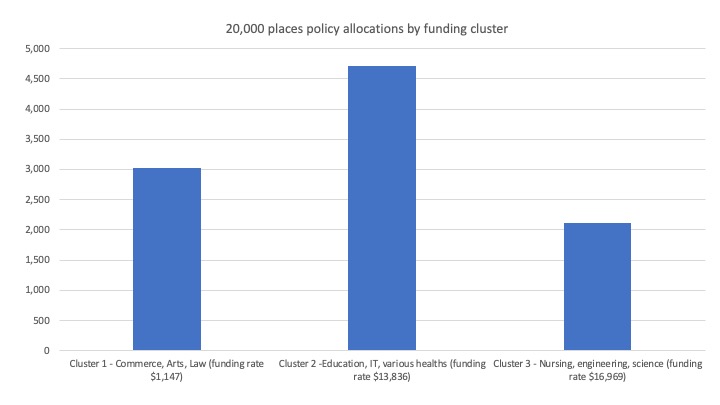
When universities received their allocations many were surprised by student places they had not requested. These were in funding cluster 1, the law, commerce and most humanities cluster. Just over 30 per cent (3,026) of the 9,851 places allocated in this round are in cluster 1.

The Department of Education’s manoeuvre can be seen in the funding agreements, an example below, which are prescriptive about the use of cluster 2 and 3 places, following information in funding applications, but not cluster 1. Instead, another clause says ‘these [cluster 1] places are to be delivered in line with a separate agreement between the Provider and the Department.’ To stay consistent with the original guidelines the cluster 1 courses need to be in skills shortage fields. Accounting and auditing are on the skills shortage list, although universities could also find other ‘relevant industry needs or shortages’.

Read More »