Is HELP doubtful debt likely to increase?

In February last year, when introducing legislation to change HELP repayment thresholds and rates, along with other HELP reforms, the government said that:

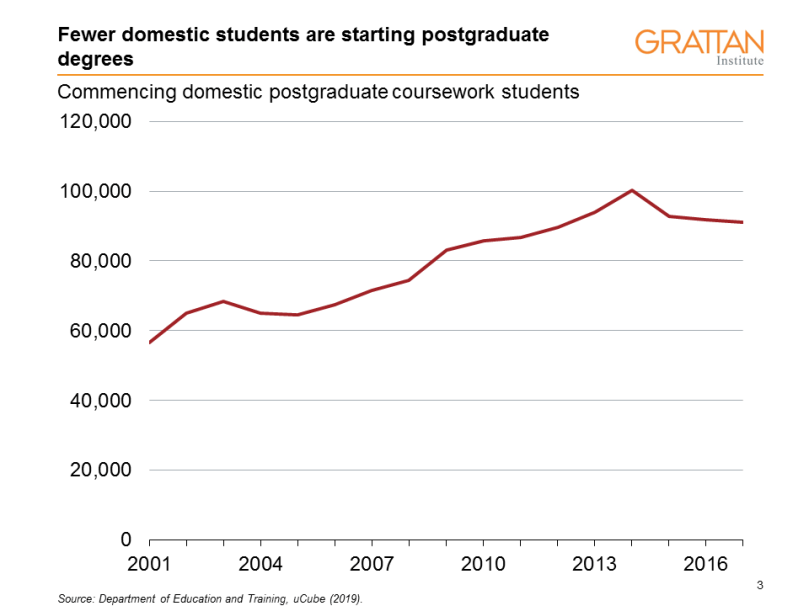
The fiscal challenge for the government is that HELP repayments have not kept pace with HELP lending growth. From 2010-11 to 2016-17, the level of new debt not expected to be repaid increased from 16 per cent to 25 per cent.

But unfortunately there is a disconnect between the stated purpose of the legislation and its likely effects. The thresholds and rate changes are unlikely to reduce doubtful debt , and indeed may increase it. Using  ATO tax data,  at the Grattan blog Will Mackey estimates that the new HELP repayment thresholds will produce slightly lower total annual student debt repayment than the previous thresholds.

The reason is that although some low and high income earners will repay more each year, most of the more numerous middle-income earners will repay less, producing a total repayment estimate of about $50 million a year less than if the previous thresholds and rates had been retained.

Read More »

Will the number of Commonwealth supported student places fall?

A couple of opinion pieces about university performance funding last week suggested that the government’s policy is aimed at increasing student places with population growth. That may be the impression the government is trying to give, but their policy provides a financial incentive to decrease the number of student places.

The government’s promise is to increase nominal funding for bachelor-degree places in line with increases in the population aged 18-64, for those universities that meet performance targets. But because percentage population increases are likely to be below inflation,  total Commonwealth Grant Scheme funding will decrease in real terms each year, even if universities get 100 per cent of their performance funding.

Although maximum CGS payments will probably increase at less than the rate of inflation the underlying Commonwealth contributions are still being indexed to the CPI. As noted last week, the demand driven funding calculation is still going on as well, so that universities receive the lesser of their demand driven or maximum grant amount. The practical effect of this is that universities can decrease the number of Commonwealth supported places each year and still get their maximum CGS funding amount.

The chart below illustrates the logic, using nursing as an example. Under the Wellings review recommendations, universities are pretty-much guaranteed 60 per cent of their maximum performance funding. So on the left-hand side of the chart below I have indexed the maximum funding amount to that and divided it by the indexed Commonwealth contribution. Next year a university could offer 4 per cent fewer nursing places than in 2017 and still get its maximum funding amount. 100 per cent performance funding does not make much difference. Read More »

The legal basis of performance funding

In December 2017, the Commonwealth froze maximum Commonwealth Grant scheme funding for bachelor-degree places for the next two years. In subsequent years, the maximum payment will increase in line with growth in the 18-64 year old population, conditional on universities meeting performance indicators.

Just before the 2017 announcement, I outlined its legal basis. It used university funding agreements to set the maximum amount, with the method chosen because it did not need parliamentary approval.

At least initially, performance funding will be administered via the funding agreements, which include a standard statement that should the university meet its performance targets it will be advised of a new maximum funding amount.

A drawback of this method of allocating performance funding is that there is no performance fund. The underlying demand driven funding system is still operating, and under section 33-5(5) of the Higher Education Support Act 2003 universities receive the lesser of their demand driven funding amount (bachelor-degree full-time equivalent student places times the relevant Commonwealth contribution) and their maximum funding amount.

All the Commonwealth is doing is promising universities it will pay a little more of what they would have been entitled to anyway under demand driven funding. Read More »

Is vocational education of lower status than higher education?

Earlier this month, Scott Morrison said that he wanted to raise the status of TAFE, declaring that “TAFE is as good as uni”.

On common status indicators, TAFE seems to come second to university education. There is status associated with academic ability, and TAFE requires lower school results for admission than university. The chart below shows the ATARs of students admitted to the two systems since the mid-1990s according to LSAY. Although almost all high-ATAR students go to university, the two sectors have long recruited in overlapping ATAR ranges. But the regular media stories about low-ATAR university admissions might have narrowed the historical status gap. ATAR range

Higher education also benefits from being the gateway to high- prestige and highly-paid occupations. But as graduates find it more difficult to find high-prestige or well-paid jobs, and  increasingly fall behind people with some vocational qualifications on employment and earnings, perhaps higher education’s status is slipping.

And there is some survey evidence that the status gap between the systems is not necessarily very large.Read More »

Current higher education policies are the unsatisfactory result of political misjudgements in 2017. There are better ways of balancing the interests of students, universities and taxpayers.

Higher education is one of the sectors most affected by Saturday’s surprise election result. Labor’s biggest promise, restoring demand driven funding from 2020, would have delivered universities funding for all bachelor-degree students, with Commonwealth  contribution rates 5.3% higher than they were were in 2017. This did not require legislation; the current funding freeze was imposed through university funding agreements and could have been ended the same way.

By contrast, if the Coalition’s current policies stay in place there will be no demand driven funding and most universities face limited nominal increases in total Commonwealth Grant Scheme funding for bachelor-degree students (a few unis have special deals that will deliver larger increases). The best-case scenario for most universities is an annual total CGS funding increase linked to growth in the 18-64 year old population, if they meet yet-to-be-announced performance criteria.

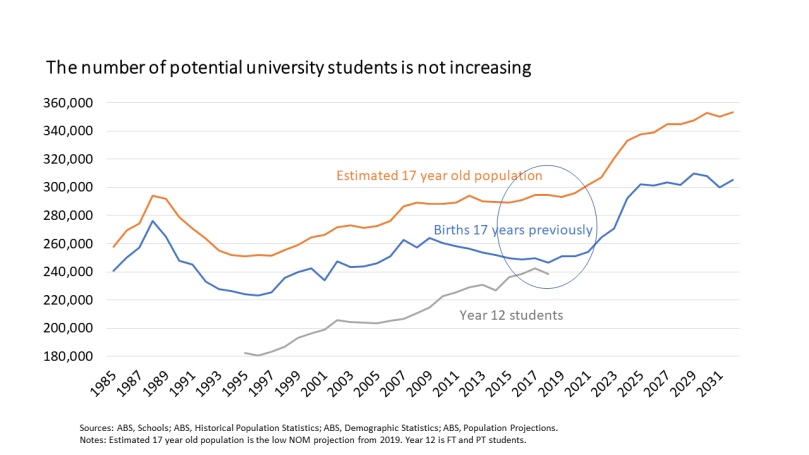
The mention of population gives the impression that the policy will respond to demographics, but this is not correct. As the chart below shows, the projected increase in the 18-64 year old population is below even recent low CPI increases. In real terms total funding for bachelor-degree students will continue to decline.

population funding

If universities decide to maintain per student funding they would provide fewer student places each year (the logic is explained in this submission). It’s not clear to what extent this will happen. Commencements were down in 2018, but quite possibly due to weak demand for student places rather than a reluctance to supply them.  Existing enrolment projections, based on numbers universities give to the Department, suggest modest growth to 2022. But whether this would be sustained long-term with annual real funding cuts is unclear.Read More »

Young people were less likely to enter higher education in the years after Whitlam than before. Demography and deficits were against them.

The three politicians with the greatest impact on higher education participation were Robert Menzies, John Dawkins and Julia Gillard. Yet I never hear anyone say, depending on their age, that “I only went to university because of Menzies/Dawkins/Gillard”.

Yet for Gough Whitlam the story is different. Last week USQ VC Geraldine Mackenzie was reported in the Australian saying “I was very fortunate to go to university after the Whitlam years when it was all free. Otherwise I may not have had that same opportunity.” And in February shadow education minister Tanya Plibersek told the Universities Australia conference that “it feels like every week, I meet someone in their 60s or 70s who reminds me about how Gough Whitlam was responsible for them going to university.”

I have argued before that Whitlam, Prime Minister 1972-1975, was very significant in the history of Australian higher education and has some lasting legacies. But I think the lesson from Whitlam’s time for now is that the biggest drivers of participation are supply-side policies on student places, and in particular how they interact with demography and fiscal policy. Because both these factors were significant in the free education era, the long-term trend towards increased higher education participation was interrupted.

Free education lasted from 1974 to 1986 (there were small charges in 1987 and 1988, before HECS started in 1989). The chart below shows that 19-year-old participation rates went up in 1976 but then fell and did not return to the previous peak until 1986. At the low point in 1982, the 19-year old higher education participation rate was 2 percentage points lower than it had been in 1975 (unfortunately, my data source starts in 1975).

19 year old participation

Read More »

The proposed law against commercial cheating and the Constitution

Successive Commonwealth governments have been creative in finding ways to by-pass the Constitution. That has been very necessary in education, which was originally intended to remain a State responsibility.  The Commonwealth has no direct power to legislate on an education topic other than in the territories. This creates legal issues for the Commonwealth’s attempts to ban commercial cheating. Draft legislation was released at the weekend.

The Commonwealth’s main vehicles for education policy have been section 96 tied grants to the States (no longer used for higher education, but still used for school and vocational education), the section 51(xx) power to legislate on foreign, trading and financial corporations (which relies on universities being trading corporations; this power could collapse if they went back to full public funding) and section 51 (xxiiiA), the ‘benefits to students’ power, which is the main legal basis of Youth Allowance, the Commonwealth Grant Scheme, and HELP.

Because the Commonwealth can fully legislate for the territories, the draft bill would be effective in the ACT and the Northern Territory. But in the states the legal situation is more difficult.

Read More »

Why is mature-age university demand trending down?

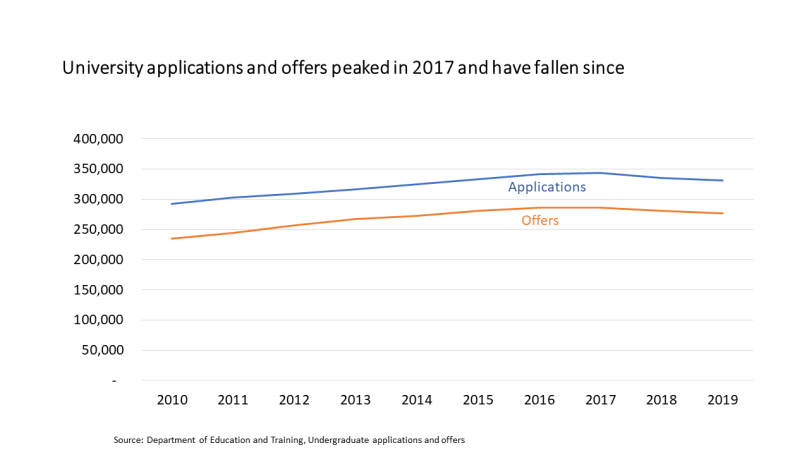
In 2018, applications from school leavers for university entry were much the same as in 2017. But from non-Year 12 applicants, demand dropped by more than 5 per cent. Full 2018 enrolment data is not yet available, but first-semester domestic commencing undergraduate enrolments fell by 1.8 per cent. Various media reports suggest that demand in 2019 will be lower than in 2018.

As the chart below shows, the largest absolute drop in applications is for people aged 20 to 24, but in percentage terms the older groups dropped at around the same rate. decline by age

Looking at the data on prior education for the non-Year 12 group, application numbers are holding for people with sub-bachelor and vocational qualifications. But the no prior tertiary education and repeat-customer higher education groups are both in decline.

People changing courses or taking another course have long been a significant component of each year’s commencing students, but during the demand driven era they increased from 23.5 per cent in 2008 to 29 per cent in 2016.

Because repeat customers are such a large part of each year’s commencing students, this hid the fact that the number of new-to-higher education students started decreasing in 2015, three years before the total number of commencing students went down.  As with the more recent data, the decline was concentrated in the older age groups, as the chart below shows.Read More »

Is HECS a tax?

My use of the word ‘lent’ in the chart below was disputed on Twitter, on the grounds that payments of HECS or HELP are tax levies. Although not spelled out in the Twitter comment, this point is often more than just a semantic one. It is part of a larger argument about how student/graduate-sourced funding of higher education should work.HELP total debt

One potential system for funding higher education is a graduate tax. The idea here is that graduates pay a proportion of their income above a threshold for a period of time after they complete their degree. With a graduate tax,  higher education is free but extra taxes are paid by financially successful graduates. The revenue could go into general government funds or be set to recover what the government thinks should be the student contribution to total higher education expenditure. But there are no specific charges for subjects or courses and there is no loan. The language of ‘lent’, ‘borrowed’ or ‘debt’ would not make sense conceptually or legally.

Veteran Labor (and current QUT) higher education policy adviser John Byron has argued for thinking about HECS in something like these terms:Read More »

How could Labor make unis increase admission requirements for teaching courses?

At the weekend, Labor announced that it would require universities to increase admission requirements for teaching students. Shadow education minister Tanya Plibersek says that:

“Labor wants the best and brightest Australians studying teaching. If universities don’t do the right thing and fix this themselves, a Labor government will make them.”

But how will a Labor government make them do it? There is no history of the Commonwealth government directly setting entry requirements for university courses. For that reason, there is no specific power in existing higher education legislation to set admission requirements.

This blog post looks at what existing powers could be used to achieve this goal.

Directly targeting lower-ATAR students

The minister can, by legislative instrument, determine that ‘a specified course of study is not one in respect of which students, or students of a specified kind, may be enrolled in units of study as Commonwealth supported students’: section 36-15 of the Higher Education Support Act 2003 (HESA 2003), emphasis added.

The legislative instrument could then specify that students with an ATAR below 80 (the figure nominated by Labor) could not be enrolled as Commonwealth supported students in teacher education. The university would then not get Commonwealth or student contributions for such students.

Such a determination would need to be made at least six months before the start of the course: section 36-15(4), HESA 2003.

In making the determination, the minister must have regard to its effect on students: section 36-15(3), HESA 2003.

A legislative instrument can be disallowed by either house of parliament, which is one potential obstacle to this method.

A determination under section 36-15 lifts the prohibition on full-fee undergraduate students: section 36-30 (1), HESA 2003. If the student is not Commonwealth supported they can only be charged a tuition fee: section 169-15, HESA 2003. This would be awkward for Labor, which came to office last time promising to abolish full-fee undergraduate places.

To ensure that the policy complied with other Labor policies and that universities did not use backdoor methods to by-pass the ban, the minister could also determine that undergraduate teaching courses are not eligible for FEE-HELP: section 104-10(2), HESA 2003. The minister must have regard to the effect on students of making such a determination. The determination can  be disallowed by either house of parliament.Read More »