Higher education inequality: how well has Australia limited differential access levels by socioeconomic status?

In an earlier post, I argued that higher education has substantial inequality-generating features. This post is the first in a series looking at how well Australia’s higher education system does in this context, starting with access to higher education. Essentially, this is about how well the higher education system can foster social mobility.

The potential of the Australia’s higher education system is constrained by the potential pool of students, which largely comes from people who have successfully completed school. Before the 1980s, that was a minority of the population. Don Anderson and A.E Vervoorn’s interesting book Access to privilege reports that in 1980 overall school retention to Year 12 was only 34.5 per cent, and 28.4 per cent at government schools. It was already a massive 88 per cent at the non-Catholic private schools, favoured by many higher SES families. They were setting up the basis for the next generation’s educational success.

In the 1980s, school completion rates increased, so that about half of low SES students finished school by the end of the decade. Low SES Year 12 completion is now at 73 per cent, compared to 80 per cent for high SES students (with the caveat that dividing the population into three groups misses likely much larger difference in the lowest and highest deciles).

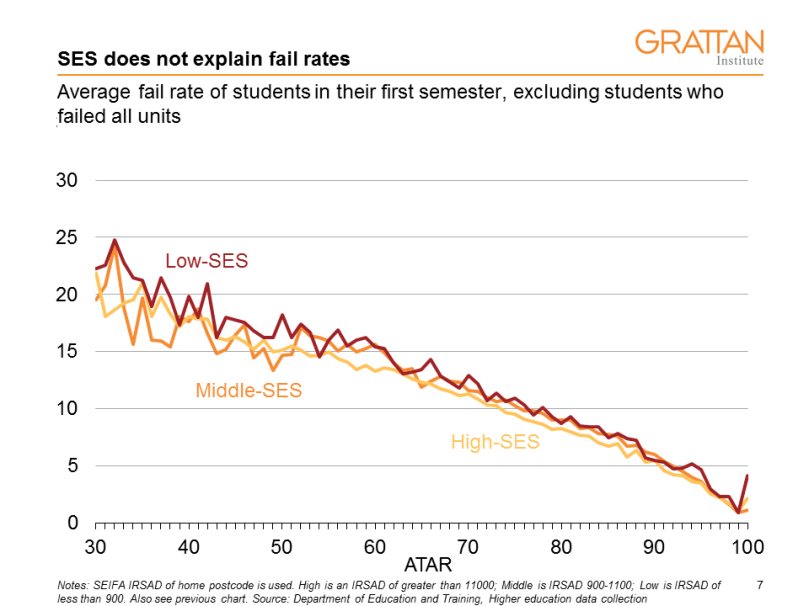
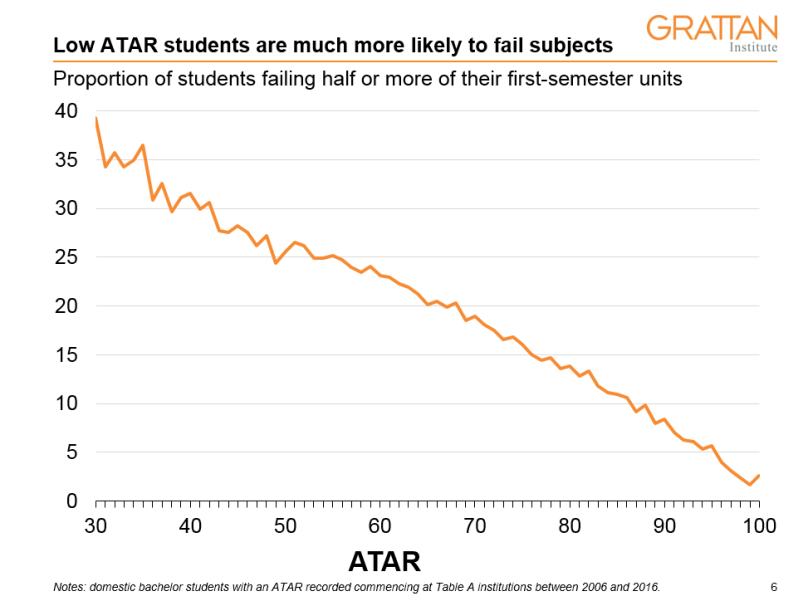
ATAR results by SES are rarely published, but some Victorian data I published in a book chapter a few years ago shows the highest SES quartile by postcode substantially over-represented in the 90+ group, and the lowest SES quartile substantially over-represented in the below 50 group.

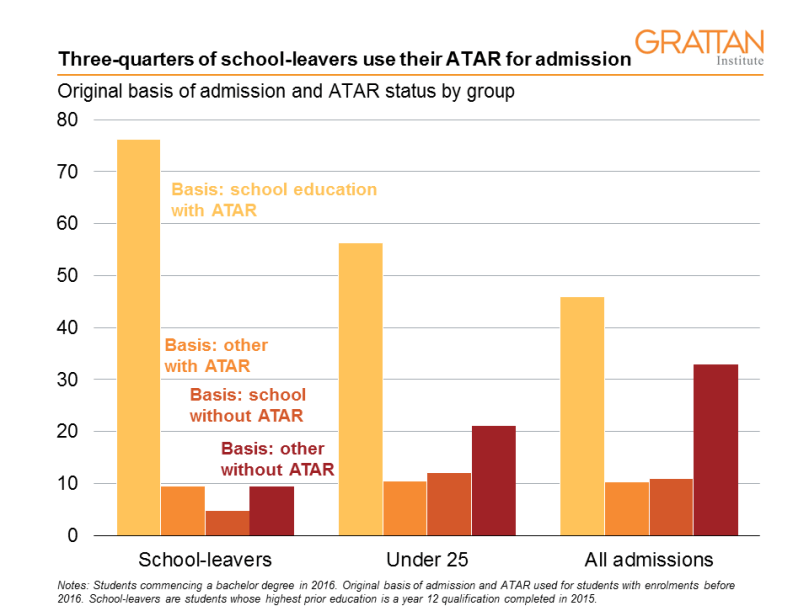
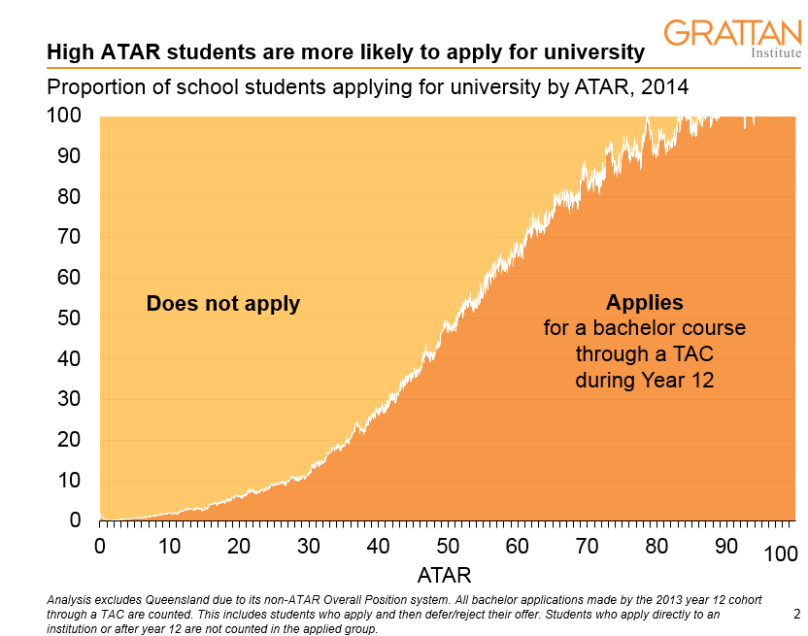
University enrolment data by definition doesn’t include Year 12 students who never apply, but we know that almost all high-ATAR school leavers put in an application. Using a parental education measure of low SES, we can see in the chart below that there are many more students with an ATAR reporting parents with a higher education qualification than we would predict based on the education levels of people old enough to be parents of undergraduates (notice the different scales).

Further, when one or both parents have degrees (the chart shows the parent with the highest qualification, but frequently both parents have degrees) the ATARs skew more markedly to the higher end, producing higher medians.

atar_parent_dist (003)

The annual NAPLAN reports show that, again, the high SES students, whether measured by parental occupation or parental education, do significantly better across all the literacy and numeracy tests, although consistent with meritocratic hopes there are – as the enrolment data also suggests – high achievers from disadvantaged backgrounds. So even though Year 12 completion has improved, we still have substantial issues with inequality of school-level academic achievement.

I don’t feel competent to judge to what extent university education faculties are to blame for this situation – although the early childhood research suggests that schools, also, are working within the constraints of the student pool. I will assess universities and higher education policy on how they deal with this academic achievement situation as they find it.

From the earliest days, universities and higher education policy (which was originally a State responsibility) have been concerned with access, offering students subsidies and scholarships. But that really only mattered in the post-WW2 era, since very few people before then went to university and it was not needed for most jobs. Hannah Forsyth has written about university admission policies in the post-war era. The Commonwealth government offered merit-based scholarships.Read More »

Was higher education ever likely to reduce inequality?

Next week I am a panelist in a discussion on whether Australia has an equitable tertiary education system. The promotional blurb says:

Australians believe we live in a fair and egalitarian country. We believe in a fair go: in equality of opportunity. We also believe that accessible education and training is a fundamental right and it facilitates prosperity, social mobility and a richer and more engaged economy.

Are these beliefs about who we are based in fact? While access to higher education has increased dramatically over the past 30 years, income and wealth inequality is also on the rise. This seeming contradiction challenges our most fundamental beliefs about intergenerational mobility. Is the education system a cure or a curse? …

When I accepted the invitation to be on the panel I told the organisers that I did not know the answers to their questions, but I could offer some observations. I am going to try a few of them out on this blog.

Starting theoretically, I think social mobility and income inequality are distinct issues. It was always more plausible that education would promote mobility in personal status than that it would reduce snapshot-in-time income inequality figures. Indeed, there are reasons for thinking that higher education is more likely to increase than decrease income inequality.

Higher education can increase individual income inequality by facilitating a more unequal labour market. Higher education provides the training to support an increasing number of highly-skilled and highly-paid professionals. In a 2017 paper, Jeff Borland and Michael Coelli have some interesting charts showing growth in demand for the kinds of cognitive skills that a university education aspires to teach. Consistent with this, numerous papers have shown substantial financial ‘returns’ to higher education. This Deloitte report from last year summarises some of the local literature and adds its own estimates. Read More »

Is the graduate labour market recovering?

Last week’s Graduate Outcome Survey, which looks at employment rates about four months after course completion, showed that full-time employment rates continue to improve. However, the proportion of new graduates looking for full-time work at this time is still high by historical standards, as the chart below shows (many of them have part-time jobs; this is not necessarily unemployment).

grad-FT-search

At the margins, there are things universities can do to make their graduates more employable. They can offer courses in fields likely to be in labour market demand, and they can offer work-integrated learning to improve graduate employability. Both were happening under the demand driven system.

But unless there is overall job growth graduate employment is unlikely to improve. When the labour market is tight the first thing to go is new entry-level positions, and so this disproportionately affects recent graduates. The effects of downturns are visible in the chart on annual growth in professional occupations and the labour market overall.

The good news is that growth in the professional labour market has fully recovered from the post-GFC crash and the second crash that started in mid-2012.

profess-employ-2

Read More »

Over-qualification: hard to measure, harder to avoid

This morning The Australian very much delivered in the government’s attempts to use annual data releases to support its case for not paying universities the full funding rate unless they meet various performance indicators. “More than a quarter of the ­nation’s graduates say their ­degrees are close to useless for their jobs” read the opening line of its page one lead story.

Concern about graduates taking jobs that don’t require degrees is very long-standing. The other day I was reading a report from 1972 – when hardly anybody had a degree compared to now – that mentioned the issue. In the past, using the approximate method of looking at what jobs graduates are doing, I estimated that in 1979 about 20 per cent of graduates were in jobs unlikely to require degrees. The equivalent figure now is about 30 per cent.

But the survey that triggered today’s story shows how complex these judgments can be. As the chart below shows, the supervisors of graduates are more likely than the graduates themselves to think that the graduate’s qualification is important.

qualification important

The other interesting aspect of the chart is the very imperfect match between ABS classifications of occupational skill levels and the views of graduates and their supervisors. Read More »

Have you ever not finished a university degree?

At the Grattan Institute, we are nearing completion of a report on not completing university degrees, one of the measures that could be used in the new performance funding regime.

We’ve got lots of interesting new data on how much time students spend enrolled before they leave, how much they have spent, and the risk factors that can help predict who will complete and who will drop out.

But the data and literature on how people feel about incomplete qualifications is very sparse, and so we decided to run our own online survey.

It’s obviously not a random sample, but with over 800 responses to date we are able to identify some general themes. With more respondents we could start to see whether reactions to not completing differ across student categories.

The survey is going to close in a few days, so if you have dropped out a degree yourself, please take it. Or if you know someone who has dropped out, please forward the link to them.

Our report is going to focus on people who have left university without any degree, but we are also interested in people with a complete degree as well as a complete one.

How can the government cap funding for Commonwealth-supported student places?

As reported recently, higher education is expected to face cuts in Monday’s MYEFO. My guess – but certainly not my preference – is that the government will use new university funding agreements to freeze the demand driven system, and to reduce postgraduate Commonwealth-supported places.

Under demand driven funding, most public universities are paid a Commonwealth contribution for each domestic bachelor degree student they enrol (section 33-5(5) of the Higher Education Support Act 2003), except in medicine which is ‘designated’ (section 30-12(b)).

However, section 33-5(5) includes a provision for setting a ‘maximum basic grant amount’ for ‘non-designated’ places (ie, all fields except medicine). This power has been used for the University of Melbourne and the University of Western Australia, which traded in undergraduate places for Commonwealth supported postgraduate places. What we now expect is that the maximum basic grant amount will be used for other universities to reduce future spending on student places.

This can be a freeze but not a cut in nominal terms due to section 30-27(3) which says that, where a maximum basic grant amount has not previously been set, it cannot be less than the amount calculated under section 33-5(5) for the previous year, ie 2017 for the 2018 funding agreements. For the University of Melbourne and the University of Western Australia, it cannot be less than the maximum amount set for 2017. The freeze could be maintained by determining that the 2019 maximum basic grant amount was the same as for 2018, which is turn was the same as 2017, and so on.

It is also possible that the maximum basic grant amount will be higher than 2017, but lower than a university would have received after indexation of the Commonwealth contribution rates under division 198 of HESA and payment for any increase in student numbers under section 33-5(5).

In practice, it is likely that most universities would lose the value of Commonwealth contribution indexation and not be paid Commonwealth contributions for any additional students they enrol. Sustained over a number of years, this could do universities significant financial damage, especially if they are already locked into growth (for example, a university that increased its commencing student numbers in 2017 will have to accommodate them while they finish their degrees).

There is no equivalent of section 33-5(5) for student contributions or HECS-HELP. Therefore universities can still receive indexed student contributions for every Commonwealth supported student they enrol.

All postgraduate, associate degree and diploma courses are designated and distributed to universities through funding agreements (section 30-10 of HESA in conjunction with 30-25(3)). These places have to be allocated to funding clusters (section 30-10(2)).

The government was already planning to cut 3,000 postgraduate Commonwealth supported places, so that is likely to go ahead. They will also have to choose which discipline clusters to cut. As with bachelor-degree places, universities could still receive student contributions directly or via HECS-HELP.

Existing postgraduate students who are enrolled on in a Commonwealth supported place are entitled to keep it (section 36-25 of HESA). Effectively, that is an entitlement to a place with a price-controlled student contribution but not necessarily a Commonwealth contribution. Universities would still be allowed to ‘over-enrol’ (ie take more students than their funding agreement states) but would only get the student contributions. For new postgraduate students, universities can offer full-fee places to replace lost Commonwealth supported places.

The government may also cut Commonwealth supported places in associate degree and diploma courses. Universities could still receive student contributions if they ‘over-enrol’ in these courses. However, they are prohibited from offering full-fee places in all undergraduate courses (section 36-30 of HESA).

The funding agreements are not legislative instruments, and therefore are not sent to Parliament and not subject to disallowance by the House of Representatives or the Senate. It is that, rather than any higher education policy rationale, which makes capping likely. It is one of the few options left for a government determined to make Budget savings without a Senate majority.

A high HELP repayment threshold increases pressure to restrict or deny access to HELP

The Department of Education and Training’s 2016-17 annual report announced the first public use of a project to link up the ATO’s HELP repayment data with the Department’s enrolment data:

In 2016–17 the department worked with both the Australian Taxation Office and the Australian Government Actuary to create a database that links education courses with
income and occupation information. In 2018, the QILT website will publish graduate income data sourced from this database, which will inform students of the earning potential in their study area.

This will, of course, be very interesting, and could include income by university attended, as well as by study area. This has been done in the UK, although their QILT equivalent does not use it at this point.

But this data linking work is being done to better understand HELP debt and which factors affect repayment. It has potential uses well beyond student advice, uses that would fit a pattern of the government trying to reduce its risk of bad HELP debt.

The most obvious of these is to restrict access to courses with high rates of non-repayment. This was a feature of the VET Student Loans reform so that

loans are only being provided for courses that are closely aligned to the skills employers need in their workplace, thereby enhancing the opportunities for graduates to work, and to repay the money lent to them by taxpayers. [emphasis added]

Read More »

The VETification of higher education is a precedent that should not be set

In The Australian this morning an article points out that publicly-funded language diplomas may be not be available to new students from next year. In my view, that is a correct implication of both general policy statements on funding diplomas and associate degrees made by the government, and the specific consultation paper on sub-bachelor courses.

Unfortunately, this is a case in which the government, in attempting to fix one problem, would create several new problems.

The original problem here is that diplomas and associate degrees were, at the last minute in 2011, excluded from the demand driven system. That means that the total number of government-funded sub-bachelor places remains set by the government, the allocation of places between universities reflects largely historical decisions, and new places (when available) are distributed according to regularly changing criteria. The distribution of places does not strongly align with the preferences of students, the strategies of universities, or the needs of employers. In the review of the demand driven system I did with David Kemp, we recommended putting sub-bachelor places into the demand driven system.

On the surface, the government’s proposal looks like it is responding positively to this recommendation. Constraints on the number of funded sub-bachelor places will be lifted in two ways. First, sub-bachelor courses approved by the minister will enter the demand driven system. Second, sub-bachelor courses not approved by the minister will be given an exception on the general ban on undergraduate full-fee places at public universities.

Language courses are in trouble because they typically fail to meet both the announced criteria for sub-bachelor demand driven funding – that they articulate into a related bachelor degree program, and that they have been developed with a focus on industry needs. Read More »

Should permanent residents lose their higher education tuition subsidies?

Under current law, access to the HELP loan scheme is a rare government financial benefit linked to citizenship rather than permanent residence. It may be the only benefit in this category.

Under the government’s proposed higher education reforms, permanent residents would become entitled to HELP.* But access to tuition subsidies under the Commonwealth Grant Scheme would instead be restricted to citizens, and permanent residents put in full-fee places. For undergraduates especially, this could cost them tens of thousands of dollars.

No universally applied rules govern who is entitled to what in Australia. But  patterns of eligibility suggest some broad principles. Generally speaking, longer and stronger connections to Australia lead to wider eligibility for government-financed benefits. Underlying this is the idea of a reciprocal welfare state; paying tax and receiving benefits are linked over a lifetime. People who aren’t committed to Australia, and who probably won’t finance as well as receive government benefits, have restricted entitlements.

The clearest example of this idea in practice is the distinction between temporary and permanent migrants. Temporaries are eligible for few benefits, while permanents get almost all. It would be unreasonable to require people to make long-term taxation contributions to Australia without making them eligible for the benefits those taxes finance. But people present in Australia for only short periods should not receive benefits they haven’t financed. The temporary/permanent distinction is not as robust as it once was because of the rise of long-term but legally temporary migrants. But that is a problem with the visa categories more than the underlying principle.

The Australian welfare state also makes sharp distinctions between residents and non-residents. Regardless of citizenship status, Australians living overseas generally aren’t entitled to social security benefits (or any higher education benefits; Australian citizens studying at the overseas campuses of Australian universities generally don’t get subsidies or loans). The main exception is the aged pension, but that is linked to past residence. Again, full legal membership of the Australian community through citizenship isn’t counting for much; being within reach of the Australian taxation system matters more.

Why are citizenship and higher education benefits linked in an unusual way?Read More »

Has the demand driven system largely achieved its objectives?

At the AFR higher education conference this week the demand driven system was criticised from the speaker’s platform and elsewhere.

Some Group of Eight universities are arguing for something they call ‘cap and trade’. The core idea is that, in exchange for accepting capped funding or student places, universities could trade in bachelor degree places and replace them with sub-bachelor or postgraduate places. Under the current system, sub-bachelor places are capped in public universities. Universities can enrol unlimited numbers of postgraduates on a full-fee basis, but in some courses they want to offer cheaper Commonwealth supported places, which are currently capped.

From the government’s perspective, cap and trade implemented across the entire system would give them more certainty about future higher education expenditure.

University of Melbourne VC Glyn Davis gave the argument a new feature at the AFR conference. He put as central to the demand driven system the goal of 40 per cent higher education attainment in the 25-34 age group. Noting that this had been achieved in some metropolitan areas, he suggested capping inner city universities while allowing outer metropolitan universities to continue growing.

The 40 per cent attainment goal was certainly part of the original Bradley report recommendations for the demand driven system and the subsequent government policy announcement. But how important is it to the overall logic of demand driven funding?Read More »