Has funding for Commonwealth supported students been cut?

With universities back job shedding, academics and their unions are looking for someone to blame. University leaders and consultants are being attacked for poor decisions. The government also gets criticised. UTS history professor Anna Clark says that over the last twenty years ‘we have seen gradual, steady decline in government investment across the sector’. In his recent lament Broken Universities, Graeme Turner says that there has been a ‘steady decline in the levels of funding per student’.

Five years ago, early in the COVID crisis, I wrote a post about government ‘cuts’. This post is an update.

Funding for Commonwealth supported students

As my earlier post noted, time series data is not straightforward. The chart below focuses on the major student funding programs, in today’s terms the Commonwealth Grant Scheme (CGS), HECS-HELP, and upfront student contributions. These funding sources have always had a link to the number of full-time equivalent Commonwealth supported students, although historically the money they delivered supported research as well as teaching expenditure.

Around these core funding sources other schemes serve the same purpose (e.g. transition funding) or similar purposes (e.g. NPILF). The chart below includes the Job-ready Graduates (JRG) transition funding and but excludes NPILF. It includes money paid from the Higher Education Continuity Guarantee, a COVID measure still in place for universities that ‘under-enrol’ that would normally face a CGS penalty. From 2021-2024 the time series excludes the enabling course loading that was previously in the CGS but moved to IRLSAF. But this funding is back in the CGS in 2025 due to the FEE-FREE Uni Ready places. The regional loading remains out from 2021 as it is still in IRLSAF and will join needs-based funding next year.

Overall my time series goes for simplicity over a full count of expenditure on student-related programs. In the time series, one big structural change should be noted, which is research student funding moving to a separate program from 2001, which caused a significant but artificial year-on-year decline.

Trends in total funding

Focusing on recent times, in nominal dollar terms total CGS funding dipped between 2021 and 2022, which was mostly short-term COVID places coming out of the system. HECS-HELP lending fell between 2020 and 2021, driven by the strange decision to pass on reduced JRG student contribution rates to all current students but to grandfather increased student contribution rates, so that only 2021 and later commencing students pay them. HECS-HELP lending fell again in 2022, with lower student numbers also affecting revenue from a university perspective.

Read More »

Gender-based violence legislation, Part 3: Reporting and penalties for higher education providers

The first post in this series outlined the meaning of gender-based violence and processes that apply to all higher education staff and students. The second post looked at processes when a complaint of gender-based violence is made.

Legislative references, unless otherwise specified, are to the Universities Accord (National Higher Education Code to Prevent and Respond to Gender‑based Violence) Bill 2025. The draft code is here; it uses the language of ‘standards’ but I will refer to code ‘sections’ when noting a specific rule or requirement.

Update 20/10/2025: The enacted legislation is here. The enacted code is here.

Reporting

The code comes with very extensive reporting requirements. All the different things providers must report on run for four pages in the code: standard 6, pp. 17-20.

The code stresses the role of the data collected on programs to reduce gender-based violence: code section 6.1.

The Secretary can disclose information received as part of this reporting: sections 43 and 44.

The Secretary must produce an annual report to be included in the Department’s annual report (which is usually tabled in Parliament in October): section 47.

Given the Department of Education’s chronic failure to release higher education data in a timely way a statutory requirement to publish an annual report is good.

While the Department’s annual report operates on a financial year basis it would be helpful to produce the data on a calendar year basis as well, to reflect the operating cycle of universities.

Read More »

Gender-based violence legislation: Part 2, Processes for victims and perpetrators

My first post on the higher education gender-based violence bill and its draft code looked at how gender-based violence is defined and the broad obligations placed on higher education providers and their staff and students.

This post examines procedures for student victims of gender-based violence and for the accused perpetrators. The rules also apply to staff, but as there are existing laws on these matters for workplaces I will focus on students. There is a 2024 summary of university policies and practices on responding to sexual violence, but I have not attempted to compare them to the code.

The code includes reasonable measures to support student victims and, to a lesser extent, accused respondents. I am not convinced, however, that the latter will face a fair process in more serious cases if universities rely on the code alone to guide their policies.

Update 20/10/2025: The enacted legislation is here. The enacted code is here.

Student victims/disclosers

A common criticism of universities has been inadequate responses to student complaints regarding sexual misconduct. In a 2021 student survey on sexual harassment and assault most victims did not report their experience to the university, but of those who did over 40% were dissatisfied. The code includes an extensive list of things that providers must do in these cases: code section 4 (all legal references unless otherwise stated are to the draft code).

These required provider actions include implementing measures to ensure the safety of the discloser, prioritising urgent access to support services, minimising how often the discloser must repeat their story, providing translation and interpretation services where necessary, implementing academic adjustments, and where necessary discussing the investigation and disciplinary processes: code section 4.6.

The discloser must have the opportunity for a support person to be present: code section 5.11.

Read More »

Gender-based violence legislation: Part 1, Definitions and requirements for all higher education providers, staff and students

Legislation on ‘gender-based violence’ in higher education is back in Parliament. Its principal purpose is to provide a legal foundation for a National Higher Education Code to Prevent and Respond to Gender-based Violence. This will be a legislative instrument made after the legislation is passed, but the minister has released its expected contents.

The code is scheduled to start on 1 January 2026 for universities and 1 January 2027 for other providers.

This post looks at the definition of gender-based violence, extension of the policy beyond higher education providers, and policies that will affect all staff and students. A second post looks at procedures for victims and perpetrators of sexual harassment or assault. A third post looks at reporting and penalties for higher education providers (apologies, but this is all much briefer than the 75-page original; 45 pages in the bill and 30 in the code).

Update 20/10/2025: The enacted legislation is here. The enacted code is here.

What is gender-based violence?

According to the bill, ‘gender‑based violence means any form of physical or non‑physical violence, harassment, abuse or threats, based on gender, that results in, or is likely to result in, harm, coercion, control, fear or deprivation of liberty or autonomy’: section 5 (legislative references, unless otherwise specified, are to the Universities Accord (National Higher Education Code to Prevent and Respond to Gender‑based Violence) Bill 2025).

Read More »

University funding systems and what graduates see as important in a job

For a side-project I’ve recently engaged with the subject of whether higher education funding systems shape the educational and career choices of students and graduates.

On one theory, where fees are charged students focus more on courses and jobs with high pay. Courses that satisfy intrinsic interests but do not offer good salary prospects would be less popular in countries with fees or after fee increases. Focus-group research on the views of students in European countries provides some support for this view (I have not cross-checked this against enrolments).

Under fee systems, depending on loan arrangements, taking courses with good job prospects may be necessary to reduce the risk of default on student debt repayments.

On another theory, also with some evidence from the European focus-group research, students in fee-paying countries may be more interested in courses that lead to personal financial rewards than courses that serve some broader public purpose. There are echoes of this argument in the local complaint that Australian higher education in the ‘neoliberal’ fee-charging era has lost sight of the ‘public good’.

I’ve discussed the role of interests in course choices before. In this post I look at the attitudes of graduates. My data source is survey evidence from the International Social Survey Programme. Unfortunately Australia only occasionally participates in these multi-nation comparative studies, but the ISSP’s 2015 work orientation questionnaire has Australian data.

What Australian graduates see as important in a job

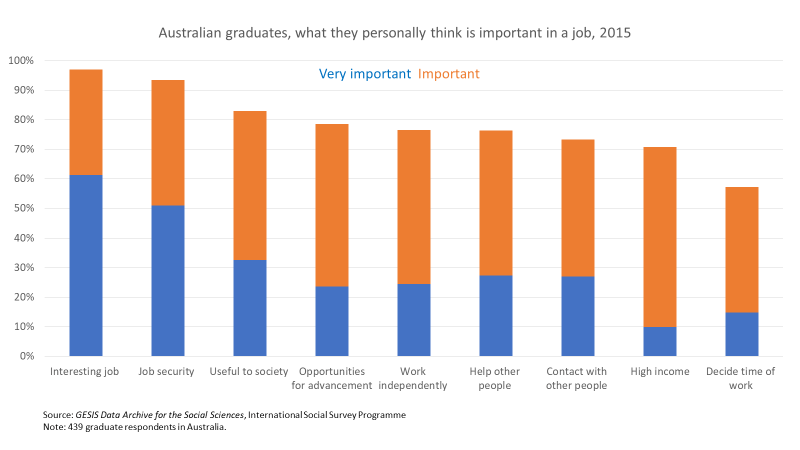
In the ISSP respondents are asked what job attributes they personally see as important.

A job being interesting is the single-most desirable attribute of a job for Australian graduates. This is consistent with interests being the dominant factor in course choice.

The ISSP question has two other-regarding options, being useful to society and helping other people. I presume helping others is a hands-on form of being useful, such as a teacher or nurse, while a policymaker, engineer or executive can produce useful-to-society structures and systems without directly helping specific individuals.

Perhaps because being useful to society is more general it is rated above helping others, and is the third mostly highly rated attribute overall.

Only 10% of graduates rate a high income as very important, the lowest of any attribute and the overall importance of money is the second-lowest of the options given. Money is nice to have but other job attributes are more important.

Read More »

Graduate income fluctuations and HELP repayment

Last week I raised concerns about the new HELP repayment system increasing the number of HELP debtors who face very long repayment times or lifetimes of student debt.

The calculations in that post assumed that people maintained their relative income position through their careers – for example that someone who earned the median income at age 25 would still do so at age 35, 45 etc. We know, however, that relative income fluctuates. Family commitments drive movements in and out of full-time work. Careers go better or worse than expected.

Without solving the problems involved in estimating how these changes affect HELP repayments, this post outlines findings on graduate income mobility and labour force status changes.

Movements between income quintiles

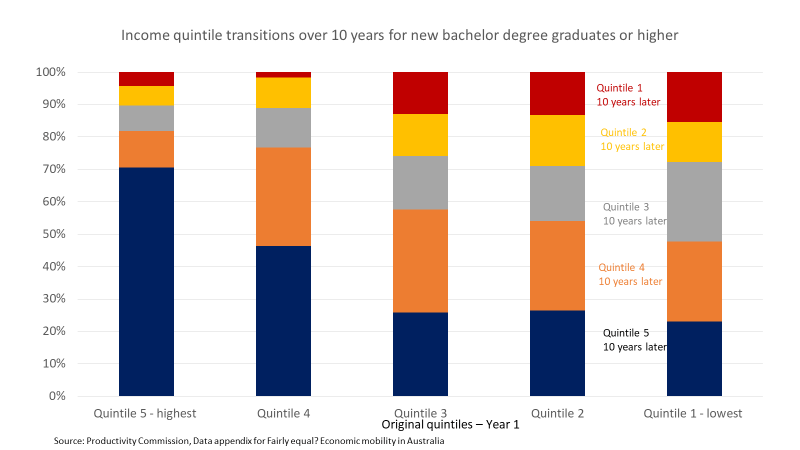
The chart below uses data from a Productivity Commission report on economic mobility. It shows changes in relative income, between five economic quintiles, over a decade since degree completion. The data source is HILDA.

Quintile 5, the highest, shows strong stability. More than 80% of graduates in quintile 5 were still there or in quintile 4 a decade later. The high starting point and following stability may be due to people already doing well in their careers acquiring postgraduate qualifications.

The other quintiles all show significant movement in relative income. Upward movement is expected as we know graduate incomes increase in the years after course completion. Almost half of graduates in the lowest quintile in year one are in the top two quintiles a decade later.

Bu there is also some stability at the lower end. In the two lowest quintiles, 1 and 2, over a quarter remain in those quintiles a decade later. In quintile 3 we see a similar share falling back to quintiles 1 and 2. While some of this is career stagnation, ten years out takes into the ages when women start leaving full-time work to meet family responsibilities.

Read More »

Will the new HELP repayment system make high EMTR problems better or worse?

The new HELP repayment system being legislated this week will move from repaying a % of total income to a % of income above the repayment threshold, a marginal system. In introducing the bill to Parliament, education minister Jason Clare quoted Bruce Chapman on a marginal system: ‘it’s much gentler and much fairer than previously—we should have done it years ago.’

While the new marginal repayment system may be gentler and fairer, it could create more widespread disincentives to working additional hours than the current total income system.

The problem with total income systems

The Universities Accord Final Report, which guides the government’s higher education agenda, criticised the total income repayment as unfair and a deterrent to work.

The underlying problem is that a multi-rate total income repayment system creates multiple threshold ‘cliffs’, income points at which earning $1 more triggers a big increase in student debt repayment. The most extreme cliffs are the lower income levels. Under the current system a debtor whose income reaches the $56,156 first threshold faces an increase in repayments from $0 to $561.56, plus 30 cents of income tax.  By earning more the student debtor reduces their take-home pay. Repayment cliffs exist, at less extreme levels, at all 18 income thresholds in the current student debt repayment system.

A total income repayment system produces some very high effective marginal tax rates (EMTR). An EMTR is jargon for how much of an extra dollar earned is lost to income tax, withdrawal of benefits, and in this case HELP repayments. EMTRs are a big issue in Australia’s welfare state, which makes widespread use of means tests – of which the HELP repayment thresholds are a version.

Read More »

The new HELP repayment system and lifetimes of student debt

The prime minister says that a degree should not come with a lifetime of debt. For that goal, the government’s HELP legislation introduced last week is contradictory. It will cut all debt owed as of 1 June 2025 by 20%, which will shorten repayment times for current debtors. But it will also cut annual debt repayments for 99% of debtors, which will lengthen compulsory repayment times for many and push others into the PM’s lifetime of debt.

In the analysis below, female debtors owing $25,000 or more with incomes in the lowest 40% of graduate earnings face an increased risk of a lifetime of student debt. However, what percentage of female debtors actually face a lifetime of debt will depend on initial debt levels and how much their incomes vary through their careers. Voluntary repayments can also affect repayment times.

How the repayment system will change

My previous post on the initial threshold summarised how the repayment system will change. The key elements are that 1) repayment exempt incomes will include everyone on $67,000 or less compared to less than $56,156 now and 2) a marginal rather than total income repayment system will reduce what most debtors repay, particularly at lower income levels.

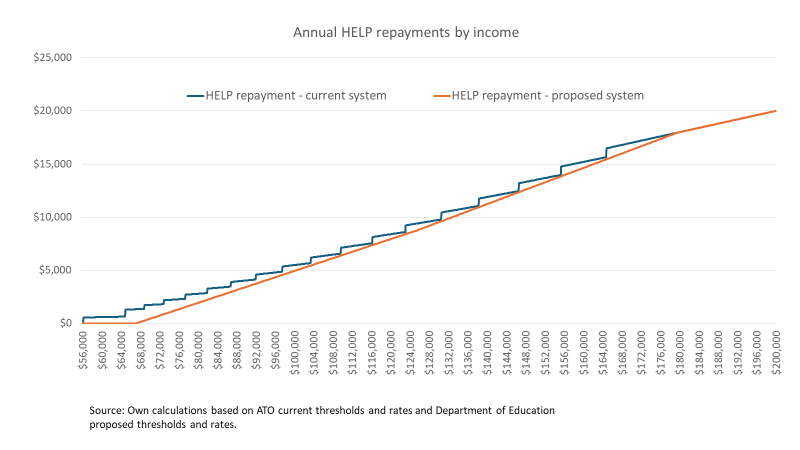
The chart below shows how this will affect HELP debtors at different annual income levels. Based on 2022-23 ATO data I estimate that 99% of debtors repaying under current thresholds will repay less per year than under the current system. The other 1%, all high income earners, will repay the same amount per year as now.

Read More »

International students and the rental market

The housing section of the RBA’s report last week on international students and the economy had higher education media dismissing the contribution of students to rent increases as a ‘furphy’. I agree that international students are at most one factor amongst many in post-COVID accommodation market problems. That said, the RBA may understate the scale of international education’s contribution to rental demand.

Student Experience Survey results

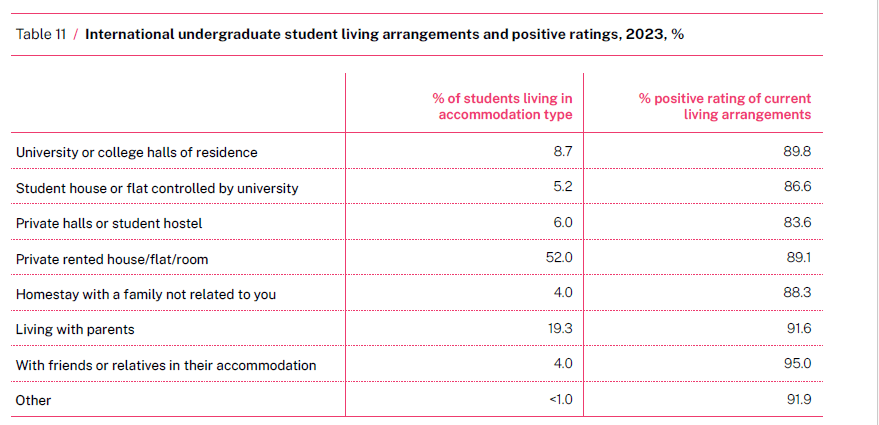
The RBA used the Student Experience Survey to try to work out the proportion of students in the private rental market where they compete with others for accommodation. The question the SES asks is below.

The RBA’s conclusion that about half of international students are in the private rental market is based on the result below, which is for undergraduates. Taking a broad definition of undergraduate that was about 40% of international students in 2023. But assuming it is broadly representative, there is still one number that I have persistently struggled to understand in this survey, which is the high percentage of international students who say they live with their parents – 19% in 2023. Can that be right?

Read More »