The history and politics of the first student debt repayment threshold

The government’s HELP legislation, cutting student debts by 20% and introducing a new repayment system, was introduced into Parliament yesterday. While I have criticisms of the 20% cut, it will be implemented and once done cannot be reversed. The changes to the repayment system will pass now but can, and probably should, be changed at a later date.

In this post I briefly explain how the repayment system will change and then discuss the choice of the first threshold.

The current and proposed student debt repayment systems

Under the current system, repayments start at an annual income of $56,156, at which point student debtors repay 1% of their total income. From there the percentage of income repaid increases incrementally to reach 10% of income at $164,712.

Under the new system repayments start at when income exceeds $67,000. At this point a marginal rate of 15% of income above $67,000 applies up to $124,999, where a marginal rate of 17% applies for income of $125,000 or more. Unexpectedly the bill restores part of the old system with an annual repayment cap of 10% of total income. This avoids some high income earners paying more than now.

The new thresholds will be indexed to growth in average weekly earnings. The current thresholds are indexed to CPI.

The logic of the first threshold

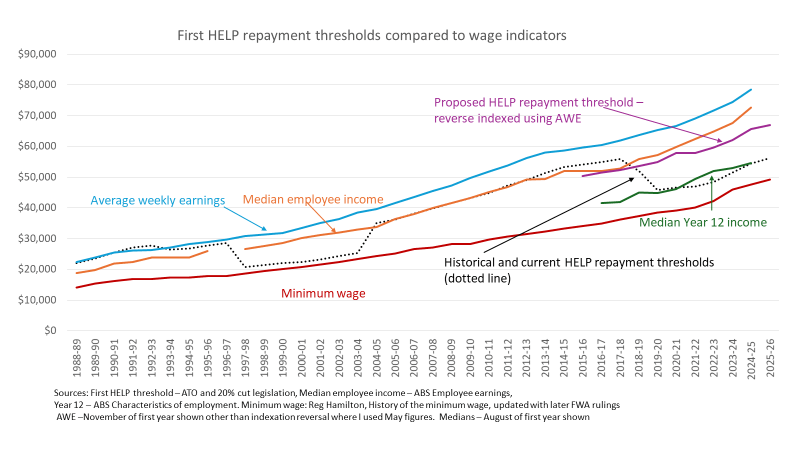
As the chart below shows, in the black dotted line, the first repayment threshold has changed over time. The long-term policy/political tension is between the idea that graduates should enjoy some financial advantage before repaying their student debt and the idea that student debt should be repaid except in cases of financial hardship. The policy pendulum is currently shifting from the latter to the former.
Read More »

Despite an increase in applications for the 2024 academic year, school leaver interest in higher education remained below mid-2010s levels

University applications statistics for 2022 to 2024 were finally released late last week, giving us another data source on demand for higher education.

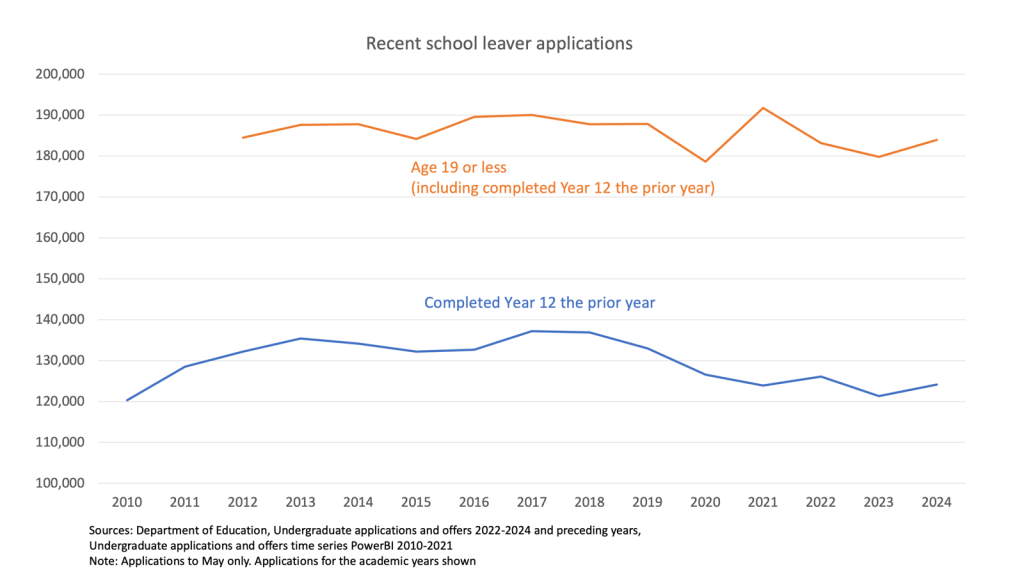
This post focuses on recent school leavers. The chart below shows that applications for this group were up in 2024 on 2023, but that the slump in applications since the late 2010s remained evident – other than the spike for academic year 2021, which is only apparent for teenagers who finished school prior to 2020. This is consistent with people deciding to sit out the COVID recession at university.

That COVID spike meant that in 2021 an unusually large share – 35% – of the 19 and under applicant group were not people who had finished school the year before. This share was 32.5% in each of 2023 and 2024, higher than any year 2012 to 2020, when it averaged 28.4%. This could mean that we are seeing more young people delaying higher education. This data source does not, however, distinguish between people who delayed applying until one or two years after finishing school, and people who enrolled but reapplied to change university and/or course.

Read More »

The Prac Payment that will go to Services Australia and the ATO, as well as students

Last year I was critical of how I thought the Commonwealth Prac Payments were going to work. These were to provide Austudy level payments, currently equivalent to $331.65 a week, for nursing, midwifery, social work and teacher education students while undertaking compulsory work placements. The payment starts on 1 July 2025 for students on income support and some working students.

Rather late in the day, the legal paperwork for its higher education version was completed last week. The vocational education diploma of nursing version paperwork was already available. The higher education version is administered by universities and funded through the ‘other grants’ provisions of the Higher Education Support Act 2003. The VET Prac Payment is administered by the Department of Employment and Workplace Relations, although the funding is authorised under the Social Security Act 1991.

Things I was concerned about that have not happened

Some of my Prac Payment concerns from last year were not realised in the policy as enacted. The Prac Payment has a means test but it is based solely on the student’s income, not family income. However family income has an indirect effect through eligibility for income support.

A policy goal is reduce the number of students who defer or withdraw from their course due to placement obligations, but students won’t need to prove that they are considering either of those things.

But in the Australian way of public policy, the Prac Payment is an underwhelming half-measure. The payment is low and will be further reduced by tax and by social security income tests. Many students won’t be eligible at all.

Read More »

What explains delays in attrition?

I was quoted at the weekend in a Herald-Sun article about attrition from Victorian universities. The journalist wanted to know how much HELP debt students typically have on drop-out, but unfortunately this data is not regularly published (it should be of course).

But based on some old Grattan analysis, which had actual data to the mid-2010s, the fact that first year is the most common year for attrition, and the strong link between part-time study and attrition, I thought that the typical $$$ figure may not be too high.

That said, average or median HELP debt on dropping out may have increased at a faster rate than indexation in the early 2020s. This is due to students spending more time enrolled before dropping out.

Read More »

What is behind increased rates of upfront payment of fees and student contributions?

It’s been a while – seven years – since I took a look at higher education student decisions to take out a HELP loan or pay upfront. Since then we’ve had instability in upfront student contribution payment incentives and increased student debt salience, triggered by high-CPI indexation. Anecdotally some students paid upfront to avoid high indexation of the subsequent debt.

Student contributions & HECS-HELP

The direct incentive to pay student contributions upfront has been framed as a discount. If the upfront discount was 10% and the fee was $1,000 a person who paid upfront would incur a debt of $900. The Commonwealth compensated the university for the lost $100, but avoided holding debt that might go bad and paying interest on its own borrowings to finance lending the student $1,000. In recent years, according to estimates in the Budget papers, about 15% of each year’s lending is not expected to be repaid.

The size of the incentive to pay student contributions upfront has varied over the last 20 years. Any incentive was abolished in 2017, restored for 2021 and 2022 to get Pauline Hanson to vote for Job-ready Graduates, and then abolished again from 2023.

I am in the no upfront discount camp, as I believe most people who pay upfront will do so anyway, whether there is a discount or not.

Read More »

What’s in the 2025 funding agreements? – ‘Higher education courses’ block grants

In February I reported on preliminary university-level 2025 allocations under the Commonwealth Grant Scheme and estimates of student contributions.* These have since been updated to add money for FEE-FREE Uni Ready places and regional university study hubs. The revised funding summary is here.

This post looks at the underlying funding agreements for more detail on the ‘higher education courses’ part of CGS funding. As usual in funding agreements since 2021, the detail reveals a range of legal and policy problems.

A spreadsheet summary of higher education courses funding for 2025 is here.

The role of higher education courses funding

Higher education courses funding is intended, by the Higher Education Support Act 2003, to be a flexible block grant. Within their total funding envelope, expressed as the ‘maximum basic grant amount’ (MBGA), universities can move resources across coursework AQF levels and between fields of education, other than medicine.

Although higher education courses funding is supposed to be flexible, both Coalition and Labor governments have used ad hoc funding agreement conditions to restrict use of higher education courses money to purposes chosen by the government.

This has in turn led to the unlegislated concepts of ‘base MBGA’ and ‘total MBGA’. Total MBGA is actual MBGA under HESA 2003. Base MBGA excludes most ad hoc programs. Its purpose is to reduce expenditure on the higher education continuity guarantee and the current equity plan funding. If universities don’t meet the ad hoc criteria they get $0 for those non-delivered places.

Overall trend in higher education courses funding

To the surprise of universities the first-term Albanese government often treated them harshly. But Labor kept the former government’s promise to index higher education courses funding to CPI. That was 4.1% for 2025. They also kept the Coalition’s region-based funding increases. While there are complex financial flows in and out of higher education courses funding – discussed further in this post – it is up 6.1% between 2024 and 2025 to a total of $7,687,211,975.

Read More »

A blog url change to andrewnorton.id.au

Since 2011 I have run this blog using the andrewnorton.net.au url. But recently I was informed by my domain supplier that ‘net.au’ domains are now reserved for businesses with a connection to Australia.

To me ‘net.au’ sounds to me like a generic website address, with ‘.com.au’ for businesses. But I am years too late to challenge the decision and I don’t want to set up an andrewnorton.net.au business. I therefore need to change the blog url.

Although I have never previously heard of ‘id.au’ addresses, they seem like the best option to avoid a future reclassification. So I will be changing to andrewnorton.id.au

At the moment andrewnorton.id.au redirects to andrewnorton.net.au but I will reverse this soon. The redirection will last until andrewnorton.net.au expires on 2 July 2025. If you get a broken link changing the ‘net’ to ‘id’ will get you to the right place.

Once the change takes place, people reading my blog on a feed will probably need to resubscribe. There will be ongoing issues with broken links. I hope that there will be no interruption for people being notified of a new post by email.

Update: In August 2025 a scam site bought use of andrewnorton.net.au. I am trying to get it taken down.

What do Australian governments owe international students?

Gaby Ramia, a University of Sydney academic, has long written about international student issues, including their security and well-being. His latest book, International student policy in Australia: The welfare dimension, accuses successive governments of ‘policy inaction’ on international student welfare.

The book opens with what became an infamous statement by then Prime Minister Scott Morrison. When asked, in the early stages of the COVID-19 pandemic, about the plight of JobKeeper-ineligible international students, Morrison responded that ‘these [student] visas and those who are in Australia under various visa arrangements, they’re obviously not held here compulsorily. If they’re not in a position to be able to support themselves, then there is the alternative for them to return to their home countries.’

A transactional relationship between Australia and international students

As Ramia’s book shows, in itself the prime minister’s statement was unsurprising. While Australia has longstanding consumer protection policies for international students, it has not offered general welfare-state type benefits. International students self-insure against the adversities that welfare states cover. As a visa condition they are supposed to arrive with savings. They are required to take out private health insurance. Education providers must provide information about welfare and other services, but are not obliged to deliver them.

Over the last quarter century the government has, to extents that vary over time, also encouraged international students to meet Australia’s labour market needs. But there was never any intention that the government fund international student related services. The government offered an Australian education and access to Australia’s labour market, not Australian welfare state support.

Ramia, by contrast, thinks that the government should take more responsibility for the welfare of international students. This should start with public transport concessions where these are not already offered and access to Medicare.

Ramia’s book was completed before the government changed its mind on international students, and started trying to cut their numbers. That policy turn creates new issues about the relationship between the government and international students.

Read More »

Temporary graduate visas – trends in applications, grants and populations

As part of its international student policy announcement, the Coalition promised a ‘rapid review into the Temporary Graduate Visas (subclass 485)’. The review would ‘address the misuse of post-study work arrangements as a way to gain access to the Australian labour market and as a pathway to permanent migration.’

While recent polls suggest the Coalition will not form government, net overseas migration will remain an important political issue. It is worth understanding trends in major migration categories such as the 485 visa.

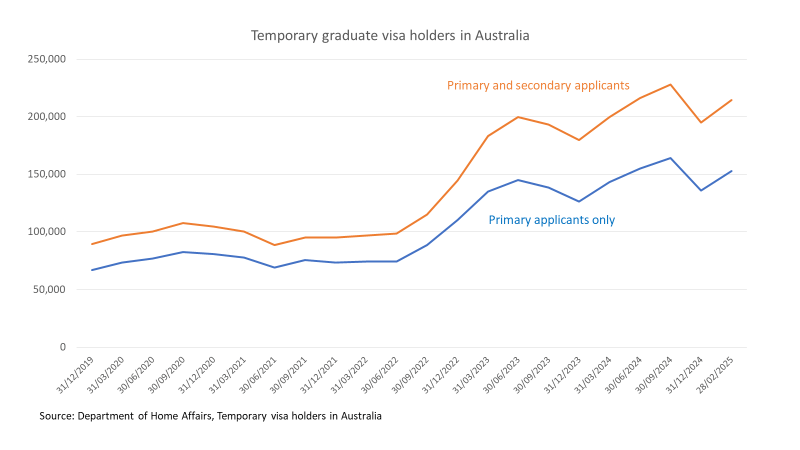
This post summarises the available 485 visa data. A key point is that although applications for new 485 visas in 2024-25 to date are lower than in previous years, in the coming years there is the potential for significant increases in total 485 visa holder numbers.

Purpose of the 485 temporary graduate visa

Today’s temporary graduate visa is descended from an early 2010s policy that was designed to make Australia more competitive in the international education market. It does this by letting former international students access the labour market, so doing this is not ‘misuse’ according to the policy’s intent. The pathway element is more contentious. The 485 visa can be a pathway to permanent residence but it offers no guarantees. Government and student expectations proably differ on this matter.

In any case, as the numbers reported below show, there is no way all 485 visa holders in Australia in early 2025 could transition to a permanent migration program of 185,000 people for 2024-25.

Trends in the number of temporary graduate visa holders

The Department of Home Affairs does not publish how many people hold a 485 visa. The closest we get to a stock figure is a monthly count of temporary migrants in Australia. As at 28 February 2025, 214,714 people were in Australia on 485 visas. This was about 14,000 down on the 30 September 2024 peak. The monthly in-country totals undercount visa holders as some are temporarily overseas.

Since 2022 the primary visa holder share of the total – that is, the former student with the relevant qualification – has decreased from 75-80% of the total to 70-72%. There has been greater growth in secondary visa holders, the partners and children of primary visa holders.

Country of origin of 485 visa holders

Read More »

The Coalition’s plan to reduce international student numbers – some first thoughts

As rumoured in recent months, the Coalition has decided, if it wins office on 3 May, to cap commencing international student enrolments at a percentage of all commencing enrolments. The precise number is yet to be settled, but is expected to be around 25% and will only apply to public universities.

Student experience as well as migration concerns

A key conceptual difference with the government’s policy is that the Coalition wants to improve the domestic student experience as well as take pressure off accommodation markets. That’s why they chose a % of enrolments rather than, as under Labor, formulas driven by past enrolment patterns – although Labor did include a penalty for institutions with high concentrations of international students.

So far as I know, no careful research examines whether high concentrations of international students adversely affect domestic students in measurable ways. There are many anecdotal complaints, especially around group assignments. Is it a coincidence that computing, engineering and business courses, which have high concentrations of international students, have relatively low student satisfaction (chart below)?

Perhaps international students have nothing to do with it. Long ago, looking at the old CEQ results, I observed that students in vocational courses seem less satisfied than other students. Speculatively they have more instrumental motivations, and so enjoy study less. They study in fields where universities compete with industry and the professions for staff. Academic salaries might not attract the best possible teachers.

Questions about the domestic student experience are at least worth asking and answering as best we can. Universities are too conflicted to do it or release the results if they do. It’s another argument for making higher education data available to researchers inside and outside the academy (e61 is doing a great job on this kind of research).

Read More »