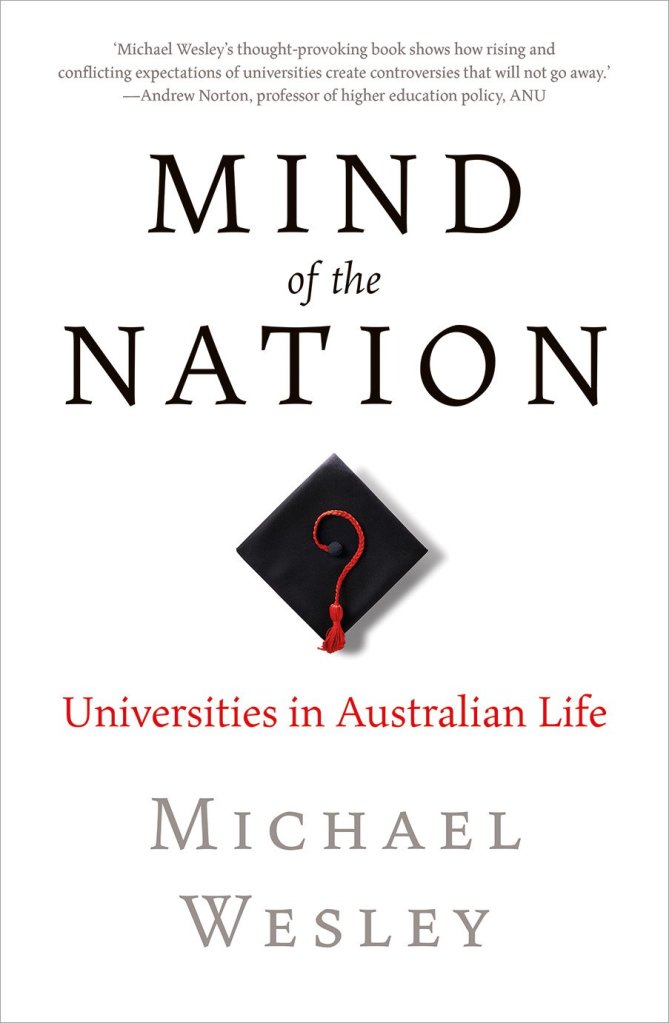
I blurbed Mind of the Nation, Michael Wesley’s new book on universities in Australian life, with the statement that it ‘shows how rising and conflicting expectations of universities create controversies that will not go away’. His book is about the cultural and political position of universities rather than higher education policy as such, although policy provides evidence of how politicians and voters see universities.
University administrators – Wesley is a deputy vice-chancellor – are at the centre of these controversies, blamed by all sides for whatever is wrong with universities. Mind of the Nation explores why universities receive so much critique and so little love or (from a university perspective) public funding, despite many successes and contributions: life-changing experiences for students, moving from an elite to a mass higher education system, creating a new export industry, large increases in research aimed at solving practical problems, and engagement with local communities.
Wesley asks why Australians admire the successes of their sporting teams, musicians and actors but not universities.
Contested missions
Universities are in some respects more like governments than businesses or other not-for-profits. Criticisms of universities are not just about their competence or the people who lead them, but also about what the organisation should be doing in the first place. Doing well in an disputed objective won’t satisfy a critic; it might just enrage them further.
Disputed objectives in turn arise, at least in part, due to the long history of universities. Over time universities have accumulated functions in practical tension with each other. These added functions have attracted new funding sources, public and private, but this money comes with accountability requirements in tension with historical modes of university governance.
Intrinsic versus extrinsic goals
Many university tensions involve conflicts between intrinsic goals pursued for their own sake and extrinsic goals when the activity is aimed at some other purpose.
Academics tend to have high intrinsic motivation for intellectually stimulating work, including knowledge for its own sake (‘basic research’). They see this as the higher purpose of universities. Funders both public and private, however, often have more specific goals and hence the bias towards applied research.
Most students want jobs, and over time the professional faculties have enrolled larger shares of all students and universities have placed more emphasis on ’employability’. But academics still believe that a university education is not just training, that it should create a more intellectually rounded and perhaps morally improved person.
Wesley has some interesting reads on university architecture, one of which is cloisters in the older universities, as places drawing on the design of monasteries ‘to enable quiet, contemplative discussion and thought free from the demands of the mundane world’. More recent buildings look like the offices that students will work in during their professional careers, the now dominant purpose of universities reflected in their physical appearance.
University administrators face this tension between objectives, trying to get academic staff motivated by their own research to meet the goals of students and external funders.
Self-governing versus accountable
The task of university administrators is made more difficult by long traditions of academics having a substantial say in university governance. Academics criticise ‘managerialism’ rather than just ‘the management’, because they object ideologically to being managed at all, rather than just like other workers complaining about how they are managed.
As Mind of the Nation observes, the growth of management power in universities over the last few decades was partly a response to governments wanting universities to contribute more and looking for levers to achieve that.
This creates another tension with deep historical roots, between university autonomy and public accountability. The ethos of strong university independence from government dates from centuries before public universities were established, or governments were expected to provide social services to their citizens, or higher education was important to more than a tiny minority of the population. Governments cannot hand over billions of dollars each year without any say in how the money is used, but universities want to maintain their autonomy.
One somewhat paradoxical aspect of higher education politics in Australia is that the people who most favour public funding of universities are also the most resistant to elected governments, as representatives of the public, setting a broader set of public objectives for universities than academics would pursue without steering from above.
Elitism versus equity
Another paradox of universities, especially in the Group of Eight institutions, is a preoccupation with excellence and status seeking that possibly exceeds any other sector – the obsession with super-selective ARC and NHMRC grants, with top-tier journals, with citations, with rankings, and more discreetly these days with ATARs – combined with the egalitarian politics of many academics and a commitment to ‘equity’.
Mind of the Nation laments a lack of progress on equity, but the strong associations between socioeconomic status and academic performance mean that excellence and equity objectives can only ever be partially reconciled. The status-seeking universities will always look hypocritical on this.
This elitism-equity tension has a right-wing version as well, which is that equity measures go too far and cause academic standards to decline.
Loyalty versus globalism
As Mind of the Nation reminds us universities have always been international; Latin was once the university lingua franca that English is today.
Universities have unusually international workforces. In the early days Australian universities relied heavily on British academics. According to the 2021 Census nearly half of academics in Australia are migrants, compared to 32 per cent of all employees.
Research is global, with one study claiming that over half of academic articles published by Australian academics have a co-author from another country.
The desire to be published in highly ranked international journals discourages academics in Australia from pursuing Australian topics that won’t interest people in other countries.
Universities have thousands of agreements with other organisations in other countries for various forms of collaboration and exchange.
Over the last few years the level of international collaboration, especially with China, has become a major political focus. There are now guidelines to counter ‘foreign interference’ and the foreign affairs minister can veto some university foreign agreements.
And over the last 30 years universities have become reliant on fee-paying international students, with the Group of Eight institutions using super-profits from high fees to pursue research output and status.
Universities face regular criticism for taking international students willing to pay the exorbitant fees charged but with insufficient English language ability.
For decades international student recruitment has created concern that domestic students might miss out. As long ago as 1966, Wesley reports, Cabinet considered but rejected a proposal to freeze international student numbers for this reason.
Most of this would not matter if universities were private institutions. But most of them were established by governments for public purposes.
Conclusion
Some fateful policy decisions – to concentrate so much of the nation’s public research investment in universities, to let teaching-research institutions dominate higher education – exacerbated these tensions but they were inevitable given the evolution of Australia’s economy and welfare state after WW2.
I am perhaps more optimistic than Wesley that the tensions are manageable. He sees transactional attitudes towards universities as a problem, but transactional relationships have vastly increased both public and private investment in universities, from which universities take a cut to pursue objectives their funders are not so interested in.
It’s untidy and a constant source of controversy. We probably should support higher education institutions with clearer and fewer missions. But in a muddle-through way the university sector has adapted a medieval model to contemporary circumstances.
 Andrew Norton
Is blurb a verb, and if so, is this yet another sign of the problems of universities?
The rise of management in universities is quite complex, not just about external demands. In the ‘good old days’, intrinsic motivation of the few scholars was enough and there was essentially no central management except of hotel services, somewhat like hospitals.
This is not the 21st century world.
Stephen
LikeLike
Thanx for a most interesting review.
I wonder how much Wesley locates the purposes of Australian universities within other countries’ views on the purposes of their universities, particularly in view of his claim you noted that ‘universities have always been international’.
I would also consider the purposes of universities in relation to other organisations which serve similar or complementary roles, such as colleges and public research organisations.
For example, I suggest the USA has a less ambivalent attitude to universities’ elitism because much of the equity mission is relegated to colleges which are articulated within higher education, and that many continental European countries are less insistent on universities’ research being more applied because they allocate more funds to government research agencies to do applied research and development.
LikeLiked by 1 person
Thanks for this review, which highlights the complexity of today’s “multiversities”. And for some the mix of aims and expectations may recall Clark Kerr (back in the 1960s) on the apparent impossibility of the multiversity leadership task: “The university president … is expected to be a friend of the students, a colleague of the faculty, a good fellow with the alumni, a sound administrator with the trustees, a good speaker with the public, an astute bargainer with the foundations and the federal agencies, a politician with the state legislature, a friend of industry, labor and agriculture, a persuasive diplomat with donors, a champion of education generally, a supporter of the professions … a spokesman to the press, a scholar in his own right, a public servant at the state and national levels, a devotee of opera and football equally … No one can be all of these things. Some succeed at being none…”
LikeLike