Peter Noonan was a rare person with expertise across vocational and higher education, and an even rarer person who made significant policy contributions to both. Sadly he passed away in 2022 at the age of 67.
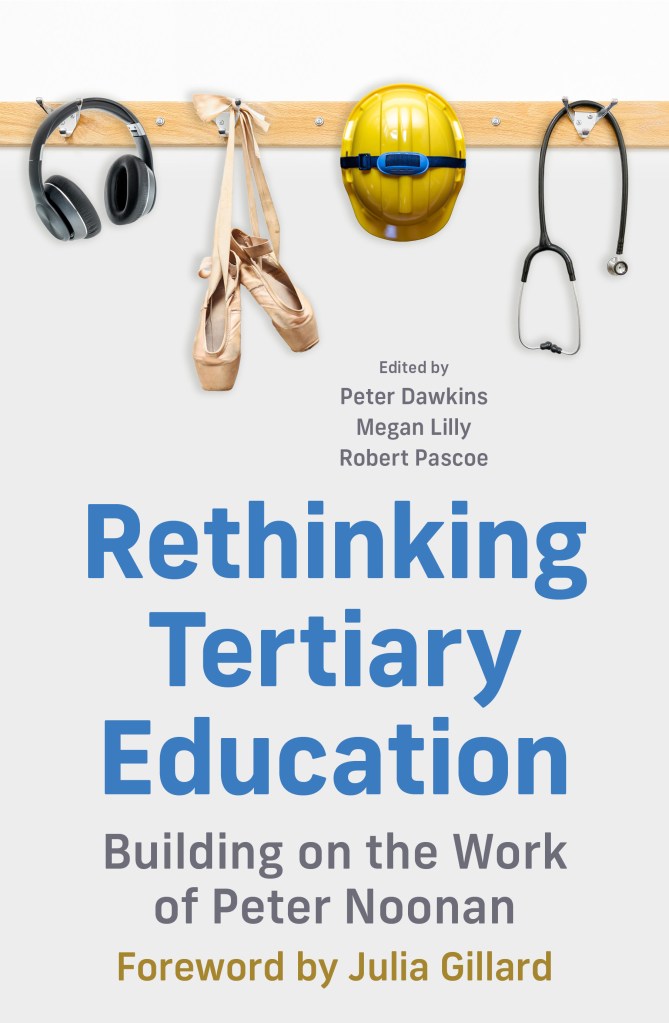
Rethinking Tertiary Education, co-edited by Peter Dawkins, Megan Lilly and Robert Pascoe, with sixteen others as co-authors, is billed as ‘building on the work of Peter Noonan’, and does so by exploring ways of making the component parts of Australia’s formal education sector – especially higher education and vocational education, but also schools – work together more smoothly than now. Pascoe also contributes an interesting biographical chapter on Noonan.
For historical and political reasons the vocational and higher education systems in Australia have quite sharp dividing lines in the nature of the qualifications they deliver, how they are funded, how they are taught, and with some exceptions the occupations they support. The book also looks at school credentials, especially the idea that they don’t measure all they should.
Australian Qualifications Framework
A major theme of Rebuilding Tertiary Education is the role of the Australian Qualifications Framework, which defines tertiary education’s regulated qualifications, from a Certificate I through to a PhD. Peter Noonan chaired a review of the AQF, which reported in 2019. The current AQF ranks qualifications at 10 levels, using criteria on the level of knowledge, level of skill, and the application of these knowledge and skills.
Sally Kift and Megan Lilly’s chapter on the AQF points out that the current system ranks by knowledge complexity, with an unfounded assumption that skills and application increase in the same way. On degree completion, however, most university graduates are novices at applying their knowledge, while students completing courses in the competency-based vocational education system should have basic proficiency in the occupation matching their training.
In their prologue, the editors draw on an OECD categorisation of different types of knowledge: ‘know what’ – knowledge of facts, ‘know why’ – scientific knowledge of the principles and laws of nature, ‘know how’ – the skills or capability to do something and ‘know who’ – information about who knows what and who knows how to do what. They argue that higher education needs more ‘know how’ and ‘know who’, while vocational education students need more ‘know what’ and ‘know why’.
Relatedly, many people have argued over the years that vocational education should be less tied to specific occupations. Providing vocational education students with more generic skills would better prepare them for change in their initial chosen occupation, for employment in different occupations, and for smoother transitions to higher education.
School learner profiles
Drawing on an earlier paper, Sandra Milligan, Anthony Mackay and Noonan discuss ‘learner profiles’ designed to give a more holistic account of a school student than just their academic results.
Learner profiles are sometimes presented as an alternative to ATAR. In the ATAR debate I generally support its continued use. This chapter shares a criticism I make of current ATAR alternatives – that they can be more about university recruitment than student success. There is a lack of publicly-available evidence that ATAR alternatives have student success predictive power above-and-beyond simply reusing data generated by the school system (ATAR, results in specific subjects, etc).
The ATAR alternatives make university admissions more confusing, time-consuming and expensive – undermining a relative strength of Australia’s higher education system in offering clear and efficient admissions processes compared to the UK and especially the USA (my view, not Milligan et al.).
Putting the university admissions debate to one side, I can see potential benefits in learner profiles. Schooling has more varied goals than tertiary education, including general personal development. A learner profile could include general capabilities such as communication skills and problem solving, and what (in a table) the authors call ‘personal virtues’ such as acting ethically, loyalty, honesty and reliability. Every ATAR release season Year 12s are reassured that they are more than their ATAR, which is obviously true but not easily conveyed in a transcript confined to academic results.
But I have reservations about aspects of the learner profile idea. While some ‘general capabilities’ such as communication skills, literacy and numeracy can be assessed against objective metrics, how would personal attributes be rated in ways that are not subjective and are meaningfully comparable? And for teenagers whose school attitudes and behaviour do not reflect the adults they will in time become, could a negative ‘learner profile’ be an obstacle to moving on? Students who play up at school could look much better later on, with more maturity and workplaces that match their interests and skills more closely than classrooms.
Funding
Several chapters cover tertiary education funding, which is messy in both vocational and higher education but with vocational education the more untidy of the two. This reflects the fact that in vocational education the states as well as the Commonwealth are major funders, and that vocational education has far greater private sector involvement, both as education providers and clients (as employers contribute to course costs more often in vocational education).
A chapter by Noonan and Sarah Pilcher lists various options for one or other of the states or the Commonwealth having clear responsibility for different qualifications. They also discuss the idea of a student entitlement, a concept also mentioned in the Universities Accord interim report last year.
Income contingent loans
A chapter by Bruce Chapman, Tim Higgins, and Lucy Yunxi Hu discuss extension of income contingent loans in vocational education. While vocational education courses are usually cheaper than higher education courses, with free courses also available, the limited coverage of the VET Student Loans program means upfront payments for many students who are charged fees.
The chapter estimates likely loan subsidies for different courses. Especially for women, these can be quite high in some courses. In principle income contingent loans should apply across the tertiary education system. But even without the corruption-driven cost blow-outs of the former VET FEE-HELP scheme these loans would come at a high cost to taxpayers.
Setting prices
A chapter by Peter Dawkins, Janine Dixon, Keith Houghton and Chapman again looks at price setting in tertiary education and the issue of who should pay. Price setting is a likely big issue in 2024, due to expected Universities Accord recommendations for reform of the student contribution system and for a levy on international student fees.
The Dawkins et al. chapter endorses the idea of a regulated overall per student funding rate (i.e. student + government contribution) being equivalent to the ‘efficient price of education’, with at most a ‘modest contribution’ to research and low profit margins (subject to a possible exception noted below). In principle this is similar to the existing Job-ready Graduates policy on funding rates, although this chapter’s authors are not convinced by the JRG costing methodology.
While there should be a relationship between teaching costs and the total funding rate, there are arguments for including a premium on top of the designated efficient cost in the regulated price:
- An efficient, low-or-no profit funding rate assumes a homogenous product with economies of scale, precluding lower student:staff ratio versions of the same course (except maybe where there are loadings for academically disadvantaged students). But should there be room for small-class teaching methods? Or sustaining niche courses that do not enrol enough students to break even? I think so – at least at a system level universities should cover a very wide range of fields of knowledge. While per student funding rates have been formally part of the system since 2005, universities can, and should be able to, treat their teaching revenue as a block grant, using profits in some areas to support activities relevant to their overall mission that are not fully self-funding.
- If (as I hope) we don’t go down the path of a centrally micro-managed student funding system there is a potential role for profit in encouraging universities to enrol more Commonwealth-supported students.
- Like previous work on a teaching-only funding rate, this chapter does not consider the practical staffing consequences. The structural separation of teaching and research public funding over the last 30 years has put huge strains on the teaching-research employment model, and is one reason why universities use casual and fixed-term employment far more than other graduate employers, which in turn makes academia a relatively unattractive career. While I support more career-track teaching-only academic jobs, realistically the opportunity to explore intellectual interests is what attracts many people to academic work. In some cases, research time is part of a salary package rather than the pursuit of excellence or industry innovation claimed by research policy. Partly linking research money to EFTSL makes sense from this perspective.
Some of these concerns are addressed in an idea to give universities some discretion to increase fees above the regulated cap, but using a taper system to reduce subsidies when they do so. That is intended to deter fee increases, but means that when fees are increased students would be charged more than the desired revenue gain to offset subsidy losses.
Who should pay?
The Dawkins et al. chapter also considers how fees should be set in a fee-regulated and subsidised system. They mention the economist’s idea that subsidies are justified by the public benefits of education, that ‘without public subsidy there would be an under-investment in higher education’. They reject this approach because the public benefits are too hard to calculate, but in my view the issues are more significant than just the complexity of identifying and valuing these benefits. There is a larger problem with the theory.
With some temporary downturns, participation in post-school education education has been increasing around the world for decades. As I noted in another post, this has happened regardless of funding system, but with the lower-subsidy systems having slightly higher participation rates – the opposite of what we would expect if the economist’s theory was right.
Increased participation in education is driven by social expectations, intrinsic interest in the field of study and related careers, and the financial benefits often associated with qualifications. Tuition subsidies increase the net financial benefit to students/graduates, but only rarely will this increase be large enough to shift a cost-benefit analysis that already takes into account job prospects and potential salary levels. Financial incentives also have limited capacity to shift course choices outside the student’s range of interests. These issues are why Job-ready Graduates student contribution changes were never likely to make a big difference to patterns of demand.
The main practical issue is a cash flow one; post-school education is best done in early adulthood when most people cannot personally afford to pay for full-time study and families have varying capacity and willingness to help. Subsidies and student loans are the solutions, with their relative use varying according to the overall tax and welfare system in each country.
The chapter suggests various ways of setting student contributions – same subsidy for everyone, with fees topping up the rest of the total funding rate; the subsidy being a percentage of overall costs, with possible differences in the percentage between courses based on ‘transparently determined reasons’; and a flat fee with the government paying the rest of the funding rate.
In a 2022 paper on student contributions I argued for setting them with an eye to their practical and political consequences. Practically the main consequence of fee levels with an income contingent loan is the repayment period, with its implications for the debtor’s living standards and the government’s interest subsidy costs and risk of bad debt. That supports student contributions with some link to expected earnings.
Politically all student charges are contentious, but the first two ideas in this chapter, which link fees to teaching costs, create what I call the nurses and lawyers problem – any system that leads to medium teaching cost nursing students paying more than low cost law degree students is immediately in political trouble. The chapter mentions nursing as one of the potential exceptions to the fixed share of teaching costs model, but the expected earnings model directly deals with the issue/intuition behind concerns about high fees for nursing students, rather than creating exceptions to a general rule.
Conclusion
I have not discussed all chapters in Rethinking Tertiary Education, but it is interesting throughout, even where I do not agree with it. It is a worthy tribute to Peter Noonan and his substantial contribution to Australian tertiary education policy.
 Andrew Norton
Thanx for this interesting review.
I was particularly interested to read your support for the continued integration of teaching and research roles for may academics to offer attractive opportunities to explore intellectual interests.
Perhaps another attraction of academia is its considerable discretion over the construction of work, which is being steadily eroded by (government) accountability and (institutional) managerialism.
LikeLike