The official release yesterday of the CPI-indexed Job-ready Graduates student contributions for 2025 has prompted questions about what impact the JRG price increases have had on enrolments.
With arts, business and law student contributions to hit nearly $17,000 a year in 2025 – with our bout of inflation having increased them from $14,500 in 2021 – students would be wise to think about whether this is a sensible investment. That’s $50,000 for a basic 3 year degree or $85,000 for common combinations like arts/law or business/law.
On the other hand, as I have argued, students follow their interests while keeping an eye on which courses within their cluster of interests would have the best employment and salary outcomes.
The most sophisticated work to date, using NSW data to 2021, found small effects in the expected directions.
Using simple trends in subjects taken, this post will look at domestic commencing EFTSL by discipline in the 2010-2022 period, drawing on the annual commencing load spreadsheet produced by the Department of Education. This does not distinguish between CSP and domestic full-fee students, but it is the best I can do with publicly available data.
Because I am comparing fields with very different absolute enrolments, I have converted them to an index, with 2010=1. So an index of 1.1 in a subsequent year would mean 10% more EFTSL, and an index of .9 would mean 10% fewer EFTSL.
It’s also important to note that numbers move for reasons that have nothing to do with relative preferences for different subjects. In 2021 there was an increase in commencing bachelor EFTSL, probably because COVID deprived people of other options, while in 2022 there was a large decline, due to fewer students and a larger proportion of part-time students. To provide context, with first chart below I have the index for all domestic commencing bachelor EFTSL.
Humanities & social sciences
Most attention has been the plight of humanities and social science students, as their student contributions more than doubled in most cases and because their HELP repayment prospects are relatively poor. This group is a test of price theories because foreign languages and English literature had student contribution cuts. Simple economic theory would say that demand for language related subjects would go up, and demand for subjects in other fields would go down.
The chart below shows, however, that the language subjects have shared in the general decline of arts-related subjects. Contextual factors here are universities reducing the number of languages they teach and the fact that, while a student might want to major in languages, for an arts degree they will probably do other subjects with high student contributions.
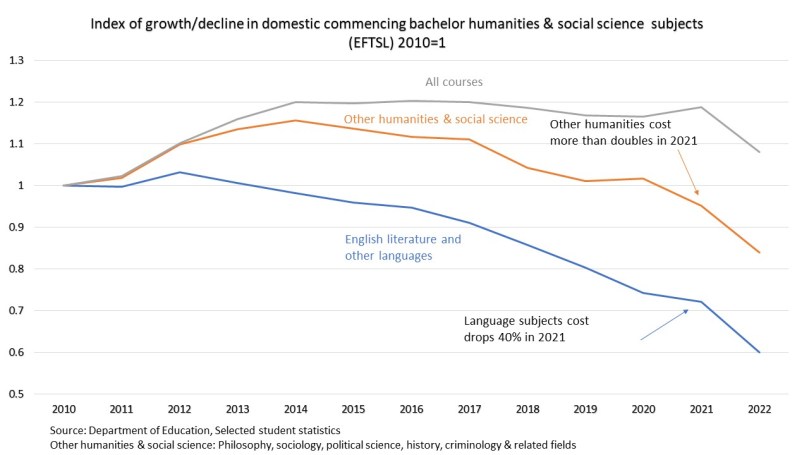
The more important thing we can see in the chart above is that these fields are in a structural decline that starts long before Job-ready Graduates. I offered some theories on why last year. It’s hard to say what is JRG and what is just a trend continuing.
What should we make of reports of some universities saying their arts enrolments are up? It’s plausible that these changes had less effect on school leavers in Gof8 universities than generally. But another factor may be the role of psychology, which shares the ABS ‘society and culture’ category with humanities and other social sciences, and could be in some university counts of social sciences.
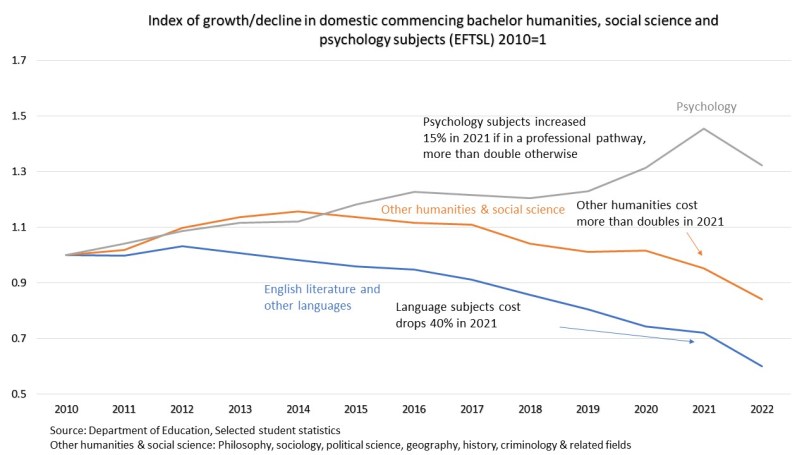
Psychology – or behavioural science as it is called in education statistics – is a mixed category. It’s better placed in health if on a clinical track, and subjects in clinical track course had a lower student contribution increase than did psychology subjects in other courses. Social psychology, by contrast, is more of a social science; although not included with other social sciences in these charts.
As can be seen in the chart below, psychology did not suffer the general decline of other fields on the chart, and boomed in 2020 and 2021 – maybe the lockdown focus on mental health? – before sharing in the general enrolment decline of 2022.
Other fields with increased student contributions
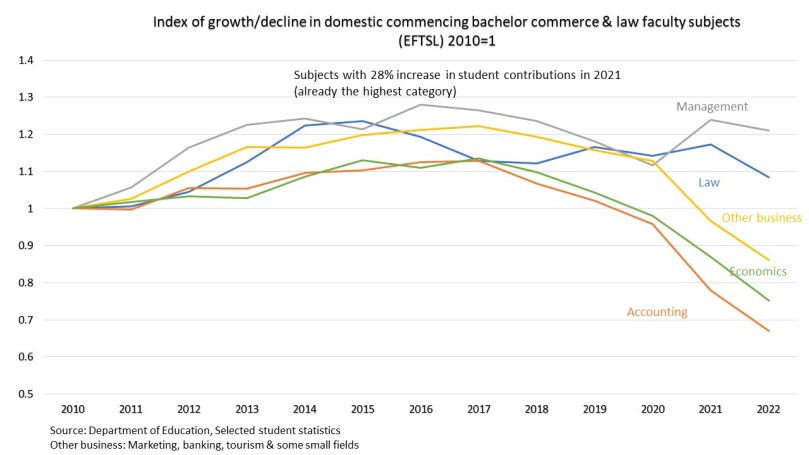
Law and business subjects already had student contributions in the highest band before JRG, but were hit with another increase. In the first JRG year, 2021, law was stable and general management subjects increased, before both joining the general 2022 decline. But commerce faculties have taken a big domestic commencing bachelor hit since the late 2010s, led by accounting and economics. Again, it is hard to say what is JRG and what a longer-term trend continuing.
Subjects with lower student contributions
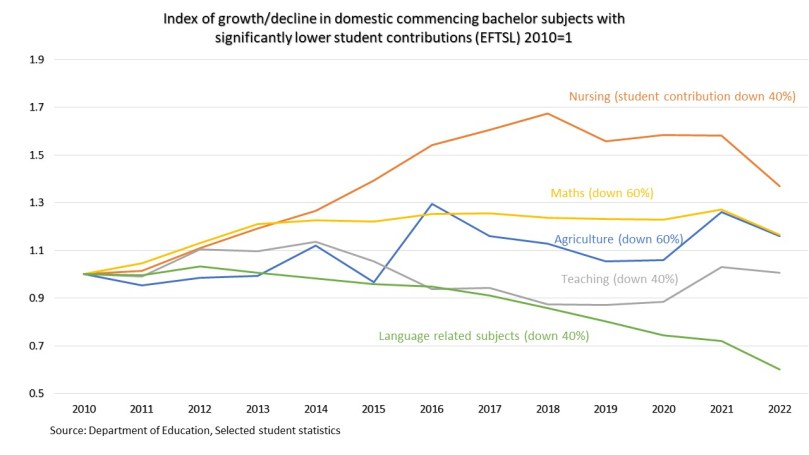
All these increases in student contributions were partly to fund cheaper student contributions in government-favoured disciplines. As the chart below shows, aside from the language-related subjects we are not seeing the enrolment carnage of arts or business. In the first year of JRG, nursing and maths were stable while agriculture and teaching grew, before all were to varying extents affected by the general decline of 2022 (due to teaching reporting errors caused by one university, it declined by more than shown). Applications for nursing in 2021 had been well up, but perhaps supply-side constraints on clinical training weakened the sector’s response.
Conclusion
It’s important to monitor these trends, but the core objection to JRG is that it is leaving some students in life-changing debt for inadequate reasons. The government should have moved before now to reduce at least arts student contributions, even if a long-term, all-discipline pricing system is postponed to the ATEC period.


Whatttt!!!the 2022 data is out!Sent from my iPhone
LikeLike
I should be writing about the 2023 data…but probably not until December based on last year.
LikeLike