Earlier this month I wrote a post showing that higher education enrolments at age 19 years, and the domestic participation rate at age 19, were down in 2023 compared to 2022.
This post explores possible reasons for this downward trend.
The teenage job market
One explanation of declining enrolments at age 19 is higher education’s counter-cyclical relationship with the labour market. At the margins, some people prefer work to study, but study when work is not available. The higher education participation and full-time employment rates in the chart below match this theory. Higher education participation increased after COVID-related full-time job losses in 2020 and then decreased as job opportunities returned.
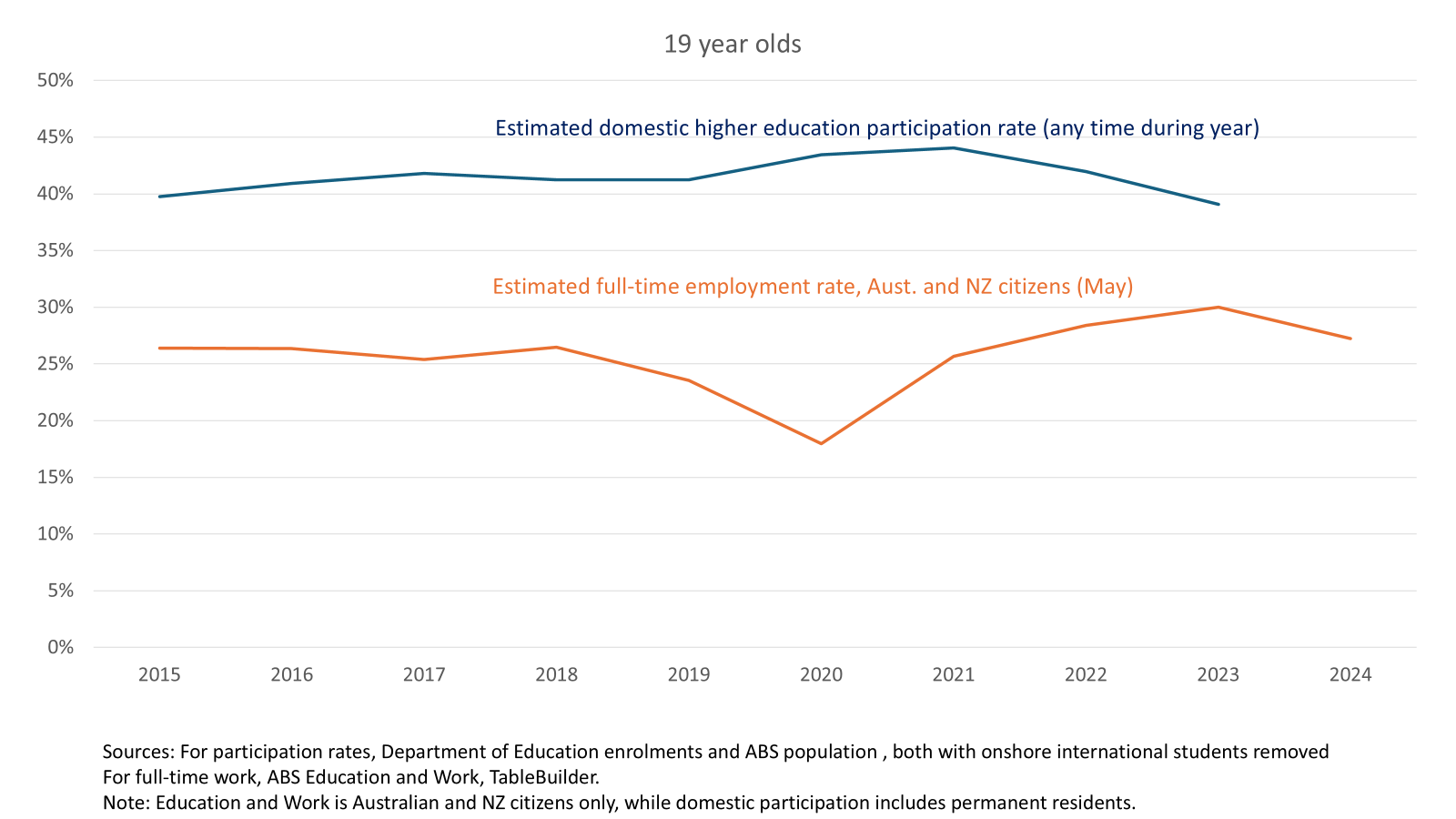
Education and Work TableBuilder supports analysis of smaller sub-groups than the standard ABS data releases, but with an increased risk of rogue results. Broader 15-19 year old statistics, however, confirm 2023 as a very strong year for full-time teenage employment. Both sources show that teenage full-time jobs grew strongly post-COVID and then softened in 2024, while remaining good compared to the 2010s.
Academic preparation
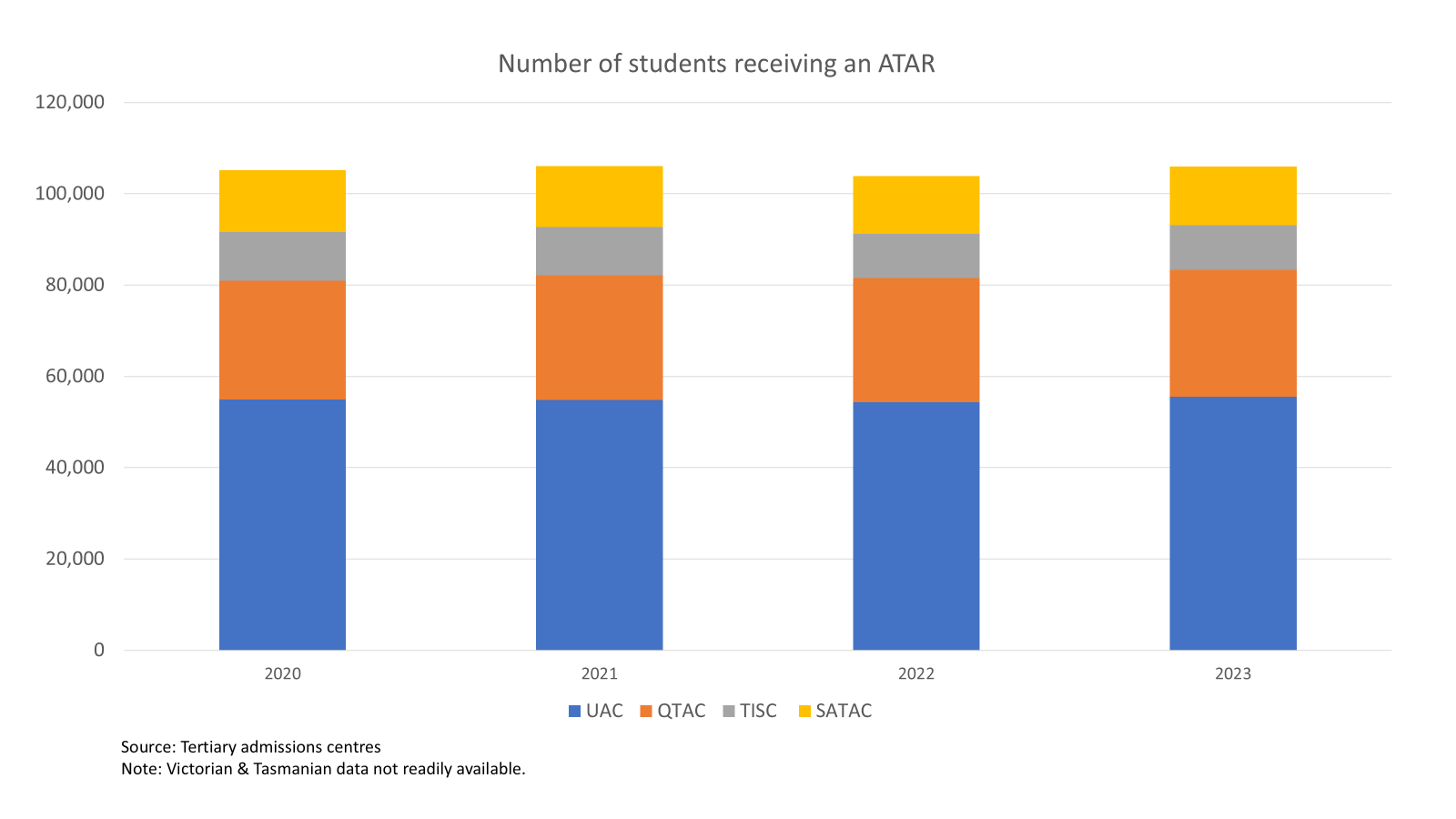
Statistics on the school to post-secondary transition are not well-organised. There is no national trend data on how many students receive an ATAR – which signals that Year 12 students have taken subjects that put them on a university track. The chart below lacks Victorian and Tasmanian data, but in the other jurisdictions the early 2020s number of Year 12 students with an ATAR is fairly stable in the 104-106,000 range. The 2021 ATAR numbers, which are most likely to align with the 2023 participation figures, were the highest in these years. I don’t think an underlying shortage of ATAR students explains a lower participation rate.
Longer-term negative trends evident in NAPLAN results, exacerbated by COVID-related disruptions, may mean that school leaver cohorts in recent years have lower academic achievement levels than earlier cohorts. If so, a smaller share of the cohort may feel confident about going on to university.
Vocational education
Direct comparison of vocational and higher education participation is not easy. Vocational students start at earlier ages – the modal age for vocational Certificate III or above enrolments is 17, compared to 19 for undergraduate courses. Many vocational students complete courses before they turn 19.
My workaround is to count all students aged 19 or less, which biases the aggregates in favour of vocational education but shows trends for this school age/school leaver group. We can see that vocational education has trended up while higher education has trended slightly down.
Apprenticeship and traineeship numbers, which include training in the workplace, are reported separately. While higher education enrolments have a counter-cyclical relationship to the labour market, apprenticeships and traineeship enrolments are pro-cyclical with conditions in industries that use them. If there is little for an apprentice or trainee to do a business will not take them on or take fewer; if there is a lot of work apprentices and trainees are more attractive to employers.
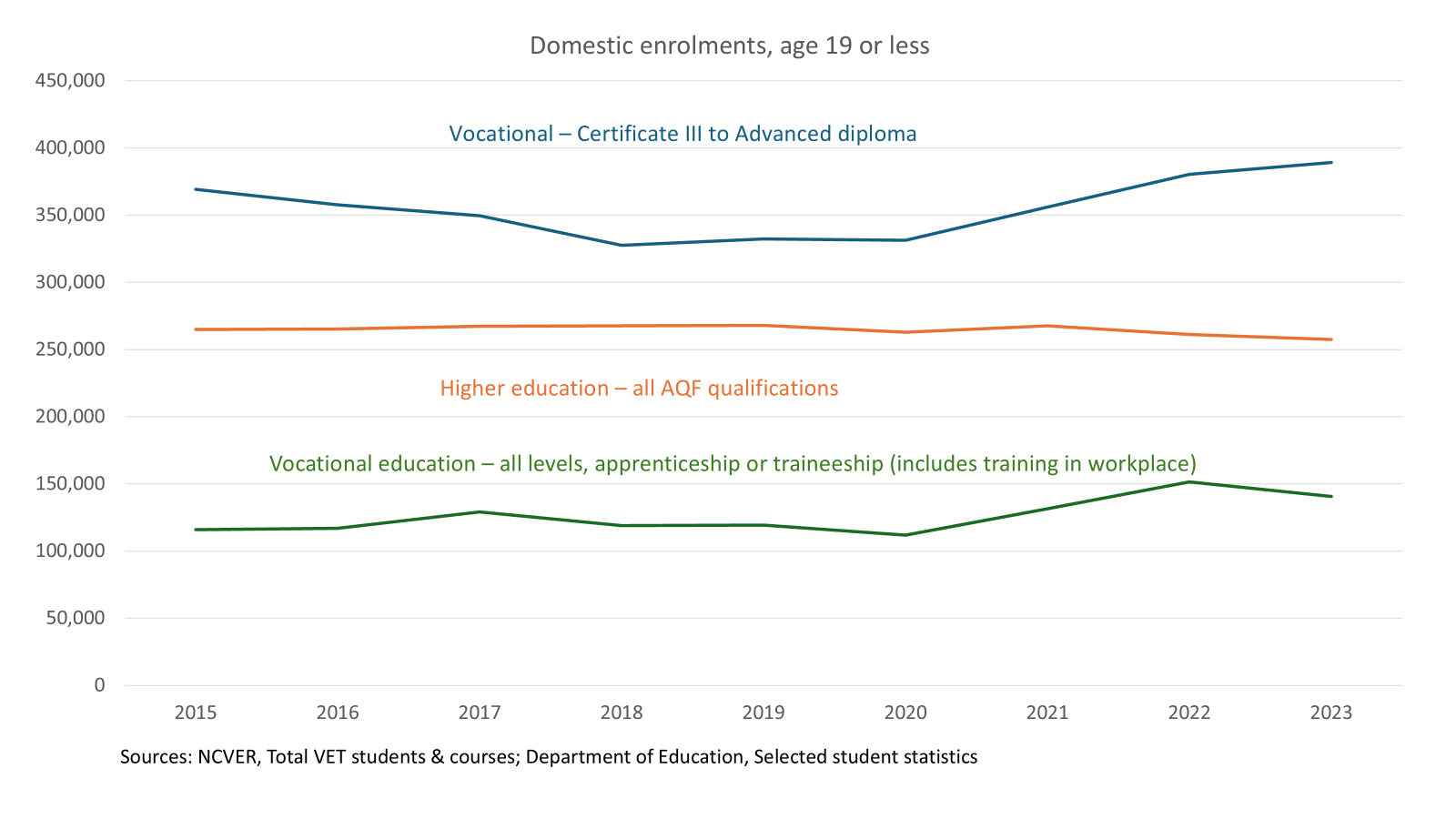
The apparent trend towards vocational education may not last. An economic downturn would reverse the cyclical influences. Vocational education policy changes constantly in ways that can push enrolments up or down, without this necessarily reflecting stable trends in student demand or the labour market (the 2015-2017 decline in the blue vocational line is partly due to the end of VET FEE-HELP).
But at least in the post-COVID period, vocational education demand and supply influences seemed to have aligned in ways that, for some young people, gave it the edge over higher education.
Conclusion
Two of my three potential explanations for declining university participation participation – more young people working full-time and more in vocational education courses – provide plausible and broadly positive explanations for why the school leaver higher education participation rate is down.
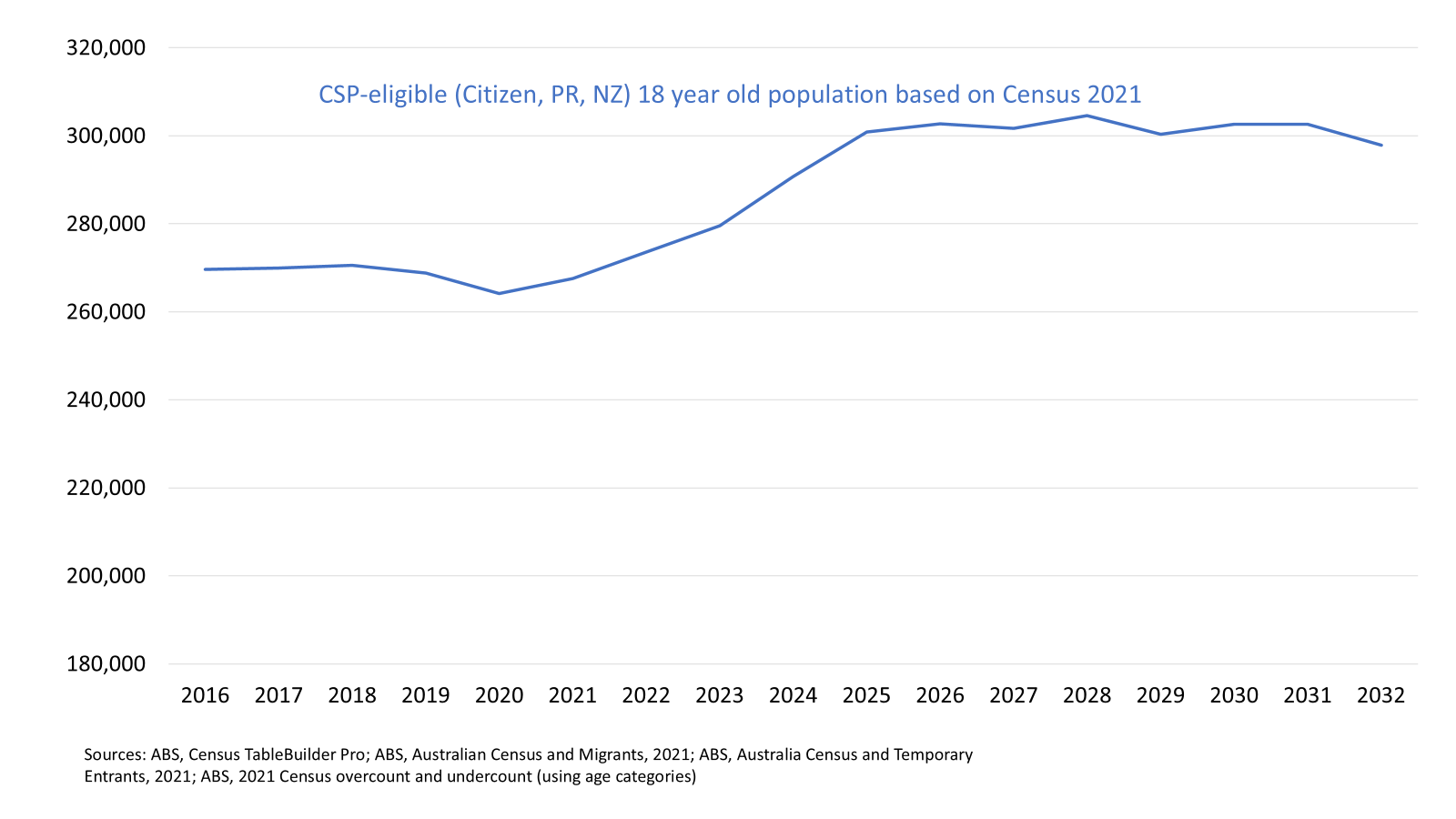
I’m still confident that the underlying school leaver population is in a growth phase, with conservative projections in the chart below. So the participation rate could remain below its peak and still deliver a higher absolute number of school leaver university students than in recent years. But there is no sign yet that we are on track for the participation and attainment increases envisaged by the Universities Accord.
 Andrew Norton
Thanks for this, Andrew.
On the topic of ATAR participation, perhaps it isn’t accurate to describe it as “declining” – but I would certainly say it is gallingly low in WA, and QLD also warrants some examination for it’s ATAR participation rate as an east coast state?
I think many in the sector have a feeling that something is “off”, but can’t quite pinpoint exactly what it is because the data is neither clear, nor consistent on the topic. Correlation doesn’t equal causation, but in the absence of great insight it could be inferred that if less than 50% of the state’s secondary students are opting out of ATAR at Year 10 – they are probably also considering University as being out of their consideration set.
LikeLike
I’d need to do more work to understand these differences, but combining the ATAR numbers with ABS schools Year 12 numbers we get NSW 73% with an ATAR, SA 70%, QLD 52%, and WA 37%.
However these will to some extent be affected by systems with significant VET in Schools where those on the vocational path remain counted in the Year 12 figures, and those where students are more likely to exit school prior to Year 12 and enrol in vocational education separate from VET in Schools.
LikeLike
Perhaps? there is/will be a +ve nudge for VET with Fee Free TAFE (started Jan 23) and corresponding -ve nudge with marginally greater ‘recognition’ by those considering uni. of ‘large’ future debt in the HE track. Making jobs/work more attractive.
LikeLiked by 1 person