I have an article in The Conversation this morning on why demand for undergraduate higher education has been weak in recent years. I looked at school leavers in this July 2025 post. This post expands on the issue of mature age demand.
Applications
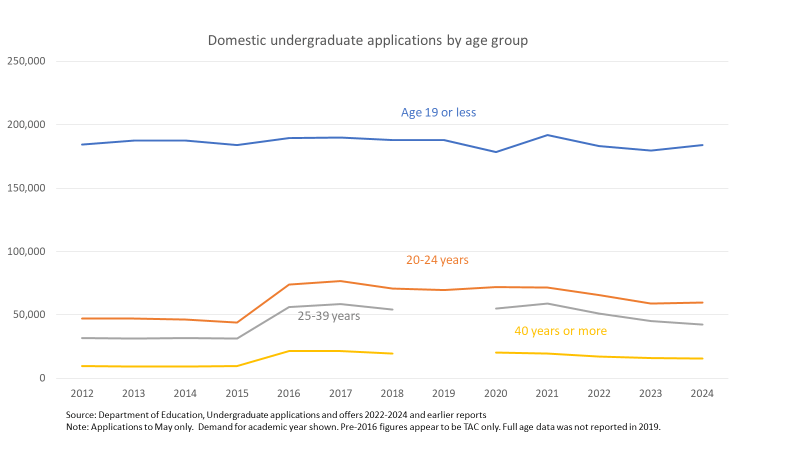
Demand from school leavers is soft but in 2024 was down only 3% on its 2017 peak. But demand from 20-24 year olds is down over the same period by 22% and for the 25 years + age group it is down by 27%. In absolute numbers, demand from school leavers fell by 6,057 applications compared to 44,545 fewer applications from mature age applicants.
Commencing enrolments
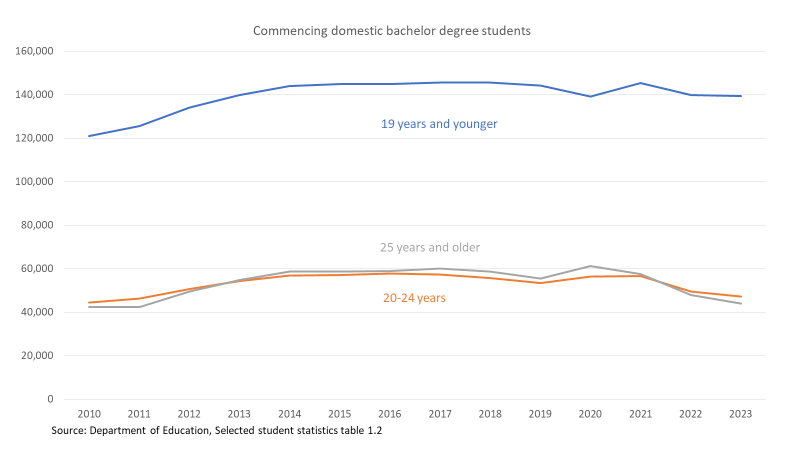
For commencing bachelor degree enrolments 2017 to 2023, unsurprisingly given the applications data, demand has also fallen by the most in the older demographics.
School leaver commencing enrolments are down 4% while the figures are 18% for the 20-24 years group and 27% for the 25+ group. Overall 6,216 fewer school leavers but 26,276 fewer mature age students.
Counter-cyclical enrolment patterns
An applications/enrolment spike in the COVID lockdown years provided evidence for one side of the counter-cyclical theory of enrolments – that more people study when jobs are hard to find. Weak labour markets reduce the ‘opportunity cost’ of education, such as forgone work and wages.
Conversely strong labour markets increase the opportunity cost of study. On average this is especially so for older people, due to their wage premium from previous labour market experience. With a strong labour market since 2022 economic theory predicts that, all other things being equal, enrolments will decline.
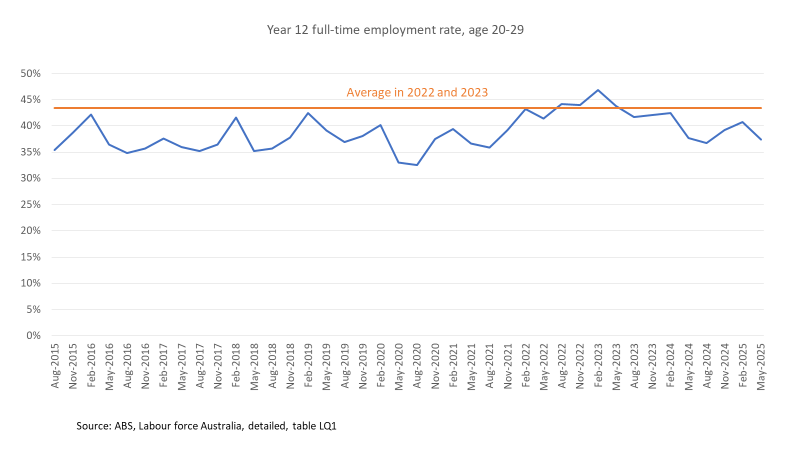
In the chart below we can see full-time employment for 20-29 year olds who have completed Year 12 but have no degree was at its lowest level in 2020, in the 2015-2025 period for which we have education levels in the labour force survey. In the initial post-COVID lockdown period, however, we can see that it was much easier than it had been in the 2010s to get a full-time job with a Year 12 qualification only.
The 2020s has provided evidence in favour of the counter-cyclical theory of higher education enrolments.
But does a cyclical theory of enrolments fully explain declining mature-age commencements?
Cohort prior education attainment effects
In the non-school market cohort effects are also likely to be keeping enrolments down. As school leaver higher education participation rates increased with the demand driven system, jumping from 30% enrolment rates at age 19 in 2007 to 40% in 2016, a larger proportion of the people wanting a university education already had it by their early 20s. On a cohort theory, this leaves a smaller potential market of mature age students.
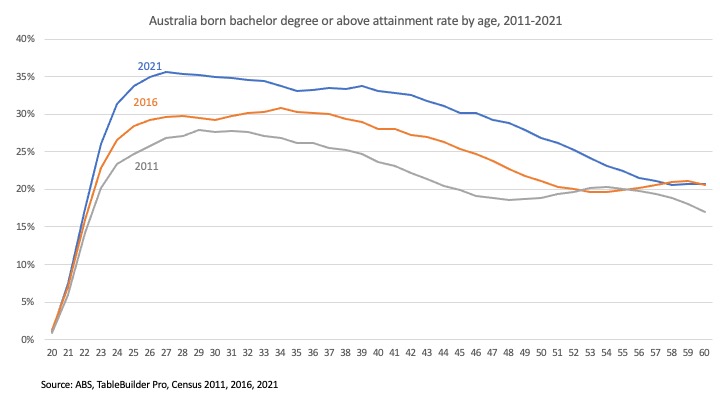
My plan to examine this through successive census years faced some problems. Migrants typically have much higher education levels than people born in Australia. They significantly affect overall attainment rates. To avoid their impact on the data I restricted my census analysis to people born in Australia (below). This shows the expected bachelor degree or above attainment increases for people of a given age at the five year census intervals.
Mid-20s attainment rates were 8-9 percentage points higher in 2021 than they had been in 2011.
Conclusion
The decline in mature-age enrolments is partly cyclical. Full-time employment levels have declined recently for 20-somethings without degrees, which may be good news for universities.
However, there is also a structural element to recent weak demand. The higher share of 20-something and older people who already have a degree will limit potential demand. This is bad news for universities that have historically relied on mature-age students.
On a more positive note, with more bachelor-degree graduates in the population, the potential market for postgraduate study is higher, although it is also subject to cyclical swings.


Thanks Andrew, as ever.
One other factor which has potentially driven these trends is that between 2017 and 2023, the Australian government loosened the restrictions on Commonwealth supported funding for sub-bachelor courses.
Prior to 2020, these courses were treated as ‘designated courses of study’ while bachelor degrees were ‘non-designated courses of study’; these represented two separate funding pools and the effect was significant barriers for universities to trade their subsidised student places between bachelor degrees and lower level courses.
As soon as these fairly arbitrary funding barriers were removed, universities expanded their sub-bachelor offerings and more students chose them. The number of domestic commencing students in sub-bachelor courses at public universities (table A) jumped, from about 12,000 per year in the period 2017-9 to 20,000 per year in 2020-23. This is about a quarter of the size of the overall decrease in bachelor commencements that you quote in this piece, so it seems like this makes a material contribution.
So some of the explanation for reduction in bachelor demand (potentially applying to both school leavers and older audiences) in the last decade is down to substitution between bachelor and sub-bachelor qualifications, enabled by a gentle liberalisation of university funding arrangements under the previous government.
LikeLike
Could Australia have passed Peak Degree? Perhaps we have passed the point where everyone who needs a degree has one. If employers instead demand specific skills, which can be evidenced by industry or VET certifications, or by a direct AI administered test, will university qualifications be as important?
LikeLike
Could Australia have passed Peak Degree? Perhaps we have passed the point where everyone who needs a degree has one. If employers instead demand specific skills, which can be evidenced by industry or VET certifications, or by a direct AI administered test, will university qualifications be as important?
LikeLike