Directing some university funding based on student, rather than just course, characteristics was one good idea coming from the Universities Accord. Students arrive in higher education with varying academic abilities. Other personal attributes and circumstances present potential obstacles to successful study. In a mass higher education system these are routine issues. But some universities enrol more students needing help to succeed than others, a fact only indirectly recognised to date, through equity group funding.
In 2024 I argued that needs based funding should go beyond equity group membership and use more reliable needs indicators, including admissions information. Policy should stop prioritising niche targeted programs over larger-scale initiatives that would benefit many students but higher-needs students the most. Broader changes to pedagogy or student services, for example.
But the needs based funding system as introduced for 2026, for which we now have additional administrative detail, is for the most part not genuine needs based funding. It is an update of old equity programs. In this post I will examine the ‘equity component’ of the new program. A later post will look at the ‘regional component’.
The legal framework
The current legal basis of needs based funding is intended to be temporary. Like previous equity programs it is authorised under section 41-10 (item 1) of the Higher Education Support Act 2003, under which the minister makes ‘grants to promote equality of opportunity in higher education’. It is one of the ‘other grants’ in the Act, that is other than the Commonwealth Grant Scheme (CGS). All ‘other grants’, and the amounts paid under them, are at the discretion of the minister. The plan, however, is to give needs based funding its own statutory basis in the CGS. We are yet to see the necessary legislation.
While current legal arrangements are temporary they are also unusual and unsatisfactory. The funding amounts and formulas, which I will discuss shortly, are not in the needs based funding legislative instrument. This instrument regulates eligibility for and use of needs based funding, but not how it is calculated. Indeed, it does not require that any money be paid at all.
Section 41-30 of HESA 2003 states that the amount of each ‘other grant’ is based on the guidelines, of which there are none for this matter, or ‘the amount determined in writing by the minister’. So needs based funding depends on this ministerial determination.
Instead of specifying the funding rules in a legislative instrument, the Department of Education has issued a document called Needs-based Funding Guidance v1.0 December 2025. This has no formal legal status, but tells universities how the minister intends to calculate funding per institution under section 41-30.
Funding determined this way without formal guidelines is not unprecedented in higher education policy, for example the national institutes grants. But I can’t think of another example where there is an underlying funding formula but the government has chosen not to put it into legal form. I see this as another example of the decline of the rule of law in higher education, in favour of ministerial or potentially ATEC discretion.
I expect that needs based funding will be paid, but to date there is no public evidence that the necessary funding has been authorised.
Which students are covered?
The equity component of needs based funding has two groups of eligible students, low SES and Indigenous.
A low SES student, according to the program’s legal guidelines, is someone resident in the lowest quartile of the population aged 15-64 years, at the time of the 2021 Census, according to the ABS Index of Education and Occupation (IEO). This is a geographic proxy measure of SES.
From a provider perspective, the geographic proxy location will be the first address at the student’s current provider (Funding guidance document, p. 4). Many low SES students who moved to study prior to their first address being recorded will not be counted. The IEO formula includes the number of university students, so areas around universities have high IEO ratings.
An Indigenous student is defined by the Indigenous Education (Targeted Assistance) Act 2000, which specifies that Torres Strait Islanders are included.
Commencing and continuing students
Commencing students are funded at the base rate even if part-time. Continuing students are funded by EFTSL.
I support this as some support costs are for persons; whether they are part-time or full-time is less important. The largest costs are likely to be in first year.
Commencing students includes internal transfers. (Source for both the Funding guidance document, p. 6.)
Course level
For equity students only undergraduate courses are included (Funding guidance document, p. 13).
Undergraduate courses include bachelor graduate entry and bachelor honours (technically a separate course) (TCSI e310 items 8 and 9, p. 14 of the Funding guidance document).
For Indigenous students undergraduate and postgraduate courses are included (Funding guidance document, p. 13).
The treatment of FEE-FREE Uni Ready courses is confusing (to me at least). As these programs are not award courses they are not classified as undergraduate (Funding guidance document, pp. 4 & e310 codes on p. 14).
The bureaucratic detail of subject funding classifications that are within scope, however, includes element 261 of e490 in TCSI, ‘a domestic student enrolled in a FEE-FREE Uni Ready course (i.e. bridging or supplementary program)’.
Does this mean that a student who only does a FEE-FREE Uni Ready course is not counted for needs based funding, but if a FEE-FREE Uni Ready student simultaneously or subsequently in the same year enrols in an undergraduate course the FEE-HELP units count for EFTSL calculation purposes?
As there is no EFTSL requirement for commencing students in the needs based funding formula I am not sure that element 261 will ever do much work.
I can see the case for excluding FEE-FREE Uni Ready courses, which already offer the preparatory or remedial education that needs based funding supports, but clarity is needed.
No distinction is made between course delivery methods for the equity component of needs based funding.
Funding status
Students must be at higher education providers eligible for CGS funding in 2026 that enrolled equity students in 2024: section 52C(1) of the legal guidelines.
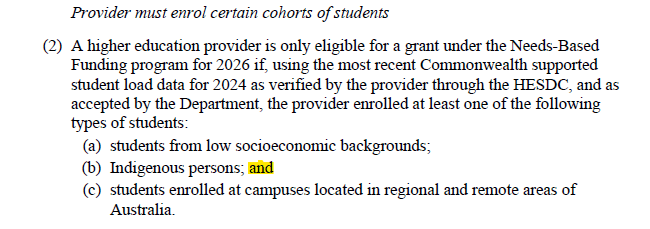
For the requirement to enrol equity students the highlighted ‘and’ in section 52C(2) below is a potential problem. Without the ‘and’ 52C(2) could be read as eligibility depending on enrolling at least one student classified as low SES or Indigenous or at a regional campus. But the use of ‘and’ rather than ‘or’ leans interpretation towards at least one of each.
Not all providers have regional campuses, which seems to exclude them from both the Equity Grant and the Regional Grant, instead of just the latter program. That is not how I interpret the Funding guidance document. I doubt it is what was intended. But the legislative instrument takes legal precedence over the Funding guidance document.
I don’t think the legal guidelines require needs-based funding to be restricted to students in Commonwealth supported places, just that the provider enrols students in the relevant categories who are in CSPs. The Funding guidance document however states that the students must be in CSPs (p. 13).
There is some inconsistency in the bureaucratic detail. As noted, Indigenous students can be funded for postgraduate courses. Research courses are listed among the eligible postgraduate courses, but these are funded from the Research Training Program, not the Commonwealth Grant Scheme (elements 02 and 03 in e310, p. 14 of the Funding guidance document). Coursework postgraduate courses are a mix of CSP and full-fee.
Level of preparedness
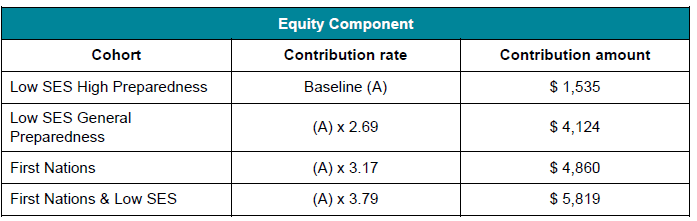
The main adjustment for actual needs in the policy is a lower rate for ‘high preparedness’ low SES students – $1,535, compared to at least $4,124 for ‘general preparedness’ (p. 7 of the Funding guidance document).
A low SES student is categorised as ‘high preparedness’ if their ATAR is 80 or over. In 2024, of the low SES students with an ATAR, 48% had an ATAR of 80 or over.
If an ATAR 80+ low SES student changes courses, however, they can be laundered back down to ‘general preparedness’ if they are admitted based on ‘complete or incomplete higher education’. About a quarter of low SES bachelor pass degree admissions are on this basis (with an unknown share previously achieving 80+ ATARs).
Proxy quality
That nearly half of low SES students with an ATAR had one of 80 or more highlights that ‘low SES’ is only a moderately good proxy for needing academic assistance. Indeed, our current definition is only a moderately good proxy for actual low SES, since the lowest quartile cuts out too many people who would meet a more objective measure of disadvantage.
As I argued in 2024, ATAR levels are highly predictive of pass/fail and complete/don’t complete. In Grattan Institute analysis from the 2010s, for full-time students SES has no predictive power of pass/fail in the first semester of study if ATAR is taken into account (several studies have found students from non-selective government schools get slightly better marks than their selective or private school peers with the same ATAR; this does not necessarily show in cruder pass/fail dichotomies).
Needs based funding graded by ATAR decile would more realistically adjust for differing levels of academic preparation.
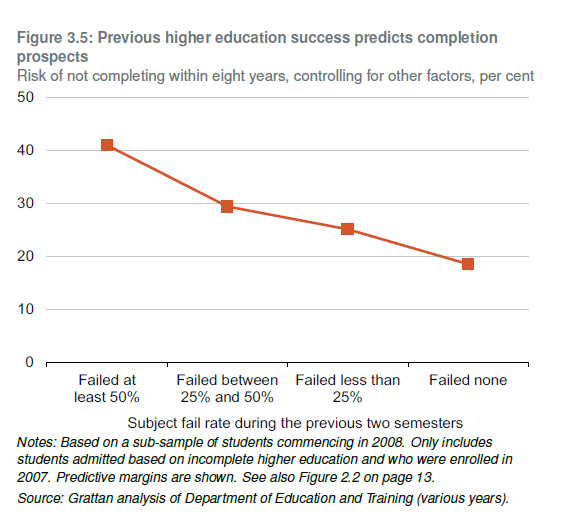
Other admission categories are harder to fund on a graded basis. But Grattan Institute work suggests that, for students admitted based on incomplete higher education, prior subject failure rates predict completion prospects.
Indigenous funding
In 2024, 9% of Indigenous commencing students had an ATAR of 80 or more but this will not reduce their needs based funding. An Indigenous student gets the same base funding rate regardless of ATAR, $4,860.
A student who is low SES and Indigenous will get a funding rate of $5,819.
Funding summary
This table from p. 7 of the Funding guidance document summarises the equity rates.
Demand driven?
Needs based funding has been sold as ‘demand driven’. While this term is repeated on page 3 of the Funding guidance document, it is not true for 2026. The funding will reflect places delivered in 2024, two years previously (p. 6).
So if a university experiences an increase in low SES or Indigenous students in 2026 it gets nothing extra to help support them.
This will be something to examine carefully in the new funding legislation. ‘Demand driven’ funding with a two year delay offers a performance funding payment more than ‘needs based funding’.
How equity money can be used
The rules on how equity money can be used are set out in broad terms in the legislative instrument and in more detail in the Funding guidance document.
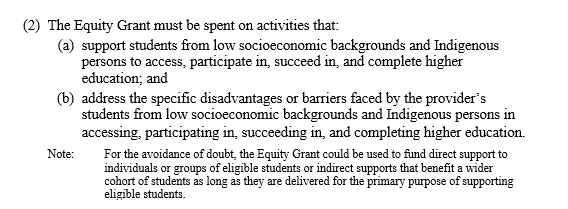
The legislative instrument rule is below:
The Funding guidance document (p. 8) cross-references an existing guidance manual, but note that this is for 2026 only.
The rules – see the note – allow for spillover benefits to non-low-SES and non-Indigenous students but discourage broad-based measures to lift performance at the course, faculty or institution level.
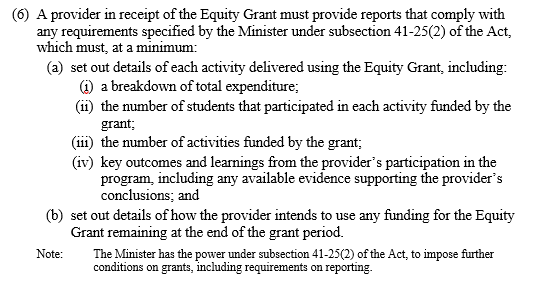
Expenditure acquittal
The reporting requirements on how needs based funding is used are more extensive in the legislative instrument than for predecessor equity programs, although I am not sure how much they will differ in practice.
Conclusion
I’m yet to see the actual funding levels for needs based funding or how it compares to predecessor programs. I expect winners and losers – the latter being universities with significant enrolments of students from regional areas who are not at regional campuses. This group exits the equity funding formula.
Despite the potential inherent in the original needs based funding idea, as implemented it looks like the old HEPPP program with a different funding formula. Some universities might be better off but noticeable sector-level improvements don’t look likely to me.
From a legal perspective needs based funding is a big step backwards. HEPPP had an indexed funding amount distributed according to a stated formula set out in a legislative instrument. This provided certainty and meant that funding arrangements were subject to parliamentary review.
Now the government has only put the rules applying to universities in a legislative instrument while imposing no enforceable rules on itself. This might only be temporary until new legislation is introduced, but it is nevertheless very poor practice.
 Andrew Norton