In his speech to the Universities Australia conference last month Jason Clare complained that the low SES share of enrolments ‘hasn’t changed that much in the last 30 years.’ He is overly pessimistic about long run trends in low SES higher education participation. But after 2017 key indicators went backwards, until a recent stabilisation with signs of partial recovery. This post explores trends and speculates on causes.
School leaver participation
One issue with measuring trends in low SES enrolments is correctly identifying low SES students. In higher education statistics a person is low SES if from an area in the lowest 25% by the ABS Index of Education and Occupation. As charts below will show, this IEO geographic proxy shows a distinctive lowest 10% for higher education participation. Above that, however, we see modest participation and attainment increments between deciles 2-6, with differences then speeding up to a distinctive top 20%.
The participation rate similarity between deciles 2-6 makes the current low SES definition unsuitable for funding purposes, but a reasonable rough guide to overall trends. Because deciles 2-6 are sociologically similar, they probably respond in similar ways to economic, educational and policy trends affecting higher education enrolments.
In his speech, the minister referred to an enrolment share metric, low SES students/all domestic students. That’s administratively convenient but analytically weak, as low SES results depend as much as movements in middle and high SES as low SES enrolments. Participation rates are better measures, low SES higher education students/low SES population.
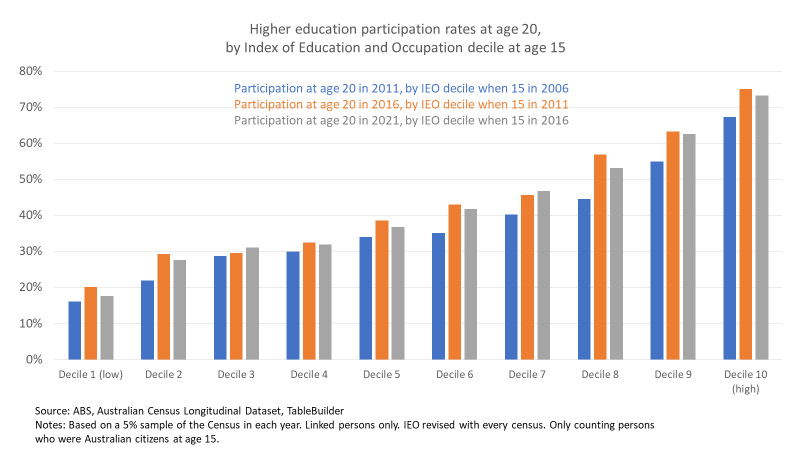
The chart below uses census longitudinal data for school leavers, taking as their SES the IEO ranking of where they lived when they were 15 years old, to better capture the social context of their secondary school years. The orange bars show that in 2016 all deciles had increased their participation rates since 2011, facilitated by the demand driven funding system. But in 2021, shown in grey bars, the participation rate in most deciles was lower than in 2016. There may be some statistical noise. This dataset takes a 5% sample of the census and my results omit unlinked census records – meaning the ABS could not track the same person from census to census or the necessary data was missing. But other data reported in this post confirms that the overall trend is real, even if some decile results are not 100% accurate.
 Andrew Norton