The ATEC legislation passed the Senate yesterday, after the government accepted amendments from the Greens and David Pocock. It now needs to be rubber-stamped by the House of Representatives and the Governor-General. Once that is done, it will become law after 28 days.
The amendments improve the legislation while still in my view leaving major flaws.
This previous post of mine links to my ATEC Senate inquiry submission and earlier posts on aspects of the legislation.
Objects of the Act
One of my criticisms was the entirely utilitarian and philistine set of ‘objects’ in the Act. While arguably no government since the 1970s has genuinely cared much about the broader functions of universities, they at least nodded to them in legislative objects. Not this government.
But the Senate amendment improves things:

Research
The ATEC bill read like a rushed committee job with nobody in enough control to ensure internal coherence. One example of this was research appearing in the objects of the bill but then disappearing from ATEC’s functions and matters on which it can give advice.
This is now fixed.
The Threshold Standards
The TEQSA-enforced Threshold Standards set the rules that all higher education providers must follow to remain registered.
Under the current system the Higher Education Standards Panel advises on the Threshold Standards. Its members must have relevant expertise. Under the government’s proposal, ATEC would take the Panel’s role but without any requirement that ATEC commissioners have relevant expertise.
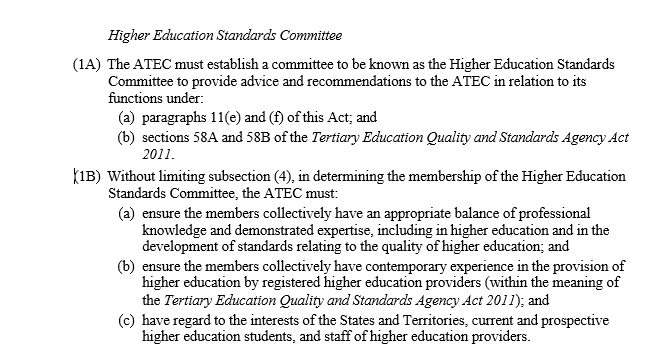
ATEC must now have a committee with relevant expertise to advise it:
The number of commissioners
Perhaps the most common criticism in the Senate inquiry submissions was around the number of commissioners.
Under the original bill, ATEC would have a full-time Chief Commissioner, a full-time First Nations Commissioner and a part-time Commissioner.
Quorum is a majority of commissioners, so two people. As the Chief Commissioner has a casting vote when votes are tied, any absence makes the Chief Commissioner the sole decision maker.
Only three commissioners also limits the range of experience and expertise the commissioners collectively have.
With one commissioner potentially only half time, that is only 2.5 FTE to make compacts with dozens of universities and perform other ATEC responsibilities.
This would inevitably mean significant delegation to ATEC staff, who will be Department of Education employees. All along the Department has sought to retain control, so this structure was a victory for them.
There can now be up to three commissioners, but I doubt there will be in practice. The part-time requirement is still there. Aside from the working hours issue, part-time employment restricts who can apply for commissioner jobs, since conflict of interest provisions block most other uses of their expertise.
So the potential for improvement through additional commissioners is there, but essentially another win for the Department.
Independent advice
Under the original bill, ATEC could only give advice on a range of topics if ‘requested by the minister’. It now has a broader power to provide unsolicited advice.
However the amendments don’t seem to have altered section 69, which requires ATEC to ‘seek and obtain the agreement of the minister before publishing any advice or recommendations’.
Problems that were not fixed – student contributions
The Greens and David Pocock both put forward amendments to to give ATEC a power to directly advise on student contributions, which the bill lacked. The government rejected this.
Oddly, on the same day as the Senate debate Jason Clare appeared on 4 Corners saying:
“I’ve said it’s [Job-ready Graduates student contributions] failed. I’ve also said it’s expensive to fix and not easy to fix. I’ve also said that the tertiary education commission that we’re setting up right now that’s in the parliament right now will have a role in making sure that we find out the best way to fix this.”
Despite such ministerial statements, the government is determined to avoid reforming student contributions.
Problems that were not fixed – excessive power through mission based compacts
Sadly nothing has changed with what I think is the single worst aspect of ATEC, its broad powers under mission based compacts.
I’ve heard this described as a quasi-regulatory power but it could be worse than that – in practice it could be a management power.
Regulations would be rules applying to all providers, but management is ATEC telling University A to take actions X, Y and Z.
Conclusion
There is still much that we don’t know about how ATEC will operate. I’m expecting at least two more major items of legislation this year, one on funding and another adding detail to ATEC’s power to cap international student numbers.
 Andrew Norton