Making the international student caps bill less bad

Today is the likely final day of public hearings for the international student caps bill, ahead of a report due on 8 October.

Despite the strong campaign against this bill the political reality is that the Opposition supports provider-level caps. This gives scope for a compromise that will see the bill pass in some form.

In my final submission to the Senate inquiry I focused on ways to make the bill less bad, while still letting the government and alternative government achieve their migration-related policy objectives.

Remove the course caps provision

80%+ of international students do not stay in Australia permanently. In this context, the government’s position that international students should be stopped from taking courses that don’t align with Australia’s skills needs borders on the absurd.

With over 25,000 courses registered on CRICOS regulating at the course level is also beyond the government’s administrative capacity. As Claire Field has been reporting, there are numerous errors in the much smaller task of imposing about 1,150 provider-level caps.

Read More »

Should ‘student-led organisations’ get a guaranteed share of student amenities fee revenue?

Senate hearings this week will examine the Universities Accord (Student Support and Other Measures) Bill. This bill includes the changes to HELP indexation, the FEE-FREE Uni Ready Places, the Commonwealth Prac payment, and a requirement that 40% of student amenities fee revenue be directed to student-led organisations. My submission to the inquiry is here.

The status quo on student amenities fees

The current law on student amenities fees is a compromise on the long-running compulsory versus voluntary student unionism debate. Prior to 2006, universities could charge an unregulated, upfront fee for student amenities. In an a reversal of normal political positions, left-wing activists supported the unregulated status quo (because it funded their activities), while Liberal students and eventually Liberal governments moved to regulate the market and abolish the fee (also because it funded left-wing activities). In 2005 the Howard government finally legislated away the compulsory fee, with effect from 2006.

In 2011, Julia Gillard legislated to restore a compulsory amenities fee, with effect from 2012. But the fee was price capped ($351 in 2024), funded by the income contingent SA-HELP loan instead of being upfront, and the revenue could only be spent on a list of specified activities. The legislation specifically prohibits the money being spent on on a political party or the election of a person to local, state or Commonwealth office.

Under guidelines derived from the Gillard-era compromise, universities must ‘provide adequate and reasonable support, resources and infrastructure for democratically elected student representatives to carry out their functions’. However there is no specific share of amenities fee revenue that must go to student-led organisations.

In practice the amenities fees is mainly relevant to Commonwealth supported places and the fixed, relatively low amount of money universities receive for them. With no CSP funding for non-academic services the student amenities fee fills this financial gap. Although universities often charge full-fee students a separate amenities fee, reflecting institutional history and politics, this is not necessary. The cost of amenities can just be bundled into the overall fee, as it typically is outside the universities. Only 5 non-university higher education providers use SA-HELP.

Changes under the bill

The Universities Accord (Student Support and Other Measures) Bill specifies that at least 40% of amenities fee revenue must go to student-led organisations: section 19-39(1). An organisation is student led if a) the majority of people on the governing body are currently enrolled or have been enrolled in the previous three years; and b) the majority of persons on the governing body have been democratically elected by students; and c) the organisation satisfies requirements specified in government-set guidelines: section 19-39(3).

Read More »
The National Student Ombudsman and academic life

A previous post outlined the contents of the Universities Accord (National Student Ombudsman) Bill introduced into parliament last week. This post examines its implications for academic life.

Although the bill generally exempts curriculum content or assessment methods from review by the Ombudsman, the minister will be able to over-ride these exemptions with a legislative instrument.

Students will use the Ombudsman to pressure academics for special consideration and to avoid discipline for misconduct. This creates an incentive for academics to accept questionable claims and overlook likely cheating rather than risk wasting time on an Ombudsman investigation.

The post’s section references are to the bill.

Academic judgment

The Ombudsman legislation does not permit student complaints ‘to the extent that the action involves the exercise of academic judgment’: section 21AD(3)(c).

The bill’s explanatory memorandum gives as examples of excluded complaints (p. 23) ‘decisions about the academic merit of a grade awarded, the content of a curriculum, and teaching and assessment methods.’

But section 21AD(4) undoes this by stating that exceptions can be over-ridden by the National Student Ombudsman Rules.

Read More »

A National Student Ombudsman – how would this new student complaints mechanism work?

Last week the government introduced legislation for a National Student Ombudsman.

This post outlines key provisions of the bill. A government summary is here. A subsequent post looks at the potential impact of the bill on academic life.

Statutory references are to the Universities Accord (National Student Ombudsman) Bill, using the sections as they would appear in the Ombudsman Act 1976 if the bill passes.

Which students can complain?

All students of higher education providers, except those enrolled in VET courses, can complain to the National Student Ombudsman (abbreviated to Ombudsman from now). Apart from the VET exception, non-higher education students are included. Enabling, microcredential and professional development course students will be covered. In some cases prospective or former students can also make complaints: sections 3(1) and 21AD(1)(a).

Another person can make a complaint on behalf of the student: section 21AD(1)(b).

Read More »

More detail on international student caps

This week the government announced the overall international student cap for 2025, of 270,000 new commencing students, with some student types not counted towards the cap. I have a high-level summary in The Conversation. This post explores the capping announcement in more detail, noting additional problems with this deeply flawed policy.

The power – or lack thereof – to exempt particular types of students

On Tuesday the government announced three new exemption categories:

  • students who are part of “twinning” arrangements, taking some of their course offshore before coming to Australia
  • students with Australian government or “key partner” foreign government scholarships
  • students from the Pacific and Timor-Leste.

On my reading of the bill, the last two exemptions are not supported by its current wording and the twinning exemption is probably not within the bill’s existing scope.

Read More »

The underexplained and insecure Commonwealth Prac Payment

The planned Commonwealth Prac Payment aims to help students finance mandatory practical training, such as clinical training or teaching rounds. Initially teaching, nursing and midwifery, and social work students in higher education and VET will be eligible.

According to the government, the Prac payment will be means-tested and is ‘intended to support learning outcomes, where the financial impacts of placements may have otherwise influenced students to defer or withdraw from study‘ (emphasis added).

The payment will be matched to the single Austudy rate, $319.50 a week as of today.

The policy is due to start on 1 July 2025, with part of the legal framework in a bill introduced into the House of Representatives last week.

Bureaucratic and intrusive eligibility criteria

Read More »

How attractive will the FEE-FREE Uni Ready places be to universities?

Last week the government introduced legislation that would, among other things, create a new funding category for what we now call enabling courses, which will be redesigned and rebadged as FEE-FREE Uni Ready places. These courses help prepare students for higher education study.

The current system

Under the current system, Commonwealth supported enabling places are funded at the Commonwealth contribution rate for the relevant discipline.

Enabling places are not capped but the financial incentives to enrol enabling CSP students are weak because no student contribution can be charged.

An enabling loading is paid in lieu for universities with an allocation of enabling funding, but many universities have no enabling loading or a low amount.

The government does not seem to update the enabling loading in a public place, but indexing a previous rate I think it is $3,886 per EFTSL in 2024.

Job-ready Graduates affected the financing of enabling places in fields with Commonwealth contribution cuts. Nearly 40% of enabling places are in the lowest Commonwealth contribution field, $1,236 for 2024. That plus the enabling loading = $5,122 per place.

Read More »

Will the ‘Costello baby boom’ have a weaker demographic effect on higher education than expected?

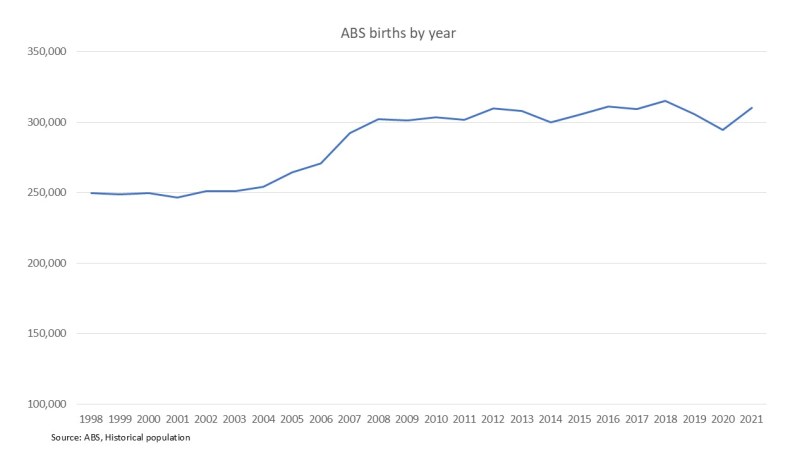
Since the late 2010s I have promoted the idea that the so-called ‘Costello baby boom’ cohorts will arrive at university age from the mid-2020s, increasing school leaver demand for higher education. As the chart below shows, annual births go from around 250,000 in the early 2000s to around 300,000 later in the decade.

Demographers are sceptical of how much effect mid-2000s pro-family policies had, but former Treasurer Peter Costello’s line that ‘if you can have children it’s a good thing to do – you should have one for the father, one for the mother and one for the country..’ was sufficiently memorable that this baby boom has his name attached to it.

As these cohorts approach university age this post takes another look at the data.

Read More »

Counting international students – the method is critical to what effects caps have

The debate on international student caps is mostly at the level of principle. But the capping bill‘s wording is also critical to its effects. A key issue is whether the cap is based on a cumulative total of enrolled international students through a year or the total on specific dates during the year. A cumulative count will have much more serious effects on students and education providers.

The cumulative count wording of the bill

The most natural meaning of the current bill is that the count is cumulative – ‘a limit’ (singular) on the ‘total’ number of overseas students enrolled in one or more years. This means that the cap is driven by the peak number during the year.

Read More »

Can migration policy alone manage international student numbers?

My paper on international student policy – new migration controls and proposed enrolment caps – is published by the ANU Migration Hub today. Some key points appear in The Conversation.

Compared to what I have already written on caps – how actual enrolments will fall below the caps and why even the government’s own agencies doubt the policy’s feasibility and fear its consequences – this paper explores the cumulative consequences to date of migration policy changes.

These consequences are already significant for vocational education and some higher education providers. This raises the question of how necessary the caps are to achieve the government’s policy goal of bringing down net overseas migration.

The policy timeline

Since October 2023 we have witnessed one of the great policy backflips of Australian political history. The Albanese government has turned from supporting the revival of international education – granting a record number of student visas in 2022-2023, extending the temporary graduate visa – to pulling almost every policy lever short of shutting the industry down to reduce international student numbers. International education now keeps political company with live sheep exports, fossil fuels, and vapes retailing.

Read More »