Senate inquiry submission on mass cancelling courses for international students, banning new higher education providers, and Indigenous demand driven funding for medical courses

Update 28/11/2025: The Senate passed some amendments to this bill. These are noted in the original posts.

————————————————————————————————-

Senate inquiry submissions are due on Friday for the Education Legislation Amendment (Integrity and Other Measures) Bill 2025.

I am releasing my late draft submission in case it helps people finalising their own submissions and to identify any errors or omissions on my part.

Update 17/11/25: Final submission on the Senate committee website.

It builds on my three prior blog posts on the subject – on mass cancelling courses for international students, on a de facto ban on new higher education providers, and on extending Indigenous demand driven funding to medical courses.

Mass cancelling CRICOS course registrations

The main new content in the submission is description of existing legislative powers that can achieve the same claimed policy goals as the course cancellation proposal.

The practical effect of the bill, if it passes, would be to enable the suspension of the rule of law. It would allow the minister to make decisions according to vague criteria, without consulting anyone or considering other relevant laws. Due process would be abolished; providers could be penalised with course cancellation even if they have followed the law and acted ethically at all times.

It shocks me that this Trump-style bid to rule by executive order has even been introduced into Parliament. It’s staggering that, given nearly a year to think again since its original defeat last year, the government has brought back a bill that is, in some places, even more defective than their first attempt. I am referring here to removing the requirement to consult TEQSA or ASQA before cancelling a course on ‘standard of delivery’ grounds.

Read More »

Mapping Australian higher education 2023 – data update March 2025

Update 20/12/2025: More recent data here.

—————————————————————————————————

I won’t have the capacity to produce another edition of my Mapping Australian higher education report in the foreseeable future, but I am extending the life of the October 2023 edition by updating the data behind the charts.

Mapping‘s chart data is the only publicly-available source of long-term time series data on many higher education topics, especially on financial matters.

I had been waiting on the 2023 university finances report before releasing another chart data update. That finally happened yesterday. Despite a record 27 universities reporting deficits, in the aggregate there was a small surplus, after a loss overall in 2022.

2023 had some weak numbers for the two main Commonwealth student programs, the Commonwealth Grant Scheme and HELP. Several factors were behind this: temporary COVID places coming out of the system, Job-ready Graduates reductions in total funding rates for some courses, and weak domestic demand. These programs trended up in 2024 and 2025, as seen in the chart below, although high CPI-driven indexation was a significant factor.

The updated chart data is available here.

How attractive will the FEE-FREE Uni Ready places be to universities?

Last week the government introduced legislation that would, among other things, create a new funding category for what we now call enabling courses, which will be redesigned and rebadged as FEE-FREE Uni Ready places. These courses help prepare students for higher education study.

The current system

Under the current system, Commonwealth supported enabling places are funded at the Commonwealth contribution rate for the relevant discipline.

Enabling places are not capped but the financial incentives to enrol enabling CSP students are weak because no student contribution can be charged.

An enabling loading is paid in lieu for universities with an allocation of enabling funding, but many universities have no enabling loading or a low amount.

The government does not seem to update the enabling loading in a public place, but indexing a previous rate I think it is $3,886 per EFTSL in 2024.

Job-ready Graduates affected the financing of enabling places in fields with Commonwealth contribution cuts. Nearly 40% of enabling places are in the lowest Commonwealth contribution field, $1,236 for 2024. That plus the enabling loading = $5,122 per place.

Read More »

Job-ready Graduates price effects?: An update with 2022 enrolment data

The official release yesterday of the CPI-indexed Job-ready Graduates student contributions for 2025 has prompted questions about what impact the JRG price increases have had on enrolments.

With arts, business and law student contributions to hit nearly $17,000 a year in 2025 – with our bout of inflation having increased them from $14,500 in 2021 – students would be wise to think about whether this is a sensible investment. That’s $50,000 for a basic 3 year degree or $85,000 for common combinations like arts/law or business/law.

On the other hand, as I have argued, students follow their interests while keeping an eye on which courses within their cluster of interests would have the best employment and salary outcomes.

The most sophisticated work to date, using NSW data to 2021, found small effects in the expected directions.

Using simple trends in subjects taken, this post will look at domestic commencing EFTSL by discipline in the 2010-2022 period, drawing on the annual commencing load spreadsheet produced by the Department of Education. This does not distinguish between CSP and domestic full-fee students, but it is the best I can do with publicly available data.

Because I am comparing fields with very different absolute enrolments, I have converted them to an index, with 2010=1. So an index of 1.1 in a subsequent year would mean 10% more EFTSL, and an index of .9 would mean 10% fewer EFTSL.

Read More »

Did bachelor degree enrolments decline significantly between 2016 and 2022?

This is a post I started writing several months ago, before the Accord final report and other major higher education policy announcements pushed it aside. I have completed it as a companion to my census attainment post on data issues in higher education.

Late last year several media outlets, using data from the ABS Education and Work survey, reported declining bachelor degree enrolments. In November 2023, bachelor degree enrolments were said to be down 12 per cent between 2016 and 2022. Another newspaper rounded the drop to 13 per cent. In December 2023 bachelor degree enrolments were said to be at their lowest level since 2011.

This post explains why these media stories exaggerate enrolment decline. The most important reason is that Education and Work does not count offshore international students. But comparing Education and Work results with enrolment data shows that it typically undercounts onshore international students and overcounts domestic students, particularly those in bachelor degrees. It also has occasional rogue surveys that produce misleading comparison years.

Read More »

How reliable are Census educational attainment numbers?

I am a big user of ABS data, including for calculating educational participation and attainment rates. Recently I have been using Census longitudinal data, which links records from a 5% sample of the Australian Census between different Census dates.

Due to respondent inattention to questions, or mistakes by family members answering for others, I would expect some inconsistent answers between censuses. But inconsistency rates for education-related questions are alarmingly high.

For the highest year of school education the ABS-reported inconsistency rate between 2016 and 2021 was 6.8%. For highest non-school qualification the inconsistency rate was 8.9% – meaning that a lower highest education qualification was reported in 2021 than 2016.

Read More »

Mapping Australian higher education 2023 – official release

Update 20/12/2025: More recent data here.

Mapping Australian higher education 2023 is now available from the ANU Centre for Social Research and Methods website.

Update 30/10/2024: There is a later version of Mapping 2023’s data here.

Update 26/10/23: A reader has pointed out that list of FEE-HELP NUHEPs is incomplete. A column of names from the original Excel file was omitted during production. The full list is available here. This list also includes three non-FEE-HELP providers registered by TEQSA since the pdf version was finalised. A corrected version of Mapping with the full list of NUHEPs, as of mid-2023, is here.

If anyone has noticed other errors please let me know.

How much the government paid for Centre Alliance’s Senate vote, and other updates from the funding agreements

This post updates one I wrote in April, including new information from revised university funding agreements posted on DESE’s website.

South Australian university Senate special deals

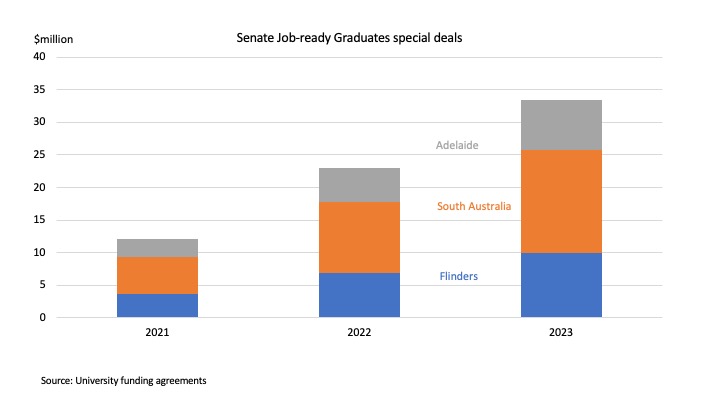
The updated funding agreements let us see how much the government paid to get Centre Alliance Senator Stirling Griff to vote for Job-ready Graduates, which is $68.6 million for South Australian universities over the 2021-2023 funding agreement period. Unlike much of the other additional money in the funding agreements, these increases are ongoing rather than temporary.

I am not sure what criteria were used in dividing the money between the South Australian universities. In 2021 Adelaide gets 1.9 per cent more than it presumably would have otherwise, Flinders 2.7 per cent, and the University of South Australia 3.1 per cent.

More short course places allocated

In my earlier post the allocated short courses fell short of the announced budget value of $252 million. Now they slightly exceed it at $258.7 million, divided between 256 undergraduate certificates valued at $102.9 million and 491 graduate certificates worth $155.8 million. My updated spreadsheet of short courses is here.

Read More »

New allocations of money and student places in the university funding agreements

Update 7/7/21: Some of the data in this post has been updated here.

———————————————————————-

Last month I wrote an overview and critique of the new university funding agreements. This post looks at new allocations of funding for student places, while a subsequent post will look at total funding allocations. Not all my numbers match previously announced total funding for the relevant program, so that is a caveat on both posts.

Under Job-ready Graduates universities are free of sub-bachelor and postgraduate student places being allocated by funding cluster, but the funding agreements show that universities have significant additional work to do in applying for and reporting on a range of small programs.

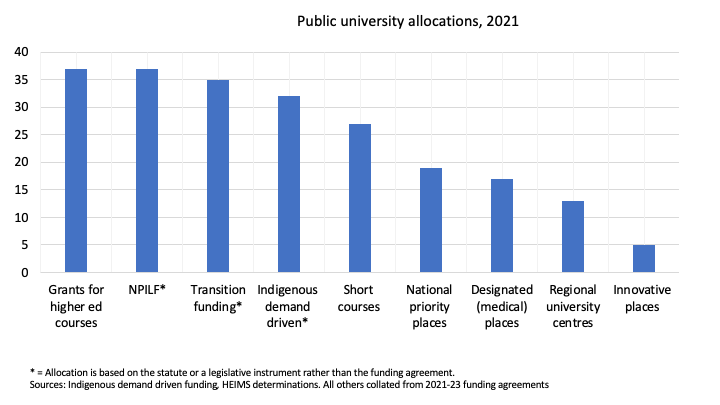
Numbers of universities getting different allocations

Job-ready Graduates introduced several new or substantially revised pots of money. Not all universities receive each of these. As the chart below shows, programs driven by criteria or formulas set out in legislative instruments (NPILF and transition funding) or the legislation itself (demand driven funding for Indigenous students from regional and remote areas) benefit the largest number of universities. Apart from the general grants for higher education courses (sub-bachelor through to masters coursework, except medicine), the ministerial/departmental discretion programs benefit fewer universities.

Short courses funding

According to the funding agreements, 27 of the 37 public universities have received once-off 2021 funding for undergraduate certificate and/or graduate certificate short courses. When a university’s funding agreement reported $0 for short courses I cross-checked against CourseSeeker with its ‘short course’ filter on and found three more universities. I am not sure whether this is because those universities adopted the ‘short course’ brand without a specific funding allocation, or because their funding agreements are yet to be updated, or because CourseSeeker is wrong. My adding up of the value of funding agreement short courses gets me to $213 million, out of the $252 million allocated for 2020-21 in the October 2020 Budget.
Read More »

Can universities just close loss-making courses?

As international student fee revenues fall universities are closing loss-making subjects and courses. Musicology at Monash. Maths and gender studies at Macquarie. Arts and social science subjects at Sydney. Neuropsychology at La Trobe.

Generally, universities have significant autonomy over what they teach. Changes in courses and subjects occur every year, in good as well as bad economic times.

But the funding agreements universities sign with the government impose some controls over course closures.

For courses leading to occupations deemed to be experiencing a skills shortage, and subjects teaching ‘nationally strategic’ languages, universities have to get government approval prior to closure.

Read More »