Did bachelor degree enrolments decline significantly between 2016 and 2022?

This is a post I started writing several months ago, before the Accord final report and other major higher education policy announcements pushed it aside. I have completed it as a companion to my census attainment post on data issues in higher education.

Late last year several media outlets, using data from the ABS Education and Work survey, reported declining bachelor degree enrolments. In November 2023, bachelor degree enrolments were said to be down 12 per cent between 2016 and 2022. Another newspaper rounded the drop to 13 per cent. In December 2023 bachelor degree enrolments were said to be at their lowest level since 2011.

This post explains why these media stories exaggerate enrolment decline. The most important reason is that Education and Work does not count offshore international students. But comparing Education and Work results with enrolment data shows that it typically undercounts onshore international students and overcounts domestic students, particularly those in bachelor degrees. It also has occasional rogue surveys that produce misleading comparison years.

Read More »

What’s going on with domestic undergraduate numbers? Part 1, Demographic differences

Higher education enrolment data for 2022 was released on Monday. Overall enrolments fell 3.2% in 2022 compared to 2021. A 1.9% increase in international student numbers partly offset a 5.1% decline in domestic numbers. In 2021 overall enrolments also fell, with the opposite dynamic – an increase in domestic students partly offset a decline in international student numbers. The 2021 and 2022 enrolment decreases were the first total enrolment reversals since the early 1950s.

Domestic undergraduates

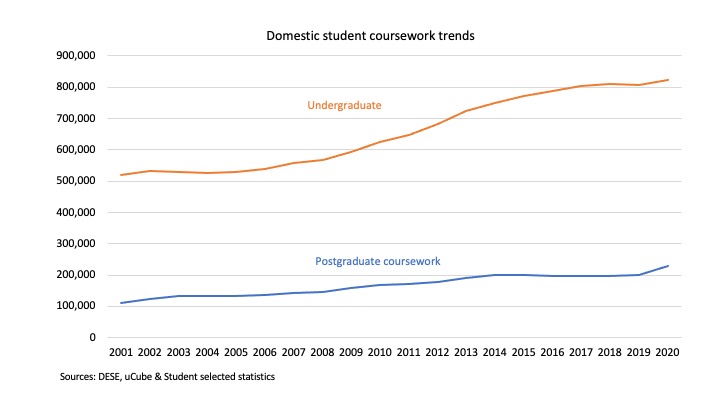
This post focuses on domestic undergraduates, the subject of many media inquiries and much speculation. The chart below shows that enrolments started growing in the late 2000s, at a fast rate during the demand driven funding era, before entering a more subdued phase in the late 2010s and then the decline discussed in this post. Sub-bachelor courses are a larger share of the total more recently than in the 2000s.

Overall domestic bachelor enrolments decreased 4.9% in 2022 compared to 2021. Despite a 2 percentage point increase in attrition rates for commencing 2021 students into 2022, the continuing cohorts offset a larger fall in commencing bachelor-degree students of 8.6%. That’s more than double the previous largest commencing student decline this century, in 2003, when the then-minister cracked down on over-enrolments. Sub-bachelor numbers are down around 4% for both commencing and total.

Read More »

Mapping Australian higher education 2023 – official release

Update 20/12/2025: More recent data here.

Mapping Australian higher education 2023 is now available from the ANU Centre for Social Research and Methods website.

Update 30/10/2024: There is a later version of Mapping 2023’s data here.

Update 26/10/23: A reader has pointed out that list of FEE-HELP NUHEPs is incomplete. A column of names from the original Excel file was omitted during production. The full list is available here. This list also includes three non-FEE-HELP providers registered by TEQSA since the pdf version was finalised. A corrected version of Mapping with the full list of NUHEPs, as of mid-2023, is here.

If anyone has noticed other errors please let me know.

The student income support system under COVID-19

A previous post on my new paper on tertiary student finances under COVID-19 showed that, despite two lockdown-caused crashes in employment, students generally did well out of the COVID-affected labour market. This post looks at the student income support system. It too did well in maintaining and increasing student living standards.

Bonus payments for student income support recipients

The base student income support payments are modest. When COVID arrived in Australia in early 2020 the fortnightly Youth Allowance rates were $304.60 a fortnight for 18 year olds living at home, and $462.50 if living away from home. But COVID-19 bonuses significantly increased the financial benefits of being on student income support.

Students receiving YA, Austudy or Abstudy on 12 March 2020 received a $750 economic stimulus payment. From 27 April to 24 September 2020 they received the $550 fortnightly Coronavirus Supplement. This supplement was then phased down, to $225 a fortnight from 25 September 2020 to 31 December 2020, and then $150 a fortnight from 1 January to 31 March 2021. A student continuously on student income support from March 2020 to March 2021 received more than $9,000 in COVID-related bonus payments.

From 1 April 2021 the base student income support rates were permanently increased by $50 a fortnight.

The number of students receiving income support increased

After March 2020 the number of Youth Allowance recipients increased significantly compared to the same months in 2019, as the chart below shows.

Read More »

The bust then boom in tertiary education student employment under COVID-19

In the major 2020 and 2021 lockdowns tertiary student employment in the 24 years and under age group fell by over 100,000, or 20 per cent of the pre-lockdown total. Yet these losses proved to be temporary. As I discuss in a new paper, student employment rates and earnings recovered to record levels. While the strong Australian labour market is obviously a major factor, the sometimes significantly overlapping employment markets for students and temporary migrants made closed borders beneficial for students as workers.

Tertiary student employment rates

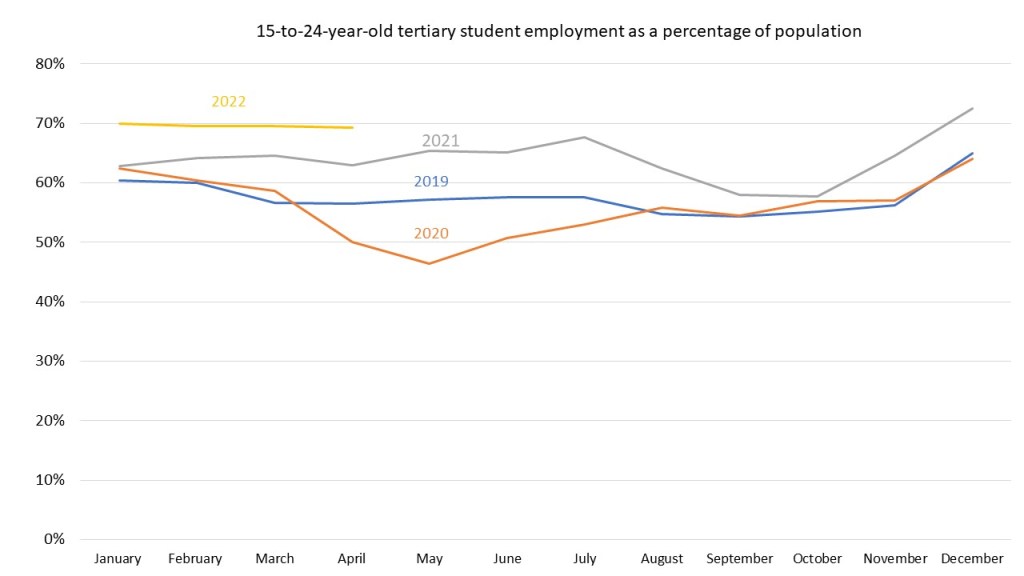
The strength of tertiary student employment is most obvious in employment rates, the percentage of the total student population with a job. Tertiary student employment levels and rates vary during the year, driven by movements in and out of both employment and enrolment. Comparisons of the same month in different years can help distinguish a trend from a normal seasonal change. December is not necessarily the peak month for total student employment, since course completions reduce student numbers. But student employment rates typically reach annual highs in December, as seasonal spikes in retail employment coincide with a summer holiday increase in student capacity to work.

As the chart below shows, employment rates fell sharply in April and May 2020 as lockdowns hit, but by August 2020 student employment rates were back at 2019 levels. In 2021 employment rates were consistently higher than in 2019, despite lockdowns in NSW, Victoria and the ACT causing a significant dip. In early 2022 student employment rates remain 10 percentage points or more above their 2019 levels.

Source: ABS Labour force detailed, table LM3
Read More »

Patterns of international student enrolment decline in the first year of COVID-19

For international students the 2020 higher education enrolment data released this week is already very out-of-date. The international branch of DESE produces more current aggregate numbers, and has been circulating up-to-date figures to experts and stakeholders. Peter Hurley used these in a recent Conversation article. It’s a model for what, after a recent IT upgrade, could and should be done for domestic enrolments (my long-after-the-fact analysis of the 2020 domestic results is here).

Although more recent current total international enrolment figures are available, a few things in the recently released 2020 enrolment data tell us more than is publicly available elsewhere.

Attrition

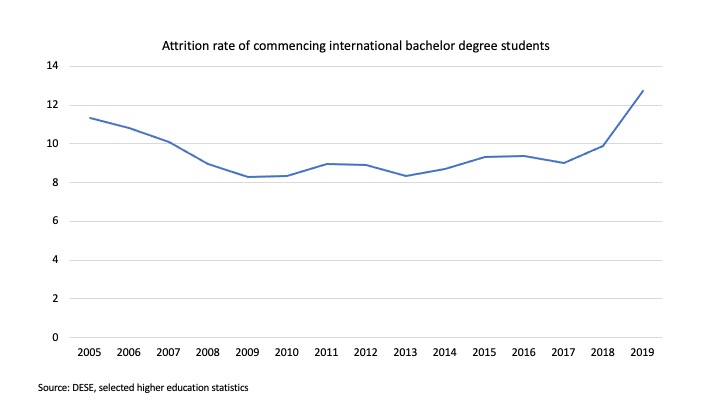
International bachelor degree students have much lower attrition rates after first year than their domestic counterparts. Flying to a foreign country and paying sometimes exorbitant fees is a strong incentive to get the degree. But while attrition for 2019 commencers into 2020 declined for domestic students, the international rate increased nearly 3 percentage points to 12.73 per cent. The most likely reason is that some international students could not get back to Australia due to travel bans.


Commencing and continuing students

Increased attrition meant fewer continuing students than would have been the case without COVID-19. But the prior boom years for commencing students meant that continuing students still increased in 2020 on 2019 figures. This is one reason why the overall decline in international students was contained to 6.6 per cent, despite an 18.2 per cent decrease in commencing numbers.

Read More »

Domestic student enrolment increases in the first year of COVID-19

The 2020 higher education student data has finally been released, giving us the first detailed look at potential COVID-19 influences on enrolments. This post is on domestic students. Another post examines international students.

Aggregate trends

Overall domestic student trends were positive for both undergraduates, up 2 per cent after a decline between 2018 and 2019, and postgraduate coursework, up 14 per cent after six years of stagnation or low growth. Postgraduate research was an exception, down by 577 enrolments or 1.3 per cent. Including enabling and non-award students total domestic enrolments were 1,133,519, 4.4 per cent up on 2019.*

Student ‘load’ – full-time equivalent enrolments – was up by less, 2.6 per cent. The headcount share of part-time students, defined as less than 75 per cent of a full-time equivalent study load, is only up by .7 of a percentage point, suggesting more part-time students with light study loads and/or more full-time students not at a 100 per cent study load.

Read More »

How much the government paid for Centre Alliance’s Senate vote, and other updates from the funding agreements

This post updates one I wrote in April, including new information from revised university funding agreements posted on DESE’s website.

South Australian university Senate special deals

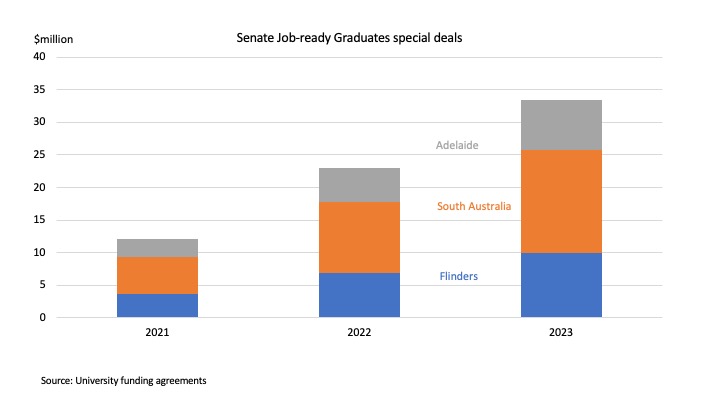
The updated funding agreements let us see how much the government paid to get Centre Alliance Senator Stirling Griff to vote for Job-ready Graduates, which is $68.6 million for South Australian universities over the 2021-2023 funding agreement period. Unlike much of the other additional money in the funding agreements, these increases are ongoing rather than temporary.

I am not sure what criteria were used in dividing the money between the South Australian universities. In 2021 Adelaide gets 1.9 per cent more than it presumably would have otherwise, Flinders 2.7 per cent, and the University of South Australia 3.1 per cent.

More short course places allocated

In my earlier post the allocated short courses fell short of the announced budget value of $252 million. Now they slightly exceed it at $258.7 million, divided between 256 undergraduate certificates valued at $102.9 million and 491 graduate certificates worth $155.8 million. My updated spreadsheet of short courses is here.

Read More »

Would universities have received JobKeeper under more favourable rules?

In 2020 the Australian government JobKeeper policy provided eligible employers and employees with a wage subsidy, which was designed to sustain employment during a COVID-related shock to the Australian economy.

Public universities were eligible for JobKeeper, but its regulations were changed several times to reduce the chance that they would qualify. I assessed the merits of the government’s university JobKeeper decisions in a previous post. No university received JobKeeper directly, although some benefited from it via their subsidiaries.

With most university annual reports now published I can partially investigate the effects of the government’s university JobKeeper decisions. As at 6 July 2021 I have 2020 financial results for 32 public universities. I am missing the South Australian universities, the University of Canberra, the University of Tasmania, and Charles Sturt University.

Time period of revenue loss

For all organisations JobKeeper eligibility involved comparing revenue in 2020 with the same period in 2019. Most organisations could choose a month or quarter, but for universities it was changed to the six month period from 1 January 2020. In my previous post, I rated this as the least defensible government university JobKeeper decision.

Early on, before the six month period was introduced, some universities thought that they could qualify (eg Sydney and La Trobe in April).

The original one month comparison option, starting with a calendar month that ends after 30 March 2020, seemed to create opportunities for some universities. Government payments arrive in fortnightly instalments, while fees are paid around due dates. In particular months international student fees received for the next semester may be a large percentage of all university income. A big drop in fee revenue in one of those months might have triggered the revenue decline threshold that made an employer eligible for JobKeeper assistance (the relevant level is discussed below).

At least at Sydney, most first semester 2020 student fee due dates were prior to 30 March (I could not find La Trobe’s dates). And Sydney is one of the ‘China universities’ affected by a border closure to China from 1 February 2020. The ‘India universities’ are unlikely to have had a March trigger month, as Indian students mostly arrived before the international borders closed completely to routine travel on 20 March 2020.

Read More »
How defensible were the government’s JobKeeper decisions for public universities?

The Australian Government’s JobKeeper program was intended as a temporary scheme to keep people in jobs during COVID lockdowns and business restrictions. It was originally scheduled to run until late September 2020. With some more limited extensions it finished at the end of March 2021. The government made several decisions that reduced the chance that a public university would qualify for JobKeeper support. This post evaluates those decisions from a public policy perspective. A subsequent post assesses how the various decisions affected public university JobKeeper eligibility.

In the rush to implement JobKeeper, the public university aspects were not well implemented or explained. University hopes were raised only to be dashed, feeding a sense of persecution as well as cutting off potential funding. I will argue, however, that the final policy position reached by the government, except for the time period for comparing 2019 and 2020 cash flows, was not wrong in principle.

More importantly, JobKeeper was never the right response to the higher education sector’s COVID-related problems. It was a short-term program aimed at helping employers maintain staff through domestic lockdowns and restrictions on activity. Regulations affecting the day-to-day activities of people in Australia were, and remain, very disruptive to universities but are not leading to a major loss of income. The financial problem is an international border closure that will last for more than two years. This will cause significant continuing revenue losses from international students into the mid-2020s.

The eventually announced extra government money for research and temporary new student places were more like what is needed. My critique of the government’s higher education response to COVID is that these policies were only announced late in 2020, and largely terminate before borders are predicted to re-open. Additional assistance for 2022 should be arranged.

Read More »