New allocations of money and student places in the university funding agreements

Update 7/7/21: Some of the data in this post has been updated here.

———————————————————————-

Last month I wrote an overview and critique of the new university funding agreements. This post looks at new allocations of funding for student places, while a subsequent post will look at total funding allocations. Not all my numbers match previously announced total funding for the relevant program, so that is a caveat on both posts.

Under Job-ready Graduates universities are free of sub-bachelor and postgraduate student places being allocated by funding cluster, but the funding agreements show that universities have significant additional work to do in applying for and reporting on a range of small programs.

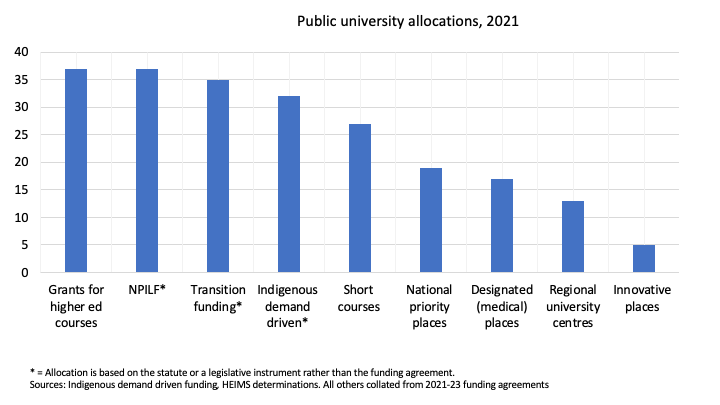
Numbers of universities getting different allocations

Job-ready Graduates introduced several new or substantially revised pots of money. Not all universities receive each of these. As the chart below shows, programs driven by criteria or formulas set out in legislative instruments (NPILF and transition funding) or the legislation itself (demand driven funding for Indigenous students from regional and remote areas) benefit the largest number of universities. Apart from the general grants for higher education courses (sub-bachelor through to masters coursework, except medicine), the ministerial/departmental discretion programs benefit fewer universities.
Short courses funding

According to the funding agreements, 27 of the 37 public universities have received once-off 2021 funding for undergraduate certificate and/or graduate certificate short courses. When a university’s funding agreement reported $0 for short courses I cross-checked against CourseSeeker with its ‘short course’ filter on and found three more universities. I am not sure whether this is because those universities adopted the ‘short course’ brand without a specific funding allocation, or because their funding agreements are yet to be updated, or because CourseSeeker is wrong. My adding up of the value of funding agreement short courses gets me to $213 million, out of the $252 million allocated for 2020-21 in the October 2020 Budget.
Read More »

University-Commonwealth funding agreements and the rule of law in higher education

The 2021-23 funding agreements between universities and the government, the first of the Job-ready Graduates era, were put on the DESE website earlier this year. In this post I compare them to the pre-JRG agreements.

My main concern is that the funding agreements are being used for matters that should be based on clear legal rules, not DESE discretion based on a one-sided ‘agreement’.

My concern reflects both the general political principle that policy decisions should be subject to parliamentary scrutiny and the practical problems caused by lack of certainty. Important funding conditions or criteria are not included in any legal document and DESE is given wide scope to interpret vague terms.

A broader scope

The most immediately obvious change is that the new funding agreements include more content than previously. They contain an overall summary of Higher Education Support Act 2003 institutional funding, including the Commonwealth Grant Scheme (CGS) funding that is the legal purpose of the funding agreements; rules around course closures, professional training, and the provision of information on costs and admissions; research, engagement and equity funding; and some background information and principles. The research, engagement and equity material is new and derives its legal standing from separate legislative instruments.

Putting key information in one place is helpful, and I would encourage the government to collate the summary funding tables combining teaching, research, equity and engagement funding for each university into a publication. But funding agreements with parts of varying legal status are not desirable. A mixed document makes it less clear for universities what they must do according to law and what is just the government/Department taking advantage of the sector’s culture of compliance. With such a large share of their income depending on their funding agreement, universities are reluctant to push back against the government’s demands.

Read More »