The Universities Accord universal learning entitlement – how might it work?

One Universities Accord interim report suggestion is a ‘universal learning entitlement’. But what would this mean, and how would it differ from what we have now?

The first part of this entitlement is to support Australians in obtaining a tertiary qualification. But it aims to go beyond ‘traditional targets’, such as for higher education or VET, to meet ‘a range of skills and other objectives’.

The interim report defines entitlement funding as ‘an appropriate combination of a public subsidy, a student contribution that would be paid through an income contingent loan … and, for some lifelong learning, an appropriate employer contribution’.

Current limits on higher education enrolments

While no Australian citizen is specifically disqualified from accessing a funded place in higher education, in practice three admissions-related obstacles can stand in their way.

Read More »

For universities the Accord interim report proposes a more extreme version of Job-Ready Graduates

The Australian Universities Accord interim report recommends overturning the most controversial Job-ready Graduates policy, using student contribution price signals to guide student course choices.

But overall the Accord interim report and Job-ready Graduates have strong parallels. They both take a utilitarian view of higher education, that its purpose is to provide benefits to others rather than being of any intrinsic value. Universities exist to meet skills needs, find practical uses for research, contribute to their local communities, and promote equity. The main difference is the interim report proposals are, with student contributions the main exception, more extreme and interventionist than Job-ready Graduates.

Substantially reduced university autonomy

Historically universities in Australia and other western countries have operated with a significant degree of autonomy from government. But despite using the word ‘autonomy’ a few times the Accord interim report shows little interest in this idea.

On my count at least 25 interim report proposals would reduce the scope of university-level decision making or are new reporting requirements that set universities up for future regulation. In my list these cover general mission direction, student admissions, the mix of disciplines and courses, curriculum and teaching, use of funds, and accountability.

Read More »

Would free university increase or decrease higher education participation rates in Australia?

In a previous post I argued that Australia’s practice of charging fees for higher education reflects its broader patterns of taxation and public funding of social services.

But we have had free higher education before, 1974-1988. For a government already spending over $600 billion a year the cost of free higher education is not beyond the feasible range. I estimate costs at $4.6 to $5.9 billion a year on status quo numbers of student places in public universities. The range reflects uncertainties about how domestic students currently paying full fees would be handled. The $4.6 billion transitions currently Commonwealth supported students to free, while the $5.9 billion fully compensates universities for lost fee revenue.

Of the arguments for free higher education the one that people find most intuitive is that it would increase higher education participation. People consume more when prices go down. But somebody is paying – the government on behalf of taxpayers – and so how they would respond is the key variable in whether the number of students would go up or down.

Debt aversion

Supporters of free higher education often make demand-side arguments, that fees or loans are a deterrent to higher education participation, especially to people from disadvantaged backgrounds.

As someone with working class origins free higher education advocate Duncan Maskell says he would not have gone to university if he had to take out a loan. Occasional school student surveys have picked up similar sentiments. But the ‘debt aversion’ hypothesis has always had trouble distinguishing between sensible prudence around taking out debt that probably is not worth it (good debt aversion), and over-caution in taking out debts that would probably lead to significant long-term benefits (bad debt aversion).

Read More »

Are mini-demand driven systems a good idea?

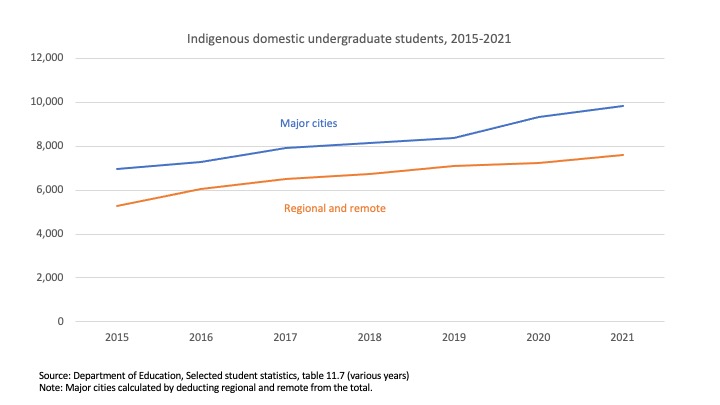
In their second submissions to the Universities Accord review Universities Australia and Innovative Research Universities both call for extending the existing demand driven system for regional and remote Indigenous students to all Indigenous students.

Mini-demand driven systems support increasing enrolments from a target population, or potentially in a target course, without risking (from a government perspective) a major cost escalation under a full demand driven system.

Although I support a return to full demand driven funding I doubt that mini-demand driven systems are a good idea.

The risks of restricted-use funds

From a government perspective the attraction of mini-demand driven systems is their apparent pursuit of some desirable outcome at low cost. Only funding for the estimated additional student places is likely to be ‘new’ money.

If so, in the transition to a new mini-demand driven system each university would lose from its overall maximum block grant amount estimated funding for current students meeting the mini-demand driven criteria – in the UA/IRU case, probably the Commonwealth contribution value of their existing student load of Indigenous students living in metropolitan areas.

As a result, ‘old’ money that could once be used flexibly for any domestic student could after the clawback only be used for about four per cent of the population.

If in practice the university attracts fewer Indigenous students than expected, or these students enrol in subjects valued at less in Commonwealth contribution terms than forecast, then the university is left with stranded resources. It has student funding that is theoretically available but in practice cannot be used.

Read More »

The 20,000 equity places that nearly weren’t allocated and that will probably never be delivered

At the 2022 election Labor promised up to 20,000 new student places in skills shortage areas for members of equity groups. The minister announced high-level allocations last October. The funding agreements implementing the promise for 2023 were published last month, providing additional but not complete detail. This a multi-year program and the current 2021-2023 funding agreements do not include 2024 commencing places.

This post describes the available information on student place allocation, highlighting the policy and legal flaws in distributing funding this way. The policy’s problems are exacerbated by the Job-ready Graduates Commonwealth contribution changes.

Allocations by funding cluster

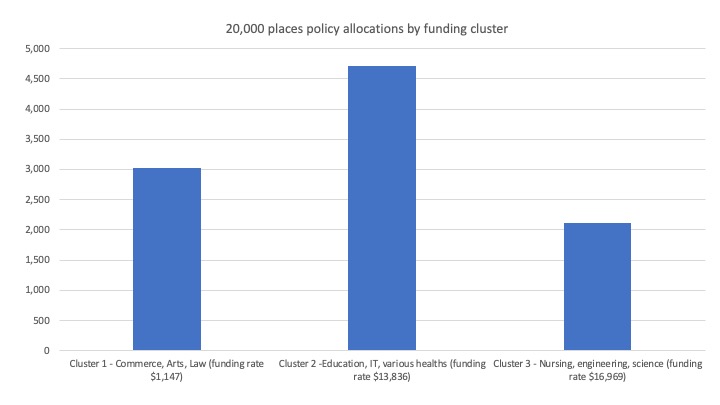
When universities received their allocations many were surprised by student places they had not requested. These were in funding cluster 1, the law, commerce and most humanities cluster. Just over 30 per cent (3,026) of the 9,851 places allocated in this round are in cluster 1.

The Department of Education’s manoeuvre can be seen in the funding agreements, an example below, which are prescriptive about the use of cluster 2 and 3 places, following information in funding applications, but not cluster 1. Instead, another clause says ‘these [cluster 1] places are to be delivered in line with a separate agreement between the Provider and the Department.’ To stay consistent with the original guidelines the cluster 1 courses need to be in skills shortage fields. Accounting and auditing are on the skills shortage list, although universities could also find other ‘relevant industry needs or shortages’.

Read More »

Urban prospective students and regional student places: the Job-ready Graduates growth mismatch

In an earlier post I looked at how Job-ready Graduates could produce fewer total student places than originally forecast. This post examines the geographic distribution of those places. Both posts draw on my first submission to the Universities Accord review.

Job-ready Graduates ‘growth’ funding is based on campus location (‘growth’ in quotation marks because it is off a reduced base). Regional campuses get 3.5 per cent annual funding growth, with 2.5 per cent for metropolitan campuses in high growth areas, and 1 per cent for other campuses. Higher growth rates for regional campuses reflect concern about lower university participation rates for people from regional areas.

Growth funding is for coming increases in the school leaver population, which will translate into increased demand for higher education. My submission uses 2021 Census data to see where the school leavers of the mid-2020s to 2030 are located, and how this aligns with higher education policy.

City/rest of state growth rates

Full regional classifications are not yet included in the publicly available 2021 Census data, so the chart below uses a greater capital city/rest of state classification. The age groups cover the young people who will finish Year 12 and seek university entry from mid-decade through to 2030. It compares their numbers to those of people the same age at the 2016 Census, who reached/will reach university age in the first half of the 2020s.

Overall the population of 9 to 16 year olds was in 2021 13.5 per cent higher than in 2016 in the greater capital city areas and 7.8 per cent higher in rest of state areas. Population growth is significant in both categories, but larger in the cities that will get a smaller funding increment.

The chart also shows variations by specific year of age, with growth rates most aligned in the 11-to-14-years age groups.

Note: Citizens only. Source: ABS Census 2016 and 2021, TableBuilder Pro
Read More »

Higher education participation rates by time of migration and language spoken at home

Some 2021 Census is now available on the ABS TableBuilder site, allowing additional analysis of the social and personal characteristics of higher education students. This posts looks at migration status and language spoken at home, previous strong predictors of higher education participation rates.

Year of arrival

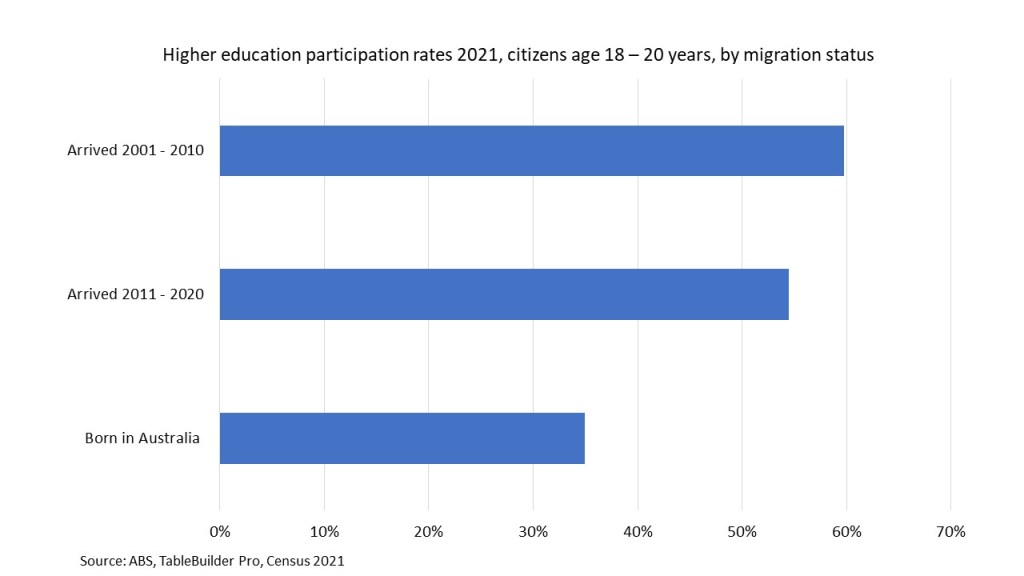
In 2021 migrants who had taken out citizenship were significantly more likely than people born in Australia to be enrolled in university in the post-school 18 to 20 years old age bracket. The participation gap was 19 percentage points for migrants in the decade prior to the 2021 census, 54 per cent participation compared to 35 per cent for young adults who were born in Australia. Migrants who arrived as younger children have a higher participation rate again, at 59 per cent.

Language spoken at home

Read More »

The legal and bureaucratic problems of the government’s 20,000 additional student places policy

Last week the government’s announced the details of how it will meet its election promise of 20,000 additional student places. Many of these details create legal and bureaucratic problems for the government and universities.

General lack of statutory authority

The program guidelines, unsurprisingly given Labor’s election promise, refer explicitly to the allocation of the 20,000 places. While unexceptional in historical policy terms this is not how things work for public universities (‘Table A providers’) under the Job-ready Graduates version of the Higher Education Support Act 2003.

Section 30-10 of HESA 2003, as cut-and-pasted below, does not give the minister the power to allocate student places to Table A institutions except in the case of designation. Only medicine is currently designated. For higher education courses, covering every course except medicine, the unit of allocation is dollars rather than student places.

Read More »

Domestic student enrolment increases in the first year of COVID-19

The 2020 higher education student data has finally been released, giving us the first detailed look at potential COVID-19 influences on enrolments. This post is on domestic students. Another post examines international students.

Aggregate trends

Overall domestic student trends were positive for both undergraduates, up 2 per cent after a decline between 2018 and 2019, and postgraduate coursework, up 14 per cent after six years of stagnation or low growth. Postgraduate research was an exception, down by 577 enrolments or 1.3 per cent. Including enabling and non-award students total domestic enrolments were 1,133,519, 4.4 per cent up on 2019.*

Student ‘load’ – full-time equivalent enrolments – was up by less, 2.6 per cent. The headcount share of part-time students, defined as less than 75 per cent of a full-time equivalent study load, is only up by .7 of a percentage point, suggesting more part-time students with light study loads and/or more full-time students not at a 100 per cent study load.

Read More »

The first Job-ready Graduates university applications data

The 2021 university applications data is out today, of more interest than usual due to two big events, COVID-19 and the Job-ready Graduates policy changes.

Early in the pandemic I thought there might be a moderate increase in school leaver applications and a larger one for mature age students. The primary reason in each case was the counter-cyclical aspect of higher education demand, with some people studying when work is hard to find.

On top of this, under Job-ready Graduates the government introduced significant changes to student contributions, so that some courses cost 2021 commencing students much more than those who commenced in previous years, while other courses cost less.

Total applications

The trend in total domestic application numbers is complicated by a change to the Queensland school starting age in 2007, which produced a dip in Year 12 numbers in 2019 with negative consequences for university applications for 2020 and a rebound in 2021. DESE has produced trend lines with and without QTAC figures to account for this issue, with the non-QTAC figures producing an increase of 2.3 per cent between 2020 and 2021 (4.4 per cent with QTAC). It’s not super-fast growth, but the 2.3 per cent is the highest since 2015.

Read More »