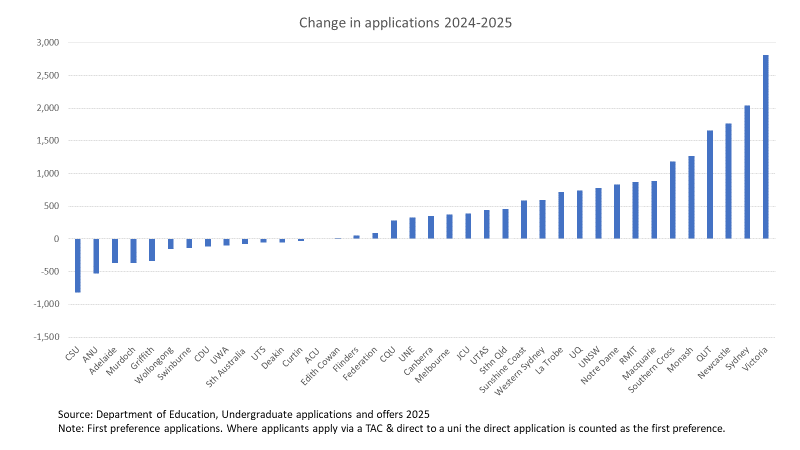
Despite an increase in applications for the 2024 academic year, school leaver interest in higher education remained below mid-2010s levels

University applications statistics for 2022 to 2024 were finally released late last week, giving us another data source on demand for higher education.

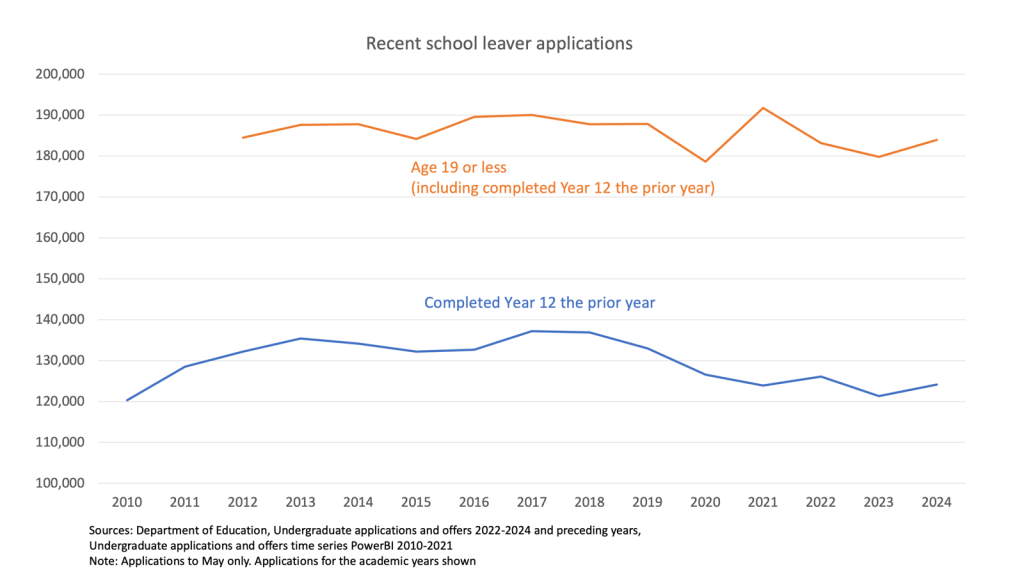
This post focuses on recent school leavers. The chart below shows that applications for this group were up in 2024 on 2023, but that the slump in applications since the late 2010s remained evident – other than the spike for academic year 2021, which is only apparent for teenagers who finished school prior to 2020. This is consistent with people deciding to sit out the COVID recession at university.

That COVID spike meant that in 2021 an unusually large share – 35% – of the 19 and under applicant group were not people who had finished school the year before. This share was 32.5% in each of 2023 and 2024, higher than any year 2012 to 2020, when it averaged 28.4%. This could mean that we are seeing more young people delaying higher education. This data source does not, however, distinguish between people who delayed applying until one or two years after finishing school, and people who enrolled but reapplied to change university and/or course.

Read More »

Accord implementation proposals, part #4: Managed demand driven funding for equity students

When the Accord final report was published one recommendation that confused me was a policy to increase equity student enrolments that was “effectively ‘demand driven for equity’ but with planned allocation of places to universities”.

A demand driven system, under which universities can enrol unlimited numbers of students meeting set criteria, can sit alongside a system of allocated student places or funding. Current Indigenous bachelor degree demand driven funding, which would be retained in the Accord model, sits alongside a soft capped block grant for most other students. But for the same courses, or student categories, demand driven and allocated student place systems are mutually exclusive.

Any hope of clarity has been dashed by the Accord implementation paper on managed growth. It proposes “managed demand driven funding for equity students”.

Read More »

What’s new in the university funding agreements, part 3: new rules on early offers

Earlier this year I wrote a couple of blog posts on the 2024 university-Commonwealth funding agreements signed late last year. Revised agreements were signed in May 2024. These agreements include new rules on early offers. This post argues that early offers rules should be legislated separately and not included as a condition of Commonwealth Grant Scheme funding.

Restrictions on school leaver early offers

As foreshadowed by the minister in February, university funding agreements now restrict school leaver early offers. The basic rules are 1) No offers to Year 11 students; 2) No offers to Year 12 students prior to September; and 3) Offers must be conditional on successful completion of a senior secondary certificate of education.

Read More »

Creating a better integrated education system – some notes on Rethinking Tertiary Education, a book building on the work of Peter Noonan

Peter Noonan was a rare person with expertise across vocational and higher education, and an even rarer person who made significant policy contributions to both. Sadly he passed away in 2022 at the age of 67.

Rethinking Tertiary Education, co-edited by Peter Dawkins, Megan Lilly and Robert Pascoe, with sixteen others as co-authors, is billed as ‘building on the work of Peter Noonan’, and does so by exploring ways of making the component parts of Australia’s formal education sector – especially higher education and vocational education, but also schools – work together more smoothly than now. Pascoe also contributes an interesting biographical chapter on Noonan.

For historical and political reasons the vocational and higher education systems in Australia have quite sharp dividing lines in the nature of the qualifications they deliver, how they are funded, how they are taught, and with some exceptions the occupations they support. The book also looks at school credentials, especially the idea that they don’t measure all they should.

Read More »

What’s going on with domestic undergraduate numbers? Part 1, Demographic differences

Higher education enrolment data for 2022 was released on Monday. Overall enrolments fell 3.2% in 2022 compared to 2021. A 1.9% increase in international student numbers partly offset a 5.1% decline in domestic numbers. In 2021 overall enrolments also fell, with the opposite dynamic – an increase in domestic students partly offset a decline in international student numbers. The 2021 and 2022 enrolment decreases were the first total enrolment reversals since the early 1950s.

Domestic undergraduates

This post focuses on domestic undergraduates, the subject of many media inquiries and much speculation. The chart below shows that enrolments started growing in the late 2000s, at a fast rate during the demand driven funding era, before entering a more subdued phase in the late 2010s and then the decline discussed in this post. Sub-bachelor courses are a larger share of the total more recently than in the 2000s.

Overall domestic bachelor enrolments decreased 4.9% in 2022 compared to 2021. Despite a 2 percentage point increase in attrition rates for commencing 2021 students into 2022, the continuing cohorts offset a larger fall in commencing bachelor-degree students of 8.6%. That’s more than double the previous largest commencing student decline this century, in 2003, when the then-minister cracked down on over-enrolments. Sub-bachelor numbers are down around 4% for both commencing and total.

Read More »

The complex rules around admitting, funding and supporting higher education students

[Update 18/12/2023: Some parts of this post have been revised as the enacted student support guidelines replaced the draft guidelines. The revisions are noted in the text.]

The support for students policy discussed in a previous post adds to an already complex system for admitting, funding and supporting higher education students. Universities have strongly argued against additional bureaucratic processes in areas covered by existing regulation. This is a positive sign – a much better strategy than taking under-funded nuclear submarine student places – and I hear that the final support for students guidelines will be at least somewhat better than the draft guidelines.

The content below is my attempt to understand how all the different rules in this space overlap, interact and potentially contradict each other. While the support for students parts may change soon (the legislation operates from 1 January 2024 [Update 18/12/2023: Now delayed until 1 April 2024]), some existing rules look redundant to me. A warning: this post contains mind-numbing details and distinctions.

Initial admission to a course

The most general rules apply on admission to a course, with TEQSA responsible for enforcement. These protect high-risk students and appear in the higher education threshold standards. They require that:

“Admissions policies, requirements and procedures are … designed to ensure that admitted students have the academic preparation and proficiency in English needed to participate in their intended study, and no known limitations that would be expected to impede their progression and completion”: Part A, section 1.1.

Order of funding priority

For Commonwealth supported students selection decisions must, in the “provider’s reasonable view” be made on “merit”: section 19-35(2) of the Higher Education Support Act 2003. The provider can, however, take into account “educational disadvantages that a particular student has experienced”: section 19-35(3).

As I noted last year, this requirement is in tension with university practices and government policies on admitting members of equity groups in preference to other applicants. The equity group categories are only proxies for educational disadvantage; membership does not say anything certain about a “particular student”.

Read More »
Mapping Australian higher education 2023 – official release

Update 20/12/2025: More recent data here.

Mapping Australian higher education 2023 is now available from the ANU Centre for Social Research and Methods website.

Update 30/10/2024: There is a later version of Mapping 2023’s data here.

Update 26/10/23: A reader has pointed out that list of FEE-HELP NUHEPs is incomplete. A column of names from the original Excel file was omitted during production. The full list is available here. This list also includes three non-FEE-HELP providers registered by TEQSA since the pdf version was finalised. A corrected version of Mapping with the full list of NUHEPs, as of mid-2023, is here.

If anyone has noticed other errors please let me know.

For universities the Accord interim report proposes a more extreme version of Job-Ready Graduates

The Australian Universities Accord interim report recommends overturning the most controversial Job-ready Graduates policy, using student contribution price signals to guide student course choices.

But overall the Accord interim report and Job-ready Graduates have strong parallels. They both take a utilitarian view of higher education, that its purpose is to provide benefits to others rather than being of any intrinsic value. Universities exist to meet skills needs, find practical uses for research, contribute to their local communities, and promote equity. The main difference is the interim report proposals are, with student contributions the main exception, more extreme and interventionist than Job-ready Graduates.

Substantially reduced university autonomy

Historically universities in Australia and other western countries have operated with a significant degree of autonomy from government. But despite using the word ‘autonomy’ a few times the Accord interim report shows little interest in this idea.

On my count at least 25 interim report proposals would reduce the scope of university-level decision making or are new reporting requirements that set universities up for future regulation. In my list these cover general mission direction, student admissions, the mix of disciplines and courses, curriculum and teaching, use of funds, and accountability.

Read More »

University offers under Job-ready Graduates

In an earlier post I looked at how university applicants responded to COVID-19 and the new Job-ready Graduates student contributions. In this post I look at how universities responded, based on the offers statistics released yesterday. All the numbers are for domestic undergraduate applicants only.

The incentives faced by universities

In the lead up to 2021 university offers university leaders made various statements about trying to meet expected extra domestic demand, as COVID cut job and travel alternatives to study. But universities also faced, and face, a difficult finanacial situation. They are simultaneously being hit by the Job-ready Graduates policy, which reduces their per student funding in many fields, and by the loss of international student revenue, with the borders now closed to new international students since March 2020. These events compromise university capacity to fund domestic undergraduate student places that do not cover their own costs

Capacity aside, Job-ready Graduates creates complex incentives. By funding at average teaching costs it creates an economies of scale model. That’s one reason why we see the closure of low enrolment subjects and courses. If there is no longer any profit on some courses that may also disincline universities from expanding. On the other hand, if universities want to maintain a course then driving up enrolments may the key to it, by spreading fixed or semi-fixed costs over larger numbers of students. And in the $14,500 student contribution fields – arts (with a few exceptions), business and law – there may be a de facto demand driven system.

Universities also need to consider a complex short-to-medium term negative effect caused by JRG only partially grandfathering pre-2021 students. The link has explanatory detail, but the practical consequence is that more of a university’s total Commonwealth teaching grant has to be spent on continuing students, leaving less money for new students.

Yet another complexity for universities is that COVID-19 made estimating student numbers more difficult. For admissions, the key risk was that offer acceptance rates would be higher than usual, and the university would end up with loss making ‘over-enrolments’ (enrolments that earn a student but not a Commonwealth contribution). This created an incentive to be cautious about offer levels.

Read More »

Recurrent critiques, concerns and crises in Australian higher education

In a previous post on Gwil Croucher and James Waghorne’s Australian Universities: A History of Common Cause, I noted a range of significant changes in Australian higher education over the last century. This post looks at recurrent themes.

Debate about the purpose(s) of the university

From the start Australia’s universities served multiple purposes, with on-going tensions between knowledge for its own sake, typically most strongly supported by academics, and meeting practical needs, typically most strongly supported by governments.

At the 1920 meeting that Croucher and Waghorne mark as the start of a national organisation of universities, University of Sydney Chancellor Sir William Cullen warned against ‘adopting too enthusiastically the current preoccupation with ideas of “national efficiency”‘.

Read More »