The legal basis of performance funding

In December 2017, the Commonwealth froze maximum Commonwealth Grant scheme funding for bachelor-degree places for the next two years. In subsequent years, the maximum payment will increase in line with growth in the 18-64 year old population, conditional on universities meeting performance indicators.

Just before the 2017 announcement, I outlined its legal basis. It used university funding agreements to set the maximum amount, with the method chosen because it did not need parliamentary approval.

At least initially, performance funding will be administered via the funding agreements, which include a standard statement that should the university meet its performance targets it will be advised of a new maximum funding amount.

A drawback of this method of allocating performance funding is that there is no performance fund. The underlying demand driven funding system is still operating, and under section 33-5(5) of the Higher Education Support Act 2003 universities receive the lesser of their demand driven funding amount (bachelor-degree full-time equivalent student places times the relevant Commonwealth contribution) and their maximum funding amount.

All the Commonwealth is doing is promising universities it will pay a little more of what they would have been entitled to anyway under demand driven funding. Read More »

Current higher education policies are the unsatisfactory result of political misjudgements in 2017. There are better ways of balancing the interests of students, universities and taxpayers.

Higher education is one of the sectors most affected by Saturday’s surprise election result. Labor’s biggest promise, restoring demand driven funding from 2020, would have delivered universities funding for all bachelor-degree students, with Commonwealth  contribution rates 5.3% higher than they were were in 2017. This did not require legislation; the current funding freeze was imposed through university funding agreements and could have been ended the same way.

By contrast, if the Coalition’s current policies stay in place there will be no demand driven funding and most universities face limited nominal increases in total Commonwealth Grant Scheme funding for bachelor-degree students (a few unis have special deals that will deliver larger increases). The best-case scenario for most universities is an annual total CGS funding increase linked to growth in the 18-64 year old population, if they meet yet-to-be-announced performance criteria.

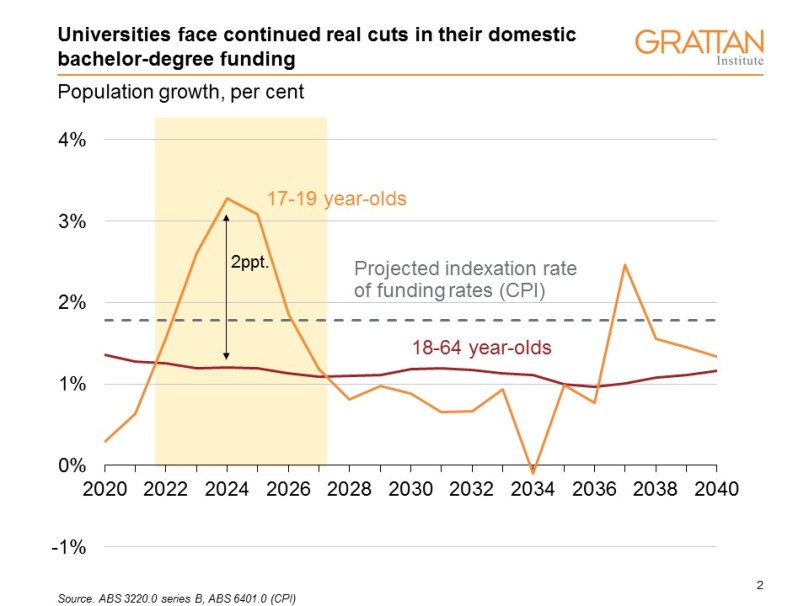
The mention of population gives the impression that the policy will respond to demographics, but this is not correct. As the chart below shows, the projected increase in the 18-64 year old population is below even recent low CPI increases. In real terms total funding for bachelor-degree students will continue to decline.

population funding

If universities decide to maintain per student funding they would provide fewer student places each year (the logic is explained in this submission). It’s not clear to what extent this will happen. Commencements were down in 2018, but quite possibly due to weak demand for student places rather than a reluctance to supply them.  Existing enrolment projections, based on numbers universities give to the Department, suggest modest growth to 2022. But whether this would be sustained long-term with annual real funding cuts is unclear.Read More »

Young people were less likely to enter higher education in the years after Whitlam than before. Demography and deficits were against them.

The three politicians with the greatest impact on higher education participation were Robert Menzies, John Dawkins and Julia Gillard. Yet I never hear anyone say, depending on their age, that “I only went to university because of Menzies/Dawkins/Gillard”.

Yet for Gough Whitlam the story is different. Last week USQ VC Geraldine Mackenzie was reported in the Australian saying “I was very fortunate to go to university after the Whitlam years when it was all free. Otherwise I may not have had that same opportunity.” And in February shadow education minister Tanya Plibersek told the Universities Australia conference that “it feels like every week, I meet someone in their 60s or 70s who reminds me about how Gough Whitlam was responsible for them going to university.”

I have argued before that Whitlam, Prime Minister 1972-1975, was very significant in the history of Australian higher education and has some lasting legacies. But I think the lesson from Whitlam’s time for now is that the biggest drivers of participation are supply-side policies on student places, and in particular how they interact with demography and fiscal policy. Because both these factors were significant in the free education era, the long-term trend towards increased higher education participation was interrupted.

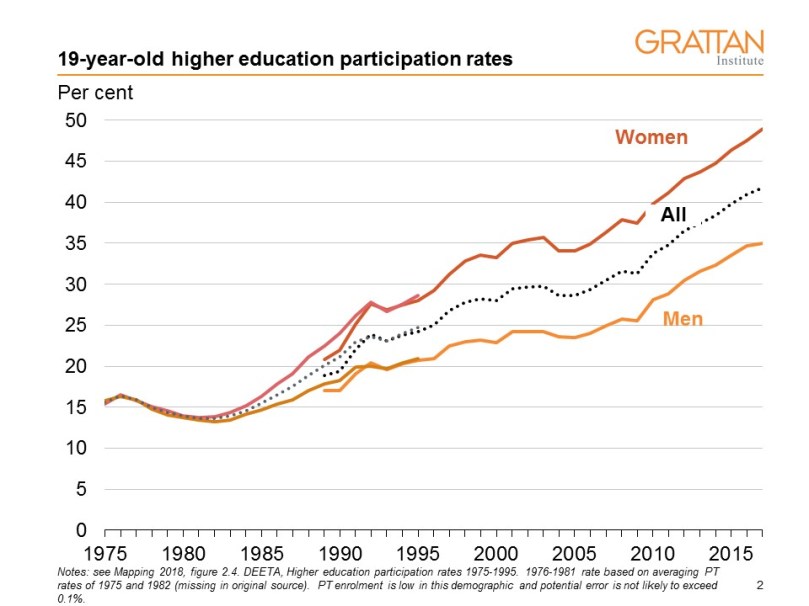
Free education lasted from 1974 to 1986 (there were small charges in 1987 and 1988, before HECS started in 1989). The chart below shows that 19-year-old participation rates went up in 1976 but then fell and did not return to the previous peak until 1986. At the low point in 1982, the 19-year old higher education participation rate was 2 percentage points lower than it had been in 1975 (unfortunately, my data source starts in 1975).

19 year old participation

Read More »

1996 Cabinet papers: HECS ideas pursued and rejected

This year’s National Archives Cabinet papers release includes material related to the 1996 Budget changes to HECS.

The most important of these were replacing flat HECS rates with ‘differential HECS’, so that rates were based on subject disciplines, and lowering the HECS repayment thresholds, so that debtors began repaying earlier and repaid more at each income level (historical thresholds are at page 47 of this document).

The main submission released today does not have these final decisions, but outlines different views within the government and bureaucracy about how to proceed.

In public statements, differential HECS was justified by reference to both course costs and the expected future income of graduates. Neither Treasury nor Finance were keen on using future income. Finance noted, as others have since, that it varies a lot between graduates. Treasury thought that it was unfair that students in some disciplines would end up paying a much larger share of costs than others.

The idea that students should pay a share of course costs has regularly resurfaced since, most notably in the 2011 base funding review. But in the Cabinet submission we see an early version of why this idea has been consistently rejected. In the draft differential HECS rates based on cost recovery, law ends up in the cheapest band 1 (of 5; there were 3 in the end), while nursing is priced in the middle. Nurses paying more than lawyers is not an easy political sell. In the final announced decision, law was in the highest-priced band and nursing in the lowest-priced band.

The Cabinet submission also has a pricing rationale of expected demand that was not, so far as I know, used in public statements.  If demand already greatly exceeds supply, prospective students are less likely to be price sensitive. But politically that raises the possibility that other students would be price sensitive, which the government wanted to downplay.

Capping access to subsidised higher education to one degree or to a time period was considered; the Fraser government had tried something similar. In the final policy this was sort-of implemented by concentrating funding cuts on postgraduate coursework places. A fuller version of the idea arrived with the 7-year learning entitlement under Brendan Nelson, which started in 2005.  It was later abolished by Labor.

While mainly about course charges, the submission also mentions means-testing access to income-contingent loans by linking it income support thresholds. That would have been the most radical conceptual departure from current policy in the submission if it had been approved. There is also the Department of Finance’s usual attempt to get real interest on student debt, which wins the prize for the most-suggested change to student loans that has never been legislated.

One omission is interesting in light of subsequent policy concerns. Although there is mention of the fact that (by design) not all HECS debt will be repaid, there are no estimates of how significant this is. Perhaps some numbers were in other submissions we have not seen yet, and could explain the big reduction in repayment thresholds.

In 1996 government accounting conventions struggled with income contingent loans, as they still do. The submission mentions which changes will and won’t count towards the politically-salient Budget deficit. Because expected losses from student doubtful debt are not counted in the deficit/fiscal balance, this biases policy towards cutting direct grants to universities, which do count.

Fortunately, however, accounting conventions did let 1996 policymakers see that selling the HECS debt was a bad deal for taxpayers. Another Cabinet submission makes this clear. This possibility was raised again in 2013, with the same eventual conclusion.

As these submissions show, many ideas around HECS/HELP recur repeatedly over time.


When can domestic undergraduates be charged full fees?

Revised 2/1/2024, principally to remove reference to repealed laws denying funding to students who had not successfully completed a sufficient share of subjects taken. Further updated 22/7/2025 to include reference to FEE-FREE Uni Ready places.


‘Full fees’ is a term used in Australia as an implied contrast with students who pay a student contribution, a price-capped student charge. A student contribution is usually combined with a tuition subsidy called a ‘Commonwealth contribution’. The two contributions together are the overall funding rate for a ‘Commonwealth supported student’.

‘Full fee’ means that there is no government subsidy and the student pays all the provider charges. These fees are not price capped, although there is a price floor for international students

A ‘full fee’ should be distinguished from an upfront fee or student contribution, which is paid directly to a higher education provider. All international and some domestic students are ineligible for a HELP student loan and therefore pay upfront.

About 6 per cent of subjects taken by domestic undergraduates are full-fee paying. The simple explanation for this is that domestic undergraduate students in public universities pay student contributions rather than full fees, while undergraduates in private universities and non-university higher education providers pay full fees. However, there are exceptions in both cases, sometimes at the unit of study (subject) level rather than the course.

In what follows, all statutory references are to the Higher Education Support Act 2003.

Entitlement to Commonwealth support at a public university

Universities have significant discretion in advising domestic students that they are Commonwealth supported: section 36-5. 

A domestic student is an Australian citizen, a New Zealand citizen, or a permanent visa holder: section 36-10(2).

Generally, domestic undergraduates enrolled in a Table A university (commonly known as public universities, although including the two Catholic universities, ACU and Notre Dame) must be enrolled as a Commonwealth supported student: section 36-30(1). Exceptions to this are discussed below. 

Once a student is a Commonwealth supported student, he or she can be charged a student contribution but cannot be charged another tuition fee: section 169-15(1).

If a student is not Commonwealth supported they must pay the tuition fee set by the provider: section 169-15(2). 

Becoming a Commonwealth supported student creates an on-going entitlement for that course, unless one of the exceptions below becomes relevant: section 36-25(1).

Read More »

How can the government cap funding for Commonwealth-supported student places?

As reported recently, higher education is expected to face cuts in Monday’s MYEFO. My guess – but certainly not my preference – is that the government will use new university funding agreements to freeze the demand driven system, and to reduce postgraduate Commonwealth-supported places.

Under demand driven funding, most public universities are paid a Commonwealth contribution for each domestic bachelor degree student they enrol (section 33-5(5) of the Higher Education Support Act 2003), except in medicine which is ‘designated’ (section 30-12(b)).

However, section 33-5(5) includes a provision for setting a ‘maximum basic grant amount’ for ‘non-designated’ places (ie, all fields except medicine). This power has been used for the University of Melbourne and the University of Western Australia, which traded in undergraduate places for Commonwealth supported postgraduate places. What we now expect is that the maximum basic grant amount will be used for other universities to reduce future spending on student places.

This can be a freeze but not a cut in nominal terms due to section 30-27(3) which says that, where a maximum basic grant amount has not previously been set, it cannot be less than the amount calculated under section 33-5(5) for the previous year, ie 2017 for the 2018 funding agreements. For the University of Melbourne and the University of Western Australia, it cannot be less than the maximum amount set for 2017. The freeze could be maintained by determining that the 2019 maximum basic grant amount was the same as for 2018, which is turn was the same as 2017, and so on.

It is also possible that the maximum basic grant amount will be higher than 2017, but lower than a university would have received after indexation of the Commonwealth contribution rates under division 198 of HESA and payment for any increase in student numbers under section 33-5(5).

In practice, it is likely that most universities would lose the value of Commonwealth contribution indexation and not be paid Commonwealth contributions for any additional students they enrol. Sustained over a number of years, this could do universities significant financial damage, especially if they are already locked into growth (for example, a university that increased its commencing student numbers in 2017 will have to accommodate them while they finish their degrees).

There is no equivalent of section 33-5(5) for student contributions or HECS-HELP. Therefore universities can still receive indexed student contributions for every Commonwealth supported student they enrol.

All postgraduate, associate degree and diploma courses are designated and distributed to universities through funding agreements (section 30-10 of HESA in conjunction with 30-25(3)). These places have to be allocated to funding clusters (section 30-10(2)).

The government was already planning to cut 3,000 postgraduate Commonwealth supported places, so that is likely to go ahead. They will also have to choose which discipline clusters to cut. As with bachelor-degree places, universities could still receive student contributions directly or via HECS-HELP.

Existing postgraduate students who are enrolled on in a Commonwealth supported place are entitled to keep it (section 36-25 of HESA). Effectively, that is an entitlement to a place with a price-controlled student contribution but not necessarily a Commonwealth contribution. Universities would still be allowed to ‘over-enrol’ (ie take more students than their funding agreement states) but would only get the student contributions. For new postgraduate students, universities can offer full-fee places to replace lost Commonwealth supported places.

The government may also cut Commonwealth supported places in associate degree and diploma courses. Universities could still receive student contributions if they ‘over-enrol’ in these courses. However, they are prohibited from offering full-fee places in all undergraduate courses (section 36-30 of HESA).

The funding agreements are not legislative instruments, and therefore are not sent to Parliament and not subject to disallowance by the House of Representatives or the Senate. It is that, rather than any higher education policy rationale, which makes capping likely. It is one of the few options left for a government determined to make Budget savings without a Senate majority.
The VETification of higher education is a precedent that should not be set

In The Australian this morning an article points out that publicly-funded language diplomas may be not be available to new students from next year. In my view, that is a correct implication of both general policy statements on funding diplomas and associate degrees made by the government, and the specific consultation paper on sub-bachelor courses.

Unfortunately, this is a case in which the government, in attempting to fix one problem, would create several new problems.

The original problem here is that diplomas and associate degrees were, at the last minute in 2011, excluded from the demand driven system. That means that the total number of government-funded sub-bachelor places remains set by the government, the allocation of places between universities reflects largely historical decisions, and new places (when available) are distributed according to regularly changing criteria. The distribution of places does not strongly align with the preferences of students, the strategies of universities, or the needs of employers. In the review of the demand driven system I did with David Kemp, we recommended putting sub-bachelor places into the demand driven system.

On the surface, the government’s proposal looks like it is responding positively to this recommendation. Constraints on the number of funded sub-bachelor places will be lifted in two ways. First, sub-bachelor courses approved by the minister will enter the demand driven system. Second, sub-bachelor courses not approved by the minister will be given an exception on the general ban on undergraduate full-fee places at public universities.

Language courses are in trouble because they typically fail to meet both the announced criteria for sub-bachelor demand driven funding – that they articulate into a related bachelor degree program, and that they have been developed with a focus on industry needs. Read More »

Should permanent residents lose their higher education tuition subsidies?

Under current law, access to the HELP loan scheme is a rare government financial benefit linked to citizenship rather than permanent residence. It may be the only benefit in this category.

Under the government’s proposed higher education reforms, permanent residents would become entitled to HELP.* But access to tuition subsidies under the Commonwealth Grant Scheme would instead be restricted to citizens, and permanent residents put in full-fee places. For undergraduates especially, this could cost them tens of thousands of dollars.

No universally applied rules govern who is entitled to what in Australia. But  patterns of eligibility suggest some broad principles. Generally speaking, longer and stronger connections to Australia lead to wider eligibility for government-financed benefits. Underlying this is the idea of a reciprocal welfare state; paying tax and receiving benefits are linked over a lifetime. People who aren’t committed to Australia, and who probably won’t finance as well as receive government benefits, have restricted entitlements.

The clearest example of this idea in practice is the distinction between temporary and permanent migrants. Temporaries are eligible for few benefits, while permanents get almost all. It would be unreasonable to require people to make long-term taxation contributions to Australia without making them eligible for the benefits those taxes finance. But people present in Australia for only short periods should not receive benefits they haven’t financed. The temporary/permanent distinction is not as robust as it once was because of the rise of long-term but legally temporary migrants. But that is a problem with the visa categories more than the underlying principle.

The Australian welfare state also makes sharp distinctions between residents and non-residents. Regardless of citizenship status, Australians living overseas generally aren’t entitled to social security benefits (or any higher education benefits; Australian citizens studying at the overseas campuses of Australian universities generally don’t get subsidies or loans). The main exception is the aged pension, but that is linked to past residence. Again, full legal membership of the Australian community through citizenship isn’t counting for much; being within reach of the Australian taxation system matters more.

Why are citizenship and higher education benefits linked in an unusual way?Read More »

Is a public-private ‘balance’ a useful higher education funding idea?

For several decades, Australian higher education policymakers have been interested in the idea that there is a desirable ‘balance’ between public and private contributions to the cost of higher education, and that a distribution of public and private benefits should inform this.

In an earlier post, I argued that a Deloitte Access Economics report released this week had come closer than any previous work to calculating a distribution of public and private benefits of higher education. What I am not convinced of is that such a calculation is useful for policymakers.

Sometimes an analysis of personal benefits and public benefits, as distinct from some ‘balance’ between them, will be helpful. In the Deloitte report (p.10) they argue that:

The economic policy rationale for governments to support higher education is the existence of a ‘market failure’ – specifically, the existence of the public benefits described above and the fact that, in the absence of government funding, the decisions by providers and students will not drive the system toward its socially optimal operation.

Economic theory suggests that students will choose to acquire knowledge where their expected private benefit is at least equal to their cost of education. If at least some public benefit exists, then this decision-making process will result in a suboptimal level of knowledge transfer activities.

In order to increase levels of knowledge and maximise the total net social benefit of higher education, governments need to be able to identify the public benefits being created, such that appropriate subsidies can be derived and applied. Identifying the relative split between public and private benefits may then inform the relative subsidy payments based on these dimensions.

Apart from the sentences in bold, I agree. I have made similar arguments myself.

The problem with the first bolded sentence is that the presence of public benefits does not of itself lead to sub-optimal levels of education. This will only happen if the total net private benefits are too low to justify enrolment. In those cases, tuition subsidies reduce costs and make it easier to get to positive net private benefits. This may encourage prospective students to enrol when otherwise they would not.

The main argument of my 2012 Graduate Winners report is that even though market failures are possible, with income contingent loans there are only limited empirical circumstances in which they actually exist.

In most cases the private benefits of higher education are already so large – Deloitte, like previous research, identifies hundreds of thousands of dollars or more extra in lifetime income (p.34) – that the tuition subsidies are unlikely to sway the decisions of someone acting in their rational economic self-interest. Subsidies at the levels historically seen in Australia usually add relatively small amounts to net private financial benefits that are already large enough to attract students to higher education. And this is before we take into account other factors influencing people to attend higher education, such as interest in their field of study, access to particular careers, the lifestyle experience of campus, status, and keeping parents happy. Read More »

The quest for a public-private higher education funding ‘balance’

Despite some contrary-sounding quotes from me in yesterday’s Australian, I think a new Deloitte Access Economics report on the public and private benefits of higher education is both a valuable overview of the literature and a significant contribution in its own right to the Australian analysis of this topic.

My criticisms relate primarily to the conceptual framework given in the original brief from the Department of Education, which I will turn to in another post. This brief in turn was based on an idea with a long history in Australian higher education politics, that there should be a ‘balance’ between public and private contributions to higher education costs, which should be related to public and private benefits.

The 1988 Wran report, which led to the introduction of HECS, argued that students should contribute to the cost of their education because they typically derived a private financial benefit from a degree. It noted that there were public as well as private benefits from higher education, but it was hard to apportion them (p. 53). This was a reason for not using analysis of either to set student contribution rates – instead, they went for a percentage of costs rather than benefits. In the version of HECS announced by the government there was a flat student contribution rate equivalent to about 20 per cent of average per student costs.

Empirically, the Wran committee could not find a way to make a distribution of public and private benefits work as a pricing mechanism. Conceptually, however, there was a certain logic to it. If students should pay for the private benefits they receive, shouldn’t the public also pay for the benefits it receives?

In 1996, announcing big cuts to per student public spending on higher education, the government echoed the Wran report, saying that although the ideal balance between public and private contributions could not be precisely established, the private benefits were substantially greater than those implied by the current HECS rates. Private benefits ended up doing almost all the policy work – the new ‘differential HECS’ rates were mainly linked to assumed future income. The higher the potential income, the higher the HECS rate. Read More »