The first COVID-19 support package for higher education

Update 15/4/20: This post contains material that has been revised and republished to take into account later information.

——————————————————–

The government now has a support plan for higher education. The key elements are letting universities keep student-related grants and loans in 2020 even if they enrol too few students, funding short courses, and regulatory fee relief.

In this era of government by tweet, media report, media release and media conference the details of how this might work are lacking as of today. I will revise this post as more detail comes to hand. For now, I will focus on the broad outline and pursue my pedantic interest in the legal basis of government policy.

Commonwealth Grant Scheme

The government’s biggest higher education funding program is the Commonwealth Grant Scheme, which pays tuition subsidies of over $7 billion a year. Under the Higher Education Support Act 2003 total payments for the year cannot exceed equivalent full-time student numbers multiplied by the relevant Commonwealth contribution.

Universities are paid fortnightly based on estimates of their CGS entitlement for the year. A few days ago the University of Sydney announced that it was down 5 per cent on its domestic student target (which could include full-fee students, which I will come to below). Whether this is due to COVID-19 or because it was just losing out in a tough NSW market is not clear. A number of other universities were struggling before COVID-19 due to demographic factors.

Whatever the reason, the minister now says that universities will be paid their original estimated funding rather than their legal entitlement. This also suspends the need to meet performance funding criteria, which is sensible. Read More »
COVID-19 could have a high fatality rate in the private higher education sector

If things look bad for public universities in the COVID-19 era, they look much worse for many providers in the private higher education sector.*  Not all are likely to survive a significant downturn in the international student market.

Although there are some commercially very successful players in private higher education, that is not the universal experience. When TEQSA reported on financial risk last year, it rated 12 per cent of for-profit providers as high risk, and 44 per cent as moderate risk. For not-for-profits, the corresponding risk ratings were 5 per cent and 40 per cent. This equates to more than 60 providers at high or moderate risk. As of April 2020, there are 134 non-university higher education providers.

The private higher education sector is diverse, with 37 providers having no international students in 2018 (based on not having a CRICOS registration). Generally speaking, however, the private higher education sector is more exposed to the international student market than public universities. About half of private sector students are internationals, compared to 31 per cent in the public universities. The true number is likely to be higher, as the statistics only include providers that have signed up for FEE-HELP, a domestic student loan program.  Providers aimed exclusively at the international market have no need for FEE-HELP.Read More »

What could the government do to stabilise university finances?

There are some pretty high figures circulating about possible university losses due to COVID-19. I have seen no supporting evidence to justify the estimates, and the top-of-the-range numbers are implausible. Nevertheless, 2018 financial data shows many institutions with thin operating margins. We have grounds for concern about how they would manage a major hit to their finances.

On the revenue side, we have actual or potential losses from international students who never arrived, international students who may have gone home, domestic students withdrawing prior to the census date, and domestic students claiming student contribution refunds and HELP remissions because their course delivery methods changed.

On the cost side, universities have had to finance quick transitions to online education for students and working at home for staff, as well as some universities offering students financial support.

This post summarises things that the government can do within existing or announced legislation to stabilise university finances. I have blogged about some of them before and will note them concisely here. Of course, other policies supported by new legislation are also possible. Read More »

COVID-19 means that universities should not be held to performance funding targets

Update 6/4/20: Since this post was written, the minister has indicated that performance funding is being reconsidered due to COVID-19.

The government’s university performance funding scheme was always based on  questionable assumptions. Among them is the belief that we can reliably distinguish a university’s contribution to various outcome indicators from the other influences on those same numbers.

I’m sceptical enough of this in normal times. But COVID-19 means that, despite the extraordinary efforts of academics and other university staff to provide continuity of education and student support, three of the four performance indicators – graduate employment, student satisfaction, and equity group enrolment share – will or are likely to worsen compared to recent years. The fourth – attrition – will probably show a positive trend that also has little to do with university performance.

Due to the total amount of performance funding being linked to population growth, COVID-19 driven changes to migration levels will also reduce how much performance money is on offer.

Graduate employment

Let’s start with graduate employment, which has a 40 per cent weighting in the performance funding formula. As I argued in a blog post on Monday, previous record-bad employment results in 2014 will be significantly exceeded. Read More »

Will university staff receive the JobKeeper payment?

Update 9/4/20: Since this post was written there was, briefly, some expectation that the revenue loss required for universities would be lower for 15 per cent. That is not happening. 

Update 24/4/20: This story keeps evolving. Due to a loophole in the legislative instrument, which sets the revenue base at GST turnover rather than total income, some universities look like they have a basis for receiving JobKeeper.

Update 25/4/20: Cancel yesterday’s update, the government is moving to block that one. But there may still be other ways that universities can get JobKeeper. A new post updates the story.


Last night there was some Twitter discussion about whether university casuals would receive the new JobKeeper payment of $1,500 a fortnight. It is to be paid via employers, but casual staff are not eligible unless they have been employed on a regular basis for the last 12 months. Given the on-gain, off-again nature of casual teaching many probably would not be eligible.

But the first issue is whether universities are eligible employers. To qualify, they need to have suffered a significant loss of revenue:

Employers (including not-for-profits) will be eligible for the subsidy if:
• their business has a turnover of less than $1 billion and their turnover will be reduced by more than 30 per cent relative to a comparable period a year ago (of at least a month); or
• their business has a turnover of $1 billion or more and their turnover will be reduced by more than 50 per cent relative to a comparable period a year ago (of at least a month).  (emphasis added)

In 2018 eleven universities had annual revenues exceeding $1 billion. They therefore have the higher 50 per cent drop in revenue requirement, rather than the 30 per cent drop for smaller universities. Read More »

Sitting out the recession at university: postgraduate courses

In previous posts, I looked at whether demand for undergraduate education would increase during the COVID-19 recession. In this post, I examine potential demand for postgraduate education.

As with initial undergraduate qualifications, theory suggests that a recession is a good time for postgraduate study. The opportunity cost of time spent out of the workforce is lower or non-existent. Studying is a relatively productive and interesting way of sitting out a recession.

In examining what happened in previous recessions I have been helped by a project that has put all the old graduate destination surveys online (scroll down to the bottom of the page here). Recessions aside, the trends are interesting.Read More »

HELP remissions and COVID-19 university course changes

Last week I published a blog post on the financial dangers posed by the COVID-19 crisis starting prior to the census date for each subject. It is a critical date for universities. They get no Commonwealth or student contributions for subjects dropped prior to the census date.

As Stephen Matchett reported in Campus Morning Mail yesterday, social media talk about dropping subjects is still at high levels. One of the reasons, that unemployment income support benefits would be more generous than student benefits, seems to have been fixed in Parliament yesterday. Although I think students are better off finishing their course on schedule if they can, we should expect higher drop-outs than usual prior to the census date.

I am also hearing reports of international students heading home before the census date because of family pressure. They might also leave because they can no longer support themselves due to the collapse of the student labour market. Due to an extraordinary new power to widen social security eligibility some international students might temporarily receive benefits, but I think entitlements are too unclear to change short-term behaviour.

If these drop-outs are happening at any scale then, except for the universities on trimesters that are already past their first census date, then serious higher education financial problems are very close, as universities will have to scale back their expected Commonwealth-supported student revenue and international student fee income for the year.Read More »

University finances, the census date and COVID-19

On Facebook I have seen undergraduate petitions calling for university classes to be suspended.  One person claimed that their institution was stalling until after the census date. This is the day when students became liable to pay their student contributions and the university becomes entitled to receive Commonwealth contributions, their government tuition subsidy.

In the Grattan report on dropping out I co-wrote a couple of years ago, we argued that the census date is an interesting and unusual feature of Australia’s higher education system. Effectively, it gives students a free try-before-you-buy option for every subject they take.

By law this period is at least 20 per cent of the semester, but on our analysis the median period before the census date was a quarter of the semester. Four weeks is common, with a census date at the end of March for first semester (earlier for universities with trimester systems).

In the other English-speaking countries we looked at students usually only have one to two weeks to change their minds without financial cost.

The late Australian date for dropping subjects or courses without cost transfers some enrolment risk from students to universities, who end up teaching students who never generate any revenue. Overall I think that is a good thing, as it creates pro-student incentives that would otherwise be lacking.Read More »

What happens if a university needs bailing out?

University finances have been in the news this year. As the travel ban on Chinese students was announced some very big financial costs were estimated – since moderated due to the third-country quarantine exception, but still estimated to be well over $1 billion, at least in temporary cash flow issues.

In worst-case COVID-19 scenarios there would be travel bans from many international student source countries, along with campus closures that could require refunds or compensating classes for affected domestic and international students.

While I doubt the worst-case scenario will become reality, the ‘rivers of gold’ era (as Simon Birmingham once described it) for university revenue is over.

Even before COVID-19 international student demand seemed to be softening, while remaining high by historical standards.

On top of this, all public universities are dealing with a decline in the real value of their bachelor-degree student funding, and some are struggling to maintain domestic student numbers due to soft demand.

Cutbacks have been reported at many universities including Wollongong, La Trobe, Sydney, Macquarie, Monash, and in the last day the University of Tasmania.

Fortunately, the universities that are most exposed to the China market are relatively wealthy. They should be able to deal with short-term liquidity issues from a mix of reduced and delayed spending, drawing on reserves and perhaps bank borrowing. But what if a university faces more serious difficulties?Read More »

Teaching public funding is skewed to STEM and health-related courses

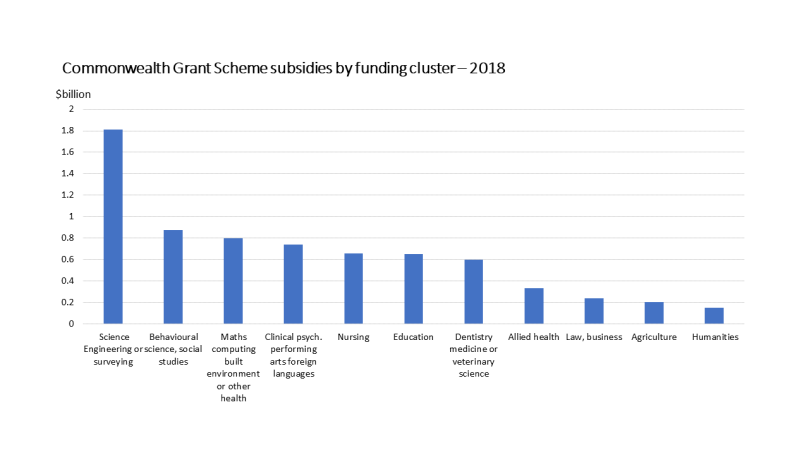
With the government now publishing data on students by funding cluster we can get a clearer idea of where Commonwealth Grant Scheme money goes.

My calculations are for 2018, and based on multiplying equivalent full-time student numbers in Commonwealth supported places by the relevant funding cluster rate. Due to the demand driven funding freeze and some universities over-enrolling allocated places the overall total exceeds what universities were actually paid. However, as it is usually not possible to specifically identify ‘over-enrolled’ students I am going to assume that this does not affect relativities between the clusters.

As the chart below shows the science, engineering and surveying funding cluster is by far the biggest recipient of Commonwealth funds, at $1.8 billion in 2018 (and this is missing the maths and statistics buried in another cluster). The health-related clusters between them received $1.6 billion, and this is also an under-count due to some health courses being in other clusters.

funding cluster spend 2018 (all)

As is the case with public research spending, public tuition subsidies are skewed to STEM and health clusters. They have 32 per cent of EFTSL but 48 per cent of funding. The humanities, which are the subject of much of the controversy around higher education, received the least money of any cluster, $151 million in 2018. This is 2.1 per cent of the total.

However, it should be noted that other subjects typically taught in Arts faculties are in other funding clusters. For example, fields such as politics and sociology are in the second largest funding cluster by dollars (which also includes psychology, social work, and similar fields) and in the fourth largest funding cluster by dollars, which includes foreign languages and media and communications, which despite a recent downward trend has grown significantly over the last decade.

(Last paragraph added after original publication after Twitter commentary.)