Preliminary 2025 funding per university for Commonwealth supported places

Due to the Department of Education’s under-reporting of higher education funding, last year I consolidated institution-level information into a spreadsheet. There were about 250 downloads each for the original and a subsequent updated spreadsheet, so I decided it was worth doing again this year. The data sources are the funding determinations for the various funding categories.

I emphasised ‘preliminary’ in the post title because the FEE-FREE Uni Ready funding is not yet included. While this is a little frustrating, the upside is that when it is added the amounts involved will be more transparent than might otherwise have been the case. [Update 28/2/25: In Senate estimates yesterday the Department said that FEE-FREE Uni Ready funding equivalent to historical enabling places as of 2022 were included in the funding agreements. Funding for new FEE-FREE Uni Ready places is yet to be released.]

The headline figures to date are Commonwealth Grant Scheme (CGS) – $8.2 billion, estimated HECS-HELP lending of $5.9 billion, and estimated upfront student contributions of $700 million. Overall, about $14.8 billion, with 95% coming from the Commonwealth in cash flow terms. That percentage will go up when we get the FEE-FREE Uni Ready information.

Read More »

Update on Accord student funding policies

With a break between jobs and other things going on I did not comment in December on the Accord-related MYEFO student funding announcements. Compared to last year’s consultation papers, the announcements included a policy change on over-enrolments, more detail on how under-enrolments will be handled, and funding amounts.

Over-enrolments

One of the worst ideas in the June 2024 managed growth consultation paper was a hard cap on Commonwealth supported places. Currently the main CSP category has a soft cap – once a university enrols CSPs valued at its maximum basic grant amount it gets only the student contribution for additional students. These student contribution-only places are known as ‘over-enrolments’. Under a hard capped system over-enrolments would receive zero funding. I explained why hard caps are a bad idea in this post.

In its MYEFO summary the government backed off a little from the hard cap idea. Now universities ‘will continue to receive student contribution amounts for a small proportion of additional students’. The reason given was the practical difficulty of hitting a precise enrolment target. [Update: At a Senate estimates hearing on 27/2/25 the Department said that ‘the overenrolment buffer will be between two per cent and five per cent’.]

Read More »

Robert Menzies and the Murray review of universities

An earlier post looked at Robert Menzies and higher education, first as Opposition leader and then as Prime Minister, from 1945 to 1956. Despite important structural changes in the early 1950s, with the Commonwealth commencing grants to universities via the states and directly financing Commonwealth scholarships, the university sector remained small and financially weak.

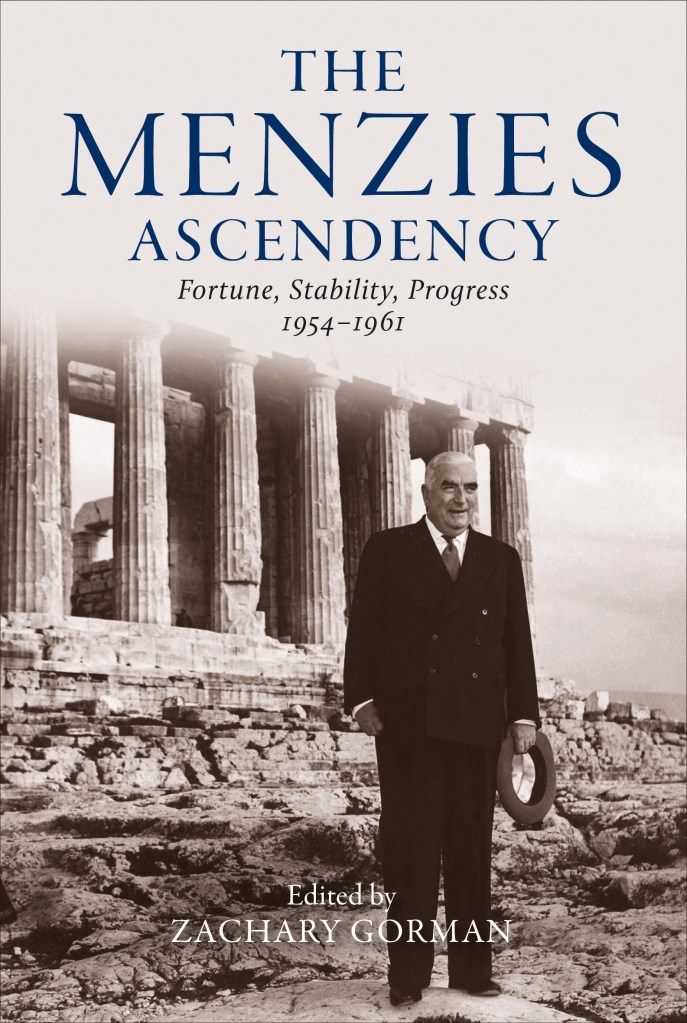
In March 1956, Menzies agreed to a university policy review, what became the Murray report. This post draws on my chapter on the Murray report in The Menzies Ascendancy: Fortune, Stability, Progress 1954–1961, edited by Zachary Gorman and published last month.

The appointment of Keith Murray to review universities

By the time Menzies agreed to the review he had already decided that major changes to university policy were needed.

In his book The Measure of the Years, Menzies says that prior to his trip to England in 1956, where he first met Keith Murray in person, he told Treasurer Artie Fadden that he was initiating an enterprise that could not fail to be ‘vastly expensive’.

In December 1956 Murray was appointed as chairman. The four other members included CSIRO Chairman Ian Clunies-Ross, believed to be the subsequent report’s main author.

Read More »

Robert Menzies and higher education, 1945 to 1956

I’m not an historian, but decided to accept a Robert Menzies Institute suggestion that I give a paper on the 1957 Murray report on universities for their 2023 conference on Menzies, which covered the years from 1954 to 1961. The book chapter version of that paper came out in December 2024.

As well as describing events surrounding the Murray report I tried some counter-factual history, in an attempt to understand the distinctive contribution of Menzies to Australian higher education policy. The post-WW2 period saw higher education expand in all the countries with which Australia compared itself. With or without Menzies, Australia’s pre-WW2 model of one impoverished, low-enrolment university in each capital city was not a plausible long-term system.

But what would have happened if Labor had remained in power after 1949, or won the close 1954 election? What would have happened if someone other than Menzies had led the Liberal Party (or the main non-Labor party, given Menzies’ role in creating the Liberal Party)?

This post looks at what happened up to 1956. A subsequent post examines the Murray report and its consequences.

Read More »

Budget treatment of student debt policy announcements

One criticism of the weekend’s big proposed changes to student debt – a new repayment system and a 20% cut to student debt balances – is that they are ‘off budget’, concealing their true cost.

The Budget includes several different takes on the government’s annual finances, including fiscal balance, headline cash and underlying cash. The Budget papers also report the value of government assets, including student debt.

The ‘underlying cash balance’ is the most commonly used Commonwealth’s Budget metric. When the Treasurer boasts about the government’s fiscal performance he uses an underlying cash measure. Unfortunately from a ‘Budget honesty’ perspective underlying cash is the weakest measure of student loan costs and of the financial impact of proposed changes to student loan policies.

Read More »

Big proposed changes to the HELP repayment system – a higher first income threshold & a marginal rate of repayment

Today the government announced big changes to the HELP repayment system. Its proposal involves several interconnected conceptual and practical considerations.

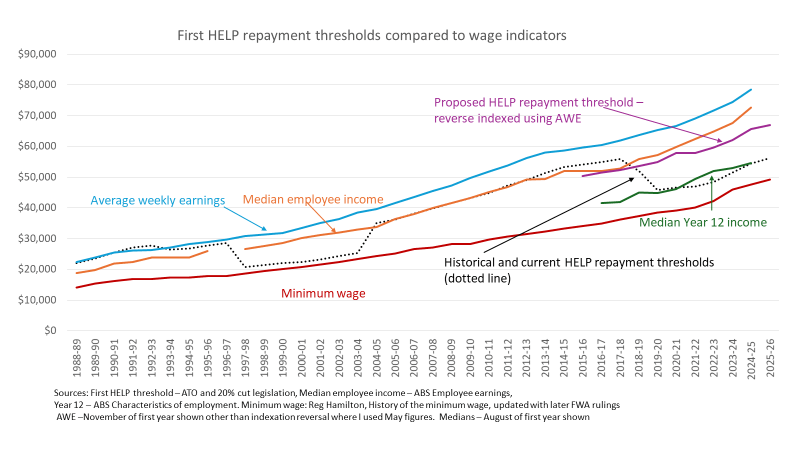
The first issue is where to set the first repayment threshold – how much should a HELP debtor earn before they start repaying? The government proposal is for a higher first threshold.

The second issue is annual repayment amounts, which affect the disposable income of debtors and how long it takes them to repay their debt. The government proposal is for most debtors to repay less HELP debt each year, increasing their annual disposable income but also their repayment time.

The third issue is the method of repayment. Should it be – as we have had since 1989 – a system which levies a % of all income when income reaches a threshold, or should we have a marginal rate system, which is a levy on income above the threshold (like the current income tax system). The government has decided on a marginal rate system.

All three issues intersect with the public finance element of HELP – the cash flow implications of the changes for the Commonwealth, and the costs in interest subsidies and bad debt. These will all be negative for the government.

In this post, I will look at the annual repayment implications for debtors, effective marginal rates of repayment, and make some initial comments about selling this reform to debtors and voters.

What the government proposes

The first threshold for repayment will go to $67,000, from $54,435 for 2024-25, and approximately $56,000 after CPI indexation for 2025-26 (I have assumed 3% indexation, which seems to be around what the government has estimated).

From this first threshold of $67,000 we will move to a marginal rate of repayment, at two levels – 15% from $67,000 to $124,999 and 17% from $125,000. These rates would replace the current whole-of-income rates ranging from 1% to 10%.

Read More »

Mapping Australian higher education 2023 – October 2024 data update

Update 20/12/2025: More recent data here.

An updated version of Mapping Australian higher education is not on the horizon, but to extend the life of the 2023 version I have updated the data behind the charts and some tables. An Excel file with these and the two further updates mentioned below is here.

Further update 6/11/2024: The 2023 Student Experience Survey results have been released. Some question changes have broken the time series but the replacement question results are recorded.

Further update 12/11/2024: A careful reader has identified the missing higher education provider mentioned below and identified other errors in my institutes of higher education appendix. Hopefully the list is now correct and complete. This update also includes 2024 bachelor and above attainment data.

The original pdf with explanatory text is here.

Some noteworthy changes since its publication:

  • We now know that domestic enrolments fell in both 2022 and 2023; enrolments last declined in 2004 (figure 3)
  • International students – although no regular reader of this blog needs this pointed out – recovered strongly from the COVID period (figure 10)
  • The source country skew of international students means that a top 15 source country does not necessarily send a lot of students, but for the first time an African country made it to the list, Kenya with 6,538 students in 2023 (figure 11) (and 7,330 onshore YTD July in 2024).
  • Higher education student income support recipient numbers continued to fall, to 156,710 in mid-2023, the lowest figure since 2009 (figure 18). While since 2022 falling income support recipients is partly due to fewer students, except for a COVID spike the number has been in structural decline since 2017.
  • Staff numbers recovered strongly in 2023 to be roughly what they were in March 2020 (figure 19)
  • HELP repayments increased increased significantly, from $5.56 billion in respect of 2021-22 to $7.8 billion in respect of 2022-23 (figure 31B). Most of this was due to voluntary repayments increasing from $780 million to $2.9 billion, as debtors sought to evade high indexation (some of which will be refunded if the indexation reduction bill passes).
  • Short-term graduate full-time employment rates improved, in 2023 reaching the best level since 2009 (figure 40)
  • The number of higher education providers continued to increase, from 198 in mid-2023 to 211 in October 2024 (appendix A and appendix B).

The Department of Education’s failure to release the 2023 Finance or Student Experience Survey publications means that the update is not as full as I would like.

A National Student Ombudsman – how would this new student complaints mechanism work?

Last week the government introduced legislation for a National Student Ombudsman.

This post outlines key provisions of the bill. A government summary is here. A subsequent post looks at the potential impact of the bill on academic life.

Statutory references are to the Universities Accord (National Student Ombudsman) Bill, using the sections as they would appear in the Ombudsman Act 1976 if the bill passes.

Which students can complain?

All students of higher education providers, except those enrolled in VET courses, can complain to the National Student Ombudsman (abbreviated to Ombudsman from now). Apart from the VET exception, non-higher education students are included. Enabling, microcredential and professional development course students will be covered. In some cases prospective or former students can also make complaints: sections 3(1) and 21AD(1)(a).

Another person can make a complaint on behalf of the student: section 21AD(1)(b).

Read More »

The underexplained and insecure Commonwealth Prac Payment

The planned Commonwealth Prac Payment aims to help students finance mandatory practical training, such as clinical training or teaching rounds. Initially teaching, nursing and midwifery, and social work students in higher education and VET will be eligible.

According to the government, the Prac payment will be means-tested and is ‘intended to support learning outcomes, where the financial impacts of placements may have otherwise influenced students to defer or withdraw from study‘ (emphasis added).

The payment will be matched to the single Austudy rate, $319.50 a week as of today.

The policy is due to start on 1 July 2025, with part of the legal framework in a bill introduced into the House of Representatives last week.

Bureaucratic and intrusive eligibility criteria

Read More »

How attractive will the FEE-FREE Uni Ready places be to universities?

Last week the government introduced legislation that would, among other things, create a new funding category for what we now call enabling courses, which will be redesigned and rebadged as FEE-FREE Uni Ready places. These courses help prepare students for higher education study.

The current system

Under the current system, Commonwealth supported enabling places are funded at the Commonwealth contribution rate for the relevant discipline.

Enabling places are not capped but the financial incentives to enrol enabling CSP students are weak because no student contribution can be charged.

An enabling loading is paid in lieu for universities with an allocation of enabling funding, but many universities have no enabling loading or a low amount.

The government does not seem to update the enabling loading in a public place, but indexing a previous rate I think it is $3,886 per EFTSL in 2024.

Job-ready Graduates affected the financing of enabling places in fields with Commonwealth contribution cuts. Nearly 40% of enabling places are in the lowest Commonwealth contribution field, $1,236 for 2024. That plus the enabling loading = $5,122 per place.

Read More »