Mapping Australian higher education – December 2025 data update

To prolong the life of Mapping Australian higher education 2023 I have been updating a spreadsheet which contains the data behind the charts and tables.

The December 2025 Mapping data update is here.

Since the last update in March 2025 the changes include the 2024 enrolment data, the 2024 university financial information, and graduate employment outcomes.

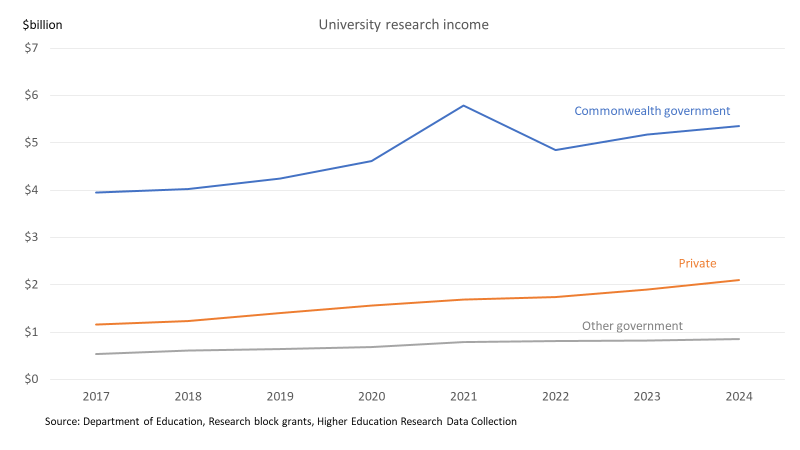
Research income has been the most recent significant data release, including research block grant funding for 2026 and the HERDC data used to calculate it, which goes up to 2024. The chart below shows the research-specific income sources 2017-2024.
I will next update the spreadsheet when we have projected 2026 spending on Commonwealth supported places in the first quarter of 2026. I hope by then the 2025 staff data will also be available.

Creating a better integrated education system – some notes on Rethinking Tertiary Education, a book building on the work of Peter Noonan

Peter Noonan was a rare person with expertise across vocational and higher education, and an even rarer person who made significant policy contributions to both. Sadly he passed away in 2022 at the age of 67.

Rethinking Tertiary Education, co-edited by Peter Dawkins, Megan Lilly and Robert Pascoe, with sixteen others as co-authors, is billed as ‘building on the work of Peter Noonan’, and does so by exploring ways of making the component parts of Australia’s formal education sector – especially higher education and vocational education, but also schools – work together more smoothly than now. Pascoe also contributes an interesting biographical chapter on Noonan.

For historical and political reasons the vocational and higher education systems in Australia have quite sharp dividing lines in the nature of the qualifications they deliver, how they are funded, how they are taught, and with some exceptions the occupations they support. The book also looks at school credentials, especially the idea that they don’t measure all they should.

Read More »

Mapping Australian higher education 2023 – official release

Update 20/12/2025: More recent data here.

Mapping Australian higher education 2023 is now available from the ANU Centre for Social Research and Methods website.

Update 30/10/2024: There is a later version of Mapping 2023’s data here.

Update 26/10/23: A reader has pointed out that list of FEE-HELP NUHEPs is incomplete. A column of names from the original Excel file was omitted during production. The full list is available here. This list also includes three non-FEE-HELP providers registered by TEQSA since the pdf version was finalised. A corrected version of Mapping with the full list of NUHEPs, as of mid-2023, is here.

If anyone has noticed other errors please let me know.

For universities the Accord interim report proposes a more extreme version of Job-Ready Graduates

The Australian Universities Accord interim report recommends overturning the most controversial Job-ready Graduates policy, using student contribution price signals to guide student course choices.

But overall the Accord interim report and Job-ready Graduates have strong parallels. They both take a utilitarian view of higher education, that its purpose is to provide benefits to others rather than being of any intrinsic value. Universities exist to meet skills needs, find practical uses for research, contribute to their local communities, and promote equity. The main difference is the interim report proposals are, with student contributions the main exception, more extreme and interventionist than Job-ready Graduates.

Substantially reduced university autonomy

Historically universities in Australia and other western countries have operated with a significant degree of autonomy from government. But despite using the word ‘autonomy’ a few times the Accord interim report shows little interest in this idea.

On my count at least 25 interim report proposals would reduce the scope of university-level decision making or are new reporting requirements that set universities up for future regulation. In my list these cover general mission direction, student admissions, the mix of disciplines and courses, curriculum and teaching, use of funds, and accountability.

Read More »

Conflicting visions of higher education’s purposes

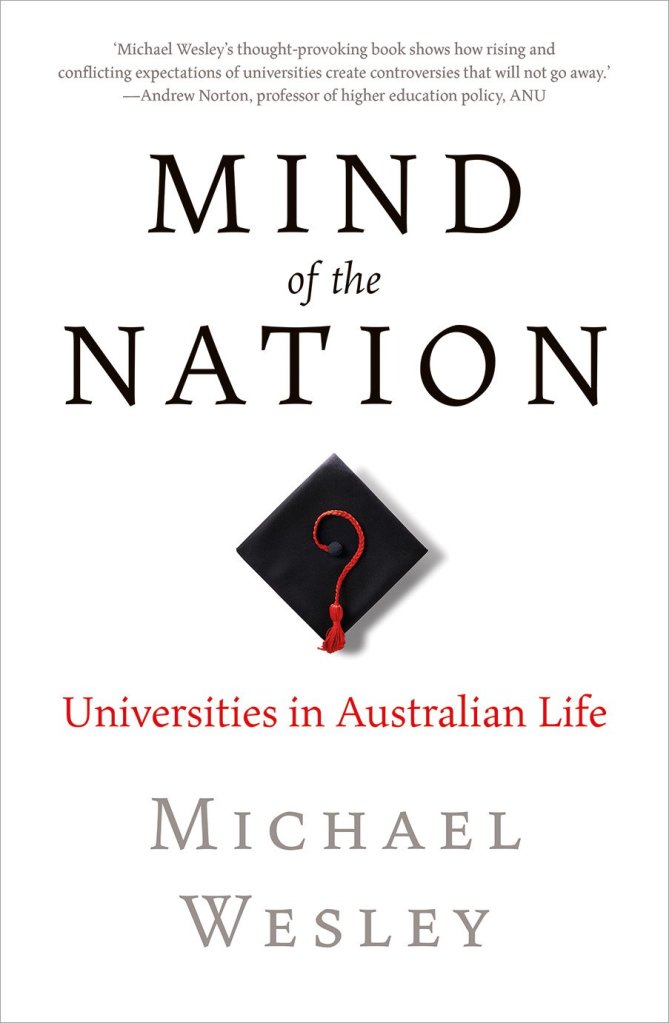
I blurbed Mind of the Nation, Michael Wesley’s new book on universities in Australian life, with the statement that it ‘shows how rising and conflicting expectations of universities create controversies that will not go away’. His book is about the cultural and political position of universities rather than higher education policy as such, although policy provides evidence of how politicians and voters see universities.

University administrators – Wesley is a deputy vice-chancellor – are at the centre of these controversies, blamed by all sides for whatever is wrong with universities. Mind of the Nation explores why universities receive so much critique and so little love or (from a university perspective) public funding, despite many successes and contributions: life-changing experiences for students, moving from an elite to a mass higher education system, creating a new export industry, large increases in research aimed at solving practical problems, and engagement with local communities.

Wesley asks why Australians admire the successes of their sporting teams, musicians and actors but not universities.

Read More »

The Budget and higher education

The Commonwealth Budget has triggered confusion about higher education funding. How much does the government spend? Has there been a cut or not?

The Budget documents understate government higher education expenditure

The only summary statement of higher education expenditure in the Budget documents is in Budget Paper No. 1, which reports spending on the higher education ‘sub-function’ (sub- of education generally).

But what is in the higher education sub-function? I’ve collated as much information as I can from the Budget papers and I think it means grants administered under the Higher Education Support Act 2003. I can’t exactly replicate it but my numbers are very close – slightly less in every year. I lack expenditure on the Indigenous Student Success Program, which HESA 2003 funds but PM&C rather than DESE administers.

The ‘higher education sub-function’ significantly understates Commonwealth assistance for higher education. As the top line in grey in the chart below shows, using numbers from Budget Statement No. 4 on agency resourcing, it doesn’t even cover money flowing under HESA 2003 itself. The difference is money lent through the HELP loan scheme. Although the Budget papers don’t specifically quantify HELP lending this is likely to become the single largest source of funding for higher education, as international student revenues collapse and the Commonwealth Grant Scheme stagnates.

Read More »

Why did universities become reliant on international students? Part 5: The rise of research rankings

In my series of posts on why universities became financially reliant on international students I have, to date, focused on domestic factors. Research funding policy changes are the most important. Universities needed new discretionary revenue to finance government-supported research projects, and to pay the salaries of staff with teaching and research roles.

But universities did not need a nearly 500 per cent real increase in international student fee revenue since 2000 to fill these budgetary gaps.

Suppose annual Commonwealth research spending was 50 per higher across the last few decades, all of it paid through block grants rather than generating additional costs via competitive grants. Up until the year 2000, as the chart below shows, a 50 per cent increase in public funding would have covered all research spending. But in 2018 Commonwealth funding 50 per cent higher than it was would still have left over 40 per cent of research spending unfunded (although there is about $1.9 billion in non-Commonwealth research income).

Profits on international students have been used to help finance a massive increase in university research expenditure this century.* Growth on this scale was something universities chose to do, not a change forced on them by government policy.

Read More »

Australia’s university research boom

Last weekend I posted some concerns about whether ABS research expenditure figures were over-estimates. They may attribute a higher proportion of academic working hours to research than a proper time-use study would show, and therefore put a too-high share of academic salaries into the ‘research expenditure’ column.

On the other hand, research output evidence is consistent with the 21st century research boom suggested by the ABS figures. The number of academic journal articles with at least one Australian author increased dramatically, as seen in the chart below.

Although missing the 1990s comparison, journal article volume data collected as part of the Excellence in Research for Australia exercise shows the same very large upward trend.

Read More »

Reality testing teaching and research cost results

My recent blog post on the cost of the teaching-research academic employment model prompted various Twitter comments on its analytical assumptions.

Friday’s post and the comments made on them also link back to other recent posts that try to understand how universities finance themselves. The posts have consistently acknowledged data issues, and that precise dollar figures cannot be attached to most of the conclusions. At best, we can get to a credible range.

The most important criticism is that my analysis assumes that the two main sources of university expenditure data, the Deloitte Access Economics study for teaching, and the ABS for research, can adequately distinguish between and separately cost scholarship and research.

According to the ABS, which uses international definitions, research is ‘creative and systematic work undertaken in order to increase the stock of knowledge – including knowledge of humankind, culture and society – and to devise new applications of available knowledge’. Scholarship, by contrast, I take as activity leading to or maintaining in-depth understanding of existing knowledge.

It is hard to have research without scholarship. How can academics claim to have increased knowledge if they are unaware of the current state of their topic or field? The literature reviews that appear in many ‘research’ articles in academic journals are scholarship.

Read More »

Why did universities become reliant on international students? Part 4: Trying to maintain a teaching-research academic workforce

In my previous post in this series, I argued that international student fees help pay for under-funded government-sponsored research grants. But these research projects are not the only partially-funded research universities are trying to finance. They also have many teaching staff on contracts that include research time, but who do not attract equivalent research income.

For academics, the expected and preferred academic career is generally to have a teaching and research or research only role. For most academics, however, teaching is not their top priority. A survey about a decade ago found that, among teaching-research academics, nearly two-thirds leaned towards or were primarily interested in research.

This bias is reinforced by the academic recruitment process, which favours people with PhDs. In 1987 less than a quarter of academics in the Colleges of Advanced Education, which by then taught the majority of higher education students, had PhDs, and 69 per cent of university academics. In 2018, across the now unified system, nearly 74 per cent of academics have a PhD.

Not surprisingly, most people who do PhDs are interested in research. In a 2010 survey, only six per cent of research students planning an academic career nominated a ‘mainly teaching’ role as their ideal job.

Read More »