Senate inquiry submission on mass cancelling courses for international students, banning new higher education providers, and Indigenous demand driven funding for medical courses

Update 28/11/2025: The Senate passed some amendments to this bill. These are noted in the original posts.

————————————————————————————————-

Senate inquiry submissions are due on Friday for the Education Legislation Amendment (Integrity and Other Measures) Bill 2025.

I am releasing my late draft submission in case it helps people finalising their own submissions and to identify any errors or omissions on my part.

Update 17/11/25: Final submission on the Senate committee website.

It builds on my three prior blog posts on the subject – on mass cancelling courses for international students, on a de facto ban on new higher education providers, and on extending Indigenous demand driven funding to medical courses.

Mass cancelling CRICOS course registrations

The main new content in the submission is description of existing legislative powers that can achieve the same claimed policy goals as the course cancellation proposal.

The practical effect of the bill, if it passes, would be to enable the suspension of the rule of law. It would allow the minister to make decisions according to vague criteria, without consulting anyone or considering other relevant laws. Due process would be abolished; providers could be penalised with course cancellation even if they have followed the law and acted ethically at all times.

It shocks me that this Trump-style bid to rule by executive order has even been introduced into Parliament. It’s staggering that, given nearly a year to think again since its original defeat last year, the government has brought back a bill that is, in some places, even more defective than their first attempt. I am referring here to removing the requirement to consult TEQSA or ASQA before cancelling a course on ‘standard of delivery’ grounds.

Read More »
Is the government introducing a de facto ban on new higher education providers?

Update 28/11/2025: Last night the Senate accepted Coalition amendments that exempt higher education providers and TAFEs from the requirement to offer courses to domestic students for two years before being eligible to offer courses to international students. So effectively the provision discussed in this post applies only to non-TAFE registered training organisations. As I noted in the original post, offering courses to domestic students for two years is much easier for RTOs than higher education providers. Large numbers of RTOs have already met the requirement and could move into international education.

While this is good news, enrolment caps the government will try again to legislate next year could prove another insurmountable obstacle to education providers of any kind entering the international market.

————————————————————————————————-

Last week Claire Field published an interesting overview of 15 new higher education providers since January 2024. But growth of this kind would become very difficult if the government’s ESOS amendment bill passes unamended. It would limit registration of new providers offering courses to international students. This post examines whether the proposed restriction would, in practice, be a de facto ban on new higher education providers.

Under the ESOS amendment bill providers could not offer courses to international students without first delivering courses to domestic students, but providers are generally not competitive in the domestic market without offering FEE-HELP loans. But to get access to FEE-HELP, providers must demonstrate experience in delivering higher education – in practice usually by teaching the international students the ESOS bill would stop them recruiting.

Legislative references are to ESOS Act 2000 section numbers, as they are or would be if the amendment bill passes unchanged.

The proposed changes

The ESOS amendment bill would give the minister the power to suspend, for up to 12 months, applications and processing of applications for course and provider registration: sections 14C to 14F.

To be registered on CRICOS to offer courses to international students the provider must have delivered courses for consecutive study periods over at least two years to domestic students in Australia: section 11(2).

This post focuses on the section 11(2) change by looking at how providers have entered the international and domestic markets in recent years.

Read More »

The future of voluntary HELP repayments

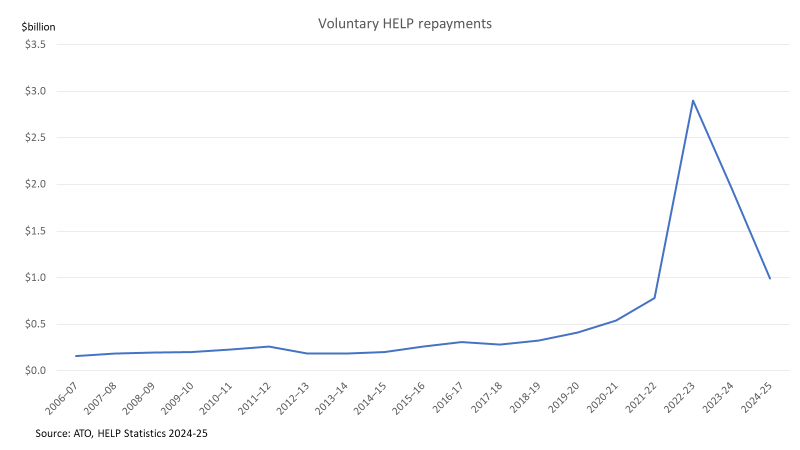
In recent years voluntary HELP repayments increased significantly, peaking at $2.9 billion in 2022-23, before dropping back to $992 million in 2024-25 (according to data released last week). This post looks at why voluntary repayments spiked and what we can expect for future years.

The spike in repayments – indexation

The 2022-23 and 2023-24 big repayment spikes in the chart above are primarily due to people repaying early to avoid high CPI indexation.

With CPI now back to normal levels this should be much less of a factor in the foreseeable future. That said, to reduce indexation costs HELP debtors considering a voluntary repayment should still make it prior to the 1 June indexation date.

Read More »

Graduate income fluctuations and HELP repayment

Last week I raised concerns about the new HELP repayment system increasing the number of HELP debtors who face very long repayment times or lifetimes of student debt.

The calculations in that post assumed that people maintained their relative income position through their careers – for example that someone who earned the median income at age 25 would still do so at age 35, 45 etc. We know, however, that relative income fluctuates. Family commitments drive movements in and out of full-time work. Careers go better or worse than expected.

Without solving the problems involved in estimating how these changes affect HELP repayments, this post outlines findings on graduate income mobility and labour force status changes.

Movements between income quintiles

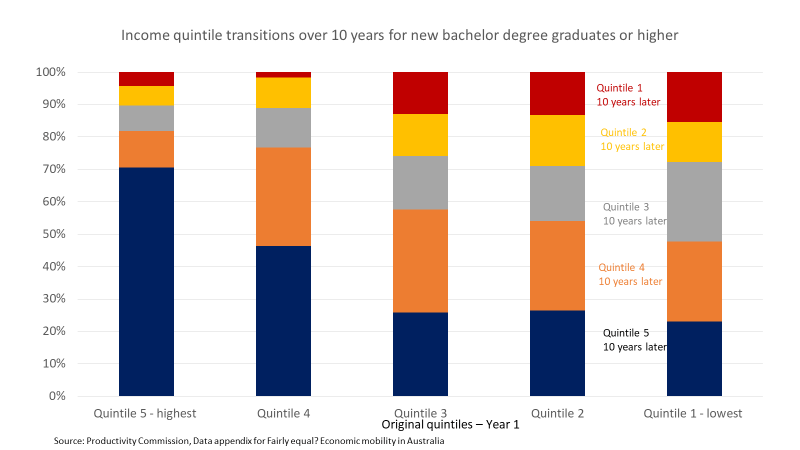
The chart below uses data from a Productivity Commission report on economic mobility. It shows changes in relative income, between five economic quintiles, over a decade since degree completion. The data source is HILDA.

Quintile 5, the highest, shows strong stability. More than 80% of graduates in quintile 5 were still there or in quintile 4 a decade later. The high starting point and following stability may be due to people already doing well in their careers acquiring postgraduate qualifications.

The other quintiles all show significant movement in relative income. Upward movement is expected as we know graduate incomes increase in the years after course completion. Almost half of graduates in the lowest quintile in year one are in the top two quintiles a decade later.

Bu there is also some stability at the lower end. In the two lowest quintiles, 1 and 2, over a quarter remain in those quintiles a decade later. In quintile 3 we see a similar share falling back to quintiles 1 and 2. While some of this is career stagnation, ten years out takes into the ages when women start leaving full-time work to meet family responsibilities.

Read More »

Will the new HELP repayment system make high EMTR problems better or worse?

The new HELP repayment system being legislated this week will move from repaying a % of total income to a % of income above the repayment threshold, a marginal system. In introducing the bill to Parliament, education minister Jason Clare quoted Bruce Chapman on a marginal system: ‘it’s much gentler and much fairer than previously—we should have done it years ago.’

While the new marginal repayment system may be gentler and fairer, it could create more widespread disincentives to working additional hours than the current total income system.

The problem with total income systems

The Universities Accord Final Report, which guides the government’s higher education agenda, criticised the total income repayment as unfair and a deterrent to work.

The underlying problem is that a multi-rate total income repayment system creates multiple threshold ‘cliffs’, income points at which earning $1 more triggers a big increase in student debt repayment. The most extreme cliffs are the lower income levels. Under the current system a debtor whose income reaches the $56,156 first threshold faces an increase in repayments from $0 to $561.56, plus 30 cents of income tax.  By earning more the student debtor reduces their take-home pay. Repayment cliffs exist, at less extreme levels, at all 18 income thresholds in the current student debt repayment system.

A total income repayment system produces some very high effective marginal tax rates (EMTR). An EMTR is jargon for how much of an extra dollar earned is lost to income tax, withdrawal of benefits, and in this case HELP repayments. EMTRs are a big issue in Australia’s welfare state, which makes widespread use of means tests – of which the HELP repayment thresholds are a version.

Read More »

The new HELP repayment system and lifetimes of student debt

The prime minister says that a degree should not come with a lifetime of debt. For that goal, the government’s HELP legislation introduced last week is contradictory. It will cut all debt owed as of 1 June 2025 by 20%, which will shorten repayment times for current debtors. But it will also cut annual debt repayments for 99% of debtors, which will lengthen compulsory repayment times for many and push others into the PM’s lifetime of debt.

In the analysis below, female debtors owing $25,000 or more with incomes in the lowest 40% of graduate earnings face an increased risk of a lifetime of student debt. However, what percentage of female debtors actually face a lifetime of debt will depend on initial debt levels and how much their incomes vary through their careers. Voluntary repayments can also affect repayment times.

How the repayment system will change

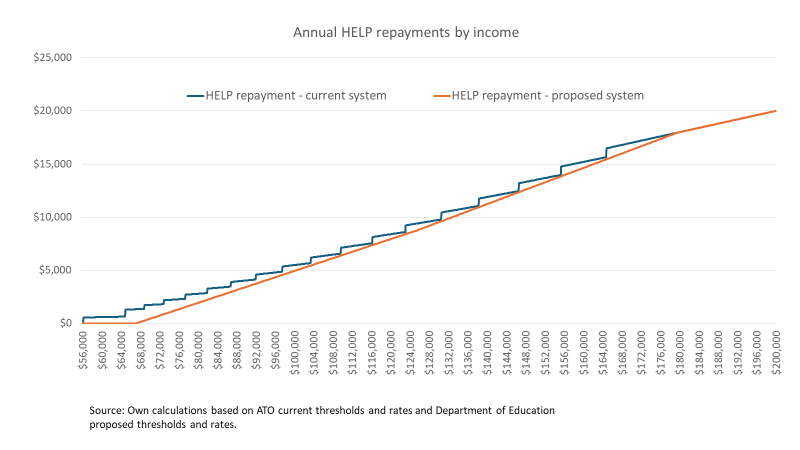
My previous post on the initial threshold summarised how the repayment system will change. The key elements are that 1) repayment exempt incomes will include everyone on $67,000 or less compared to less than $56,156 now and 2) a marginal rather than total income repayment system will reduce what most debtors repay, particularly at lower income levels.

The chart below shows how this will affect HELP debtors at different annual income levels. Based on 2022-23 ATO data I estimate that 99% of debtors repaying under current thresholds will repay less per year than under the current system. The other 1%, all high income earners, will repay the same amount per year as now.

Read More »

The history and politics of the first student debt repayment threshold

The government’s HELP legislation, cutting student debts by 20% and introducing a new repayment system, was introduced into Parliament yesterday. While I have criticisms of the 20% cut, it will be implemented and once done cannot be reversed. The changes to the repayment system will pass now but can, and probably should, be changed at a later date.

In this post I briefly explain how the repayment system will change and then discuss the choice of the first threshold.

The current and proposed student debt repayment systems

Under the current system, repayments start at an annual income of $56,156, at which point student debtors repay 1% of their total income. From there the percentage of income repaid increases incrementally to reach 10% of income at $164,712.

Under the new system repayments start at when income exceeds $67,000. At this point a marginal rate of 15% of income above $67,000 applies up to $124,999, where a marginal rate of 17% applies for income of $125,000 or more. Unexpectedly the bill restores part of the old system with an annual repayment cap of 10% of total income. This avoids some high income earners paying more than now.

The new thresholds will be indexed to growth in average weekly earnings. The current thresholds are indexed to CPI.

The logic of the first threshold

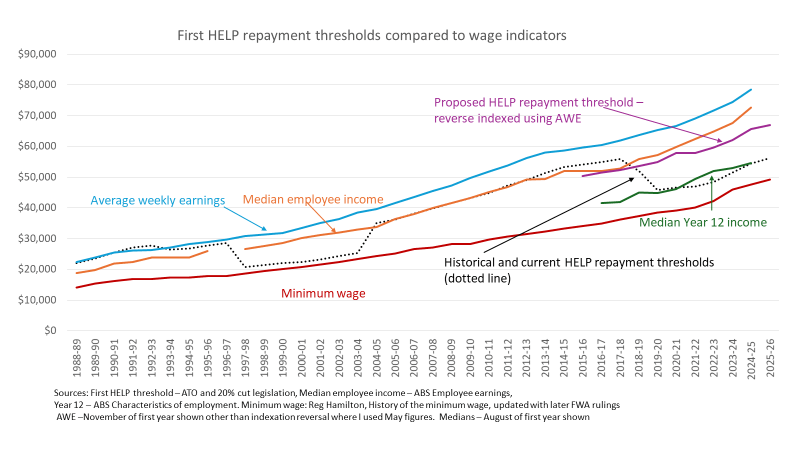
As the chart below shows, in the black dotted line, the first repayment threshold has changed over time. The long-term policy/political tension is between the idea that graduates should enjoy some financial advantage before repaying their student debt and the idea that student debt should be repaid except in cases of financial hardship. The policy pendulum is currently shifting from the latter to the former.

Read More »

What is behind increased rates of upfront payment of fees and student contributions?

It’s been a while – seven years – since I took a look at higher education student decisions to take out a HELP loan or pay upfront. Since then we’ve had instability in upfront student contribution payment incentives and increased student debt salience, triggered by high-CPI indexation. Anecdotally some students paid upfront to avoid high indexation of the subsequent debt.

Student contributions & HECS-HELP

The direct incentive to pay student contributions upfront has been framed as a discount. If the upfront discount was 10% and the fee was $1,000 a person who paid upfront would incur a debt of $900. The Commonwealth compensated the university for the lost $100, but avoided holding debt that might go bad and paying interest on its own borrowings to finance lending the student $1,000. In recent years, according to estimates in the Budget papers, about 15% of each year’s lending is not expected to be repaid.

The size of the incentive to pay student contributions upfront has varied over the last 20 years. Any incentive was abolished in 2017, restored for 2021 and 2022 to get Pauline Hanson to vote for Job-ready Graduates, and then abolished again from 2023.

I am in the no upfront discount camp, as I believe most people who pay upfront will do so anyway, whether there is a discount or not.

Read More »

Preliminary 2025 funding per university for Commonwealth supported places

Due to the Department of Education’s under-reporting of higher education funding, last year I consolidated institution-level information into a spreadsheet. There were about 250 downloads each for the original and a subsequent updated spreadsheet, so I decided it was worth doing again this year. The data sources are the funding determinations for the various funding categories.

I emphasised ‘preliminary’ in the post title because the FEE-FREE Uni Ready funding is not yet included. While this is a little frustrating, the upside is that when it is added the amounts involved will be more transparent than might otherwise have been the case. [Update 28/2/25: In Senate estimates yesterday the Department said that FEE-FREE Uni Ready funding equivalent to historical enabling places as of 2022 were included in the funding agreements. Funding for new FEE-FREE Uni Ready places is yet to be released.]

The headline figures to date are Commonwealth Grant Scheme (CGS) – $8.2 billion, estimated HECS-HELP lending of $5.9 billion, and estimated upfront student contributions of $700 million. Overall, about $14.8 billion, with 95% coming from the Commonwealth in cash flow terms. That percentage will go up when we get the FEE-FREE Uni Ready information.

Read More »

Budget treatment of student debt policy announcements

One criticism of the weekend’s big proposed changes to student debt – a new repayment system and a 20% cut to student debt balances – is that they are ‘off budget’, concealing their true cost.

The Budget includes several different takes on the government’s annual finances, including fiscal balance, headline cash and underlying cash. The Budget papers also report the value of government assets, including student debt.

The ‘underlying cash balance’ is the most commonly used Commonwealth’s Budget metric. When the Treasurer boasts about the government’s fiscal performance he uses an underlying cash measure. Unfortunately from a ‘Budget honesty’ perspective underlying cash is the weakest measure of student loan costs and of the financial impact of proposed changes to student loan policies.

Read More »