Why did universities become reliant on international students? Part 1: Government funding cuts

A decline in international student numbers has triggered Australian higher education’s biggest-ever financial crisis. But why did universities became so financially reliant on international students?

In university constituencies, a common belief is that the government cuts going back to the 1990s are a factor.

Assessing trends in government funding is not straightforward. No official time series data exists. Different historical data sources do not always match.* There are notes about these issues in the text below, the footnote and the slides. I am confident of the overall pattern, although some year-to-year comparisons are not precise.

Read More »

How reliant is Australian university research on international student profits?

The decline in international student numbers has many people worried about the future of university research in Australia. A recent report from the Chief Scientist predicted that 7,000 research jobs could go due to reduced teaching profits, philanthropy and corporate funding.

In this post, I estimate how reliant research is on international student profits. It combines data from multiple sources. None of them were designed to calculate this profit, so my result should be taken as being in a plausible range rather than as a precise total. But it can give us a sense of the scale of reliance on international students.

According to the 2018 ABS higher education research report that was released yesterday, in 2018 universities spent $12.158 billion on research. The ABS also gives sources of research funding, but these only explain 44 per cent of the total, with the rest coming from ‘general university funds’.Read More »

How profitable is university teaching?

Last month the government released the latest teaching and scholarship cost data, which is for 2018. The bachelor degree data by field of education is here, and Deloitte Access Economics also provides a detailed report. The Deloitte report looks at costs compared to discipline-level funding rates, but does not aggregate these up to analyse teaching’s contribution to sector finances. This post tries to do that.

As Deloitte’s report notes, teaching cost numbers should be used with some caution. Universities are multi-purpose institutions, carrying out teaching, research, community engagement and other activities. Staff and facilities are often not dedicated exclusively to a single purpose, and so costs need to be attributed to different activities. University accounting systems differ in their design and their ability to allocate costs in a detailed way.

Because of joint production, any ‘profits’ on teaching are not necessarily cash left over that universities can decide how to use. The money may already be spent on the research time of staff employed on a teaching and research basis, or in the capital and running costs of university buildings used for teaching and research.

With these caveats, across the sector Deloitte estimate that 52 per cent of university expenditure is attributable to teaching and scholarship. Based on the university finance report for 2018, that means Table A universities spent about $16.7 billion on teaching in 2018.Read More »

COVID-19 could have a high fatality rate in the private higher education sector

If things look bad for public universities in the COVID-19 era, they look much worse for many providers in the private higher education sector.*  Not all are likely to survive a significant downturn in the international student market.

Although there are some commercially very successful players in private higher education, that is not the universal experience. When TEQSA reported on financial risk last year, it rated 12 per cent of for-profit providers as high risk, and 44 per cent as moderate risk. For not-for-profits, the corresponding risk ratings were 5 per cent and 40 per cent. This equates to more than 60 providers at high or moderate risk. As of April 2020, there are 134 non-university higher education providers.

The private higher education sector is diverse, with 37 providers having no international students in 2018 (based on not having a CRICOS registration). Generally speaking, however, the private higher education sector is more exposed to the international student market than public universities. About half of private sector students are internationals, compared to 31 per cent in the public universities. The true number is likely to be higher, as the statistics only include providers that have signed up for FEE-HELP, a domestic student loan program.  Providers aimed exclusively at the international market have no need for FEE-HELP.Read More »

International students and the COVID-19 recession

For Australian higher education the situation of international students in the COVID-19 crisis is especially concerning. They lack the local family and social security back-ups of domestic students. It leaves them particularly vulnerable as large parts of the student labour market collapse.

And if international students have to go home or cannot pay their fees, that is the most likely trigger for a broader higher education sector crisis. At best, thousands of higher education workers will lose their jobs. At worst, many universities will need government intervention to survive.

This morning the government issued a summary statement on the situation of international students during the COVID-19 disruption.

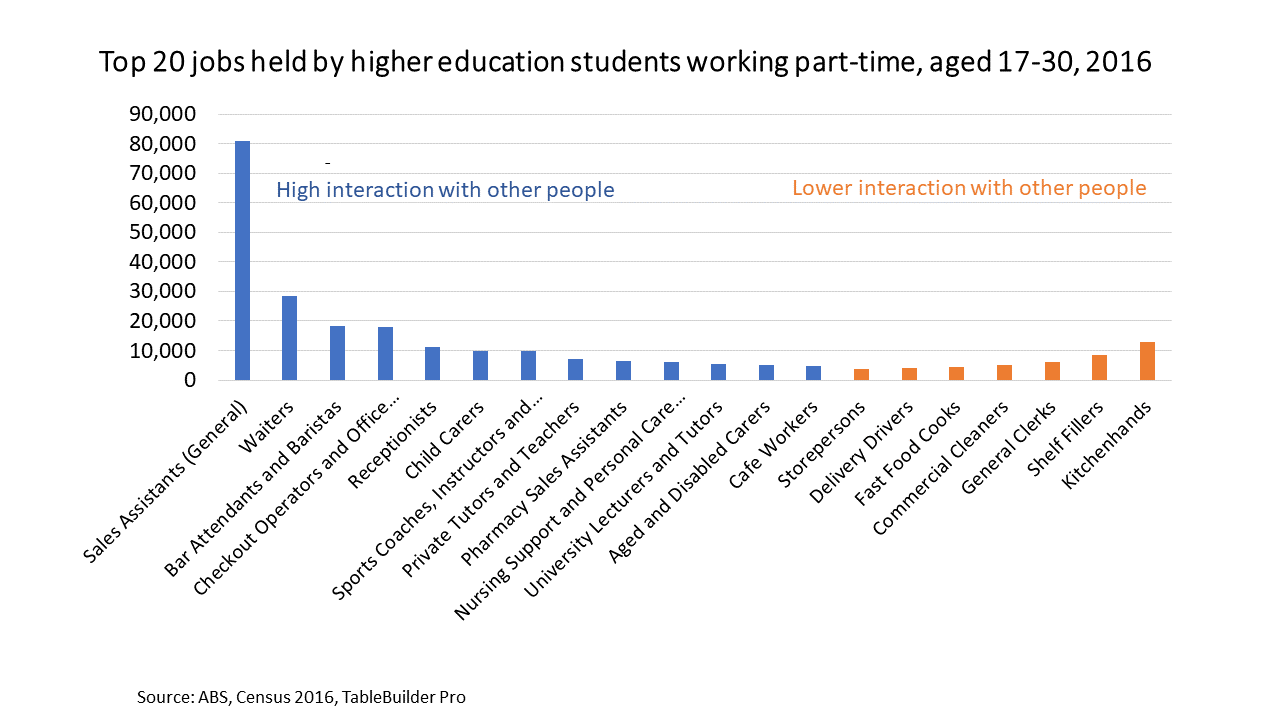
International students working in nursing and aged care have had their 40 hour per fortnight cap on working eased, as have students working in supermarkets until 1 May. While that is helpful for some students, as of 2016 the majority work in other occupations, as the chart below shows. Read More »

Will university staff receive the JobKeeper payment?

Update 9/4/20: Since this post was written there was, briefly, some expectation that the revenue loss required for universities would be lower for 15 per cent. That is not happening. 

Update 24/4/20: This story keeps evolving. Due to a loophole in the legislative instrument, which sets the revenue base at GST turnover rather than total income, some universities look like they have a basis for receiving JobKeeper.

Update 25/4/20: Cancel yesterday’s update, the government is moving to block that one. But there may still be other ways that universities can get JobKeeper. A new post updates the story.


Last night there was some Twitter discussion about whether university casuals would receive the new JobKeeper payment of $1,500 a fortnight. It is to be paid via employers, but casual staff are not eligible unless they have been employed on a regular basis for the last 12 months. Given the on-gain, off-again nature of casual teaching many probably would not be eligible.

But the first issue is whether universities are eligible employers. To qualify, they need to have suffered a significant loss of revenue:

Employers (including not-for-profits) will be eligible for the subsidy if:
• their business has a turnover of less than $1 billion and their turnover will be reduced by more than 30 per cent relative to a comparable period a year ago (of at least a month); or
• their business has a turnover of $1 billion or more and their turnover will be reduced by more than 50 per cent relative to a comparable period a year ago (of at least a month).  (emphasis added)

In 2018 eleven universities had annual revenues exceeding $1 billion. They therefore have the higher 50 per cent drop in revenue requirement, rather than the 30 per cent drop for smaller universities. Read More »

The student workforce and COVID-19

According to ABS statistics, about 60 per cent of students in full-time tertiary education have jobs (this includes vocational and higher education). Their major occupations put them at elevated risk of catching infectious diseases and of losing hours or jobs due to the COVID-19 recession.

Exposure to disease

Because the census has detailed occupational information I am using it as my data source for jobs, even though it is now nearly four years old. The chart below shows the top 20 jobs for higher education students aged 30 or less who work part-time. The top 20 includes just over two-thirds of all employed students in this group.

As expected, student employment has a strong skew to occupations with large amounts of routine interaction with other people. Sales assistants are by far the largest single group. Waiters, bar attendants and baristas make up the next two largest groups. People in these occupations are all relatively likely to interact with someone with COVID-19, although if self-quarantine works not while that person is showing symptoms. job interaction with public

Read More »

How bad is the international student English language problem?

The English language abilities of international students keep coming up as an issue. Despite reassurances from the regulator and universities, there is little publicly-available evidence to support a conclusion that the language issues are too infrequent or not serious enough to be a major concern.

Although we should always be careful with statistics on self-assessed abilities, they can provide a rough guide. If someone says that they do not speak English very well chances are that they will struggle in an English-speaking university.

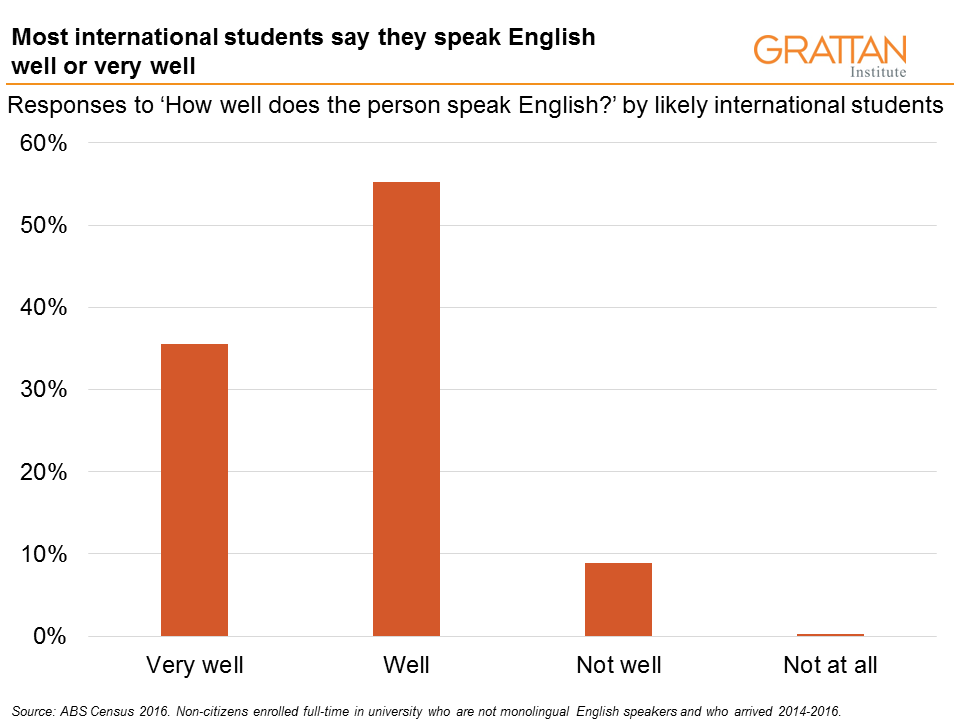
One source of data on self-assessed English is the 2016 Census. The Census does not directly identify people on student visas, but I have used a number of filters – enrolled full-time in university, non-citizen, and arrived in Australia 2014-2016 – to identify likely international students. I also removed people who are monolingual English speakers. It’s likely that the data still includes some visitors to Australia and domestic students, such as those on humanitarian visas, but it should be dominated by international students.

As the chart below shows, the vast majority of likely international students say that they speak English well or very well. However, 9 per cent say that they do not speak English well.

English language overall

Read More »

Migration has outpaced demand driven funding as a source of additional graduates

As the latest OECD Education at a Glance publication confirms, Australia is a high tertiary education attainment country. But large-scale migration makes it hard to interpret Australian figures – what is the result of policies aimed at educating Australian citizens, and what is due to our commercial international education industry and skills-based migration program?

Although demand driven funding increased the annual number of people completing bachelor degrees, on my calculations using the ABS Education and Work survey additional citizen graduates of Australian universities account for slightly less than half of the increase in graduate numbers since 2013 — 406,000 additional Australian or New Zealand citizen graduates of Australian universities and 421,000 extra graduates who hold degrees from overseas universities or are non-citizen holders of Australian university degrees.

20-64 overseas and domestics

The chart below attempts to break the numbers down a bit further, although the categories are not straightforward.

Education and Work separately identifies people on a student visa, which it puts at 142,000 in 2018 (80 per cent with overseas degrees). I have deducted these from the other non-citizen categories. As postgraduate international enrolments have been growing more quickly than undergraduate in recent times, I expect this category to grow in future years. types of overseas grad
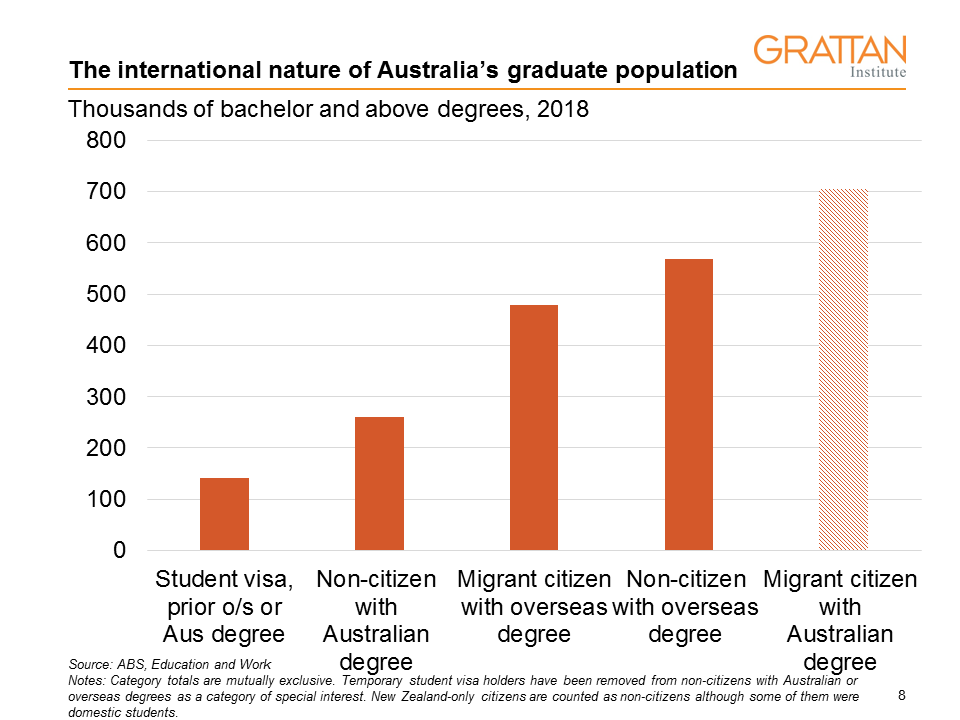
In Education and Work, the ABS continues its irritating standard practice of not identifying permanent residents, who are entitled to a Commonwealth supported place and to remain indefinitely in Australia. There were 36,000 domestic students with PR in 2017. This means the ‘non-citizen with an Australian degree’ category is a mix of them (after they graduate) and former international students on temporary or permanent visas. With increasing numbers of completing international students getting 485 visas, I expect that this will be a growing category.

What I find most interesting in this data is the very large number of people with overseas degrees – more than a million in total. About 45 per cent have have taken out citizenship. Most of them would be the product of Australia’s skilled migration program, although there were also 58,000 New Zealand citizens, who can come to Australia without going through the usual visa system, with an overseas degree.

On right-hand side of the second chart I have a column ‘migrant citizen with an Australian degree’, representing just over 700,000 people, that in the first chart appears in the ‘domestic’ time series. Most of them, I think, would have been domestic students (just under half arrived in 1996 or earlier), but some largish proportion would have been people who arrived as international students and subsequently became citizens.

In 2018, 68 per cent of degree holders in Australia were Australian or New Zealand citizens with degrees from Australian universities. But because we cannot identify the former international students in this group, it is quite likely that more than a third of all degree holders in Australia acquired their qualification with no assistance from Australian higher education policy.
 

International students should be able to make political donations

Late last year, the federal government introduced a bill to prohibit foreign political donors. It would have strangled charity and NGO political activity with red tape. After a strong backlash, earlier this month the government introduced a revised bill, with a substantially reduced, although still significant, level of donor-checking bureaucracy. Labor is backing the bill.

While the government’s amendments reduce the burdens on NGOs, they are more draconian for foreign donors. In the bill’s original version, all donations below $250 were deemed allowable. In the current version, foreign donors are completely banned from donating for Commonwealth electoral expenditure. This includes donations to political parties and to NGOs when their political advocacy might influence voting in a federal election.

While NGOs won’t need any anti-foreigner measures on donations below $100, a foreign donor could, in theory, be fined up $42,000 for making such a donation. NGOs would not be legally obliged to warn small donors of these potential consequences.Read More »