I blurbed Mind of the Nation, Michael Wesley’s new book on universities in Australian life, with the statement that it ‘shows how rising and conflicting expectations of universities create controversies that will not go away’. His book is about the cultural and political position of universities rather than higher education policy as such, although policy provides evidence of how politicians and voters see universities.
University administrators – Wesley is a deputy vice-chancellor – are at the centre of these controversies, blamed by all sides for whatever is wrong with universities. Mind of the Nation explores why universities receive so much critique and so little love or (from a university perspective) public funding, despite many successes and contributions: life-changing experiences for students, moving from an elite to a mass higher education system, creating a new export industry, large increases in research aimed at solving practical problems, and engagement with local communities.
Wesley asks why Australians admire the successes of their sporting teams, musicians and actors but not universities.
“…migration should not simply be about bringing in workers in to fill gaps, it should be about helping people put down roots, to join in the life of our country towns and suburbs. To make a home, to raise a family, to join our Australian family – strengthening our economy and our great multicultural society.”
Thirty years ago Anthony Albanese’s statement would have restated migration orthodoxy. Australia rejected the ‘guest worker’ model of Germany or Singapore or the Gulf states. Most long-term migrants were permanent residents on arrival, with pathways to citizenship. While over time policy moved from assimilation to multiculturalism, the expectation that most ‘join our Australian family’ was a constant.
But from the mid-1990s temporary multi-year visa migration became more common. Major categories included international students, skilled workers and later temporary graduate visas. Working holiday visas and the long-standing open border with New Zealand also increased non-tourist resident numbers. Their total population peaked at 1.7 million in 2019 but fell to 1.2 million during COVID border closures before starting to recover.
In the major 2020 and 2021 lockdowns tertiary student employment in the 24 years and under age group fell by over 100,000, or 20 per cent of the pre-lockdown total. Yet these losses proved to be temporary. As I discuss in a new paper, student employment rates and earnings recovered to record levels. While the strong Australian labour market is obviously a major factor, the sometimes significantly overlapping employment markets for students and temporary migrants made closed borders beneficial for students as workers.
Tertiary student employment rates
The strength of tertiary student employment is most obvious in employment rates, the percentage of the total student population with a job. Tertiary student employment levels and rates vary during the year, driven by movements in and out of both employment and enrolment. Comparisons of the same month in different years can help distinguish a trend from a normal seasonal change. December is not necessarily the peak month for total student employment, since course completions reduce student numbers. But student employment rates typically reach annual highs in December, as seasonal spikes in retail employment coincide with a summer holiday increase in student capacity to work.
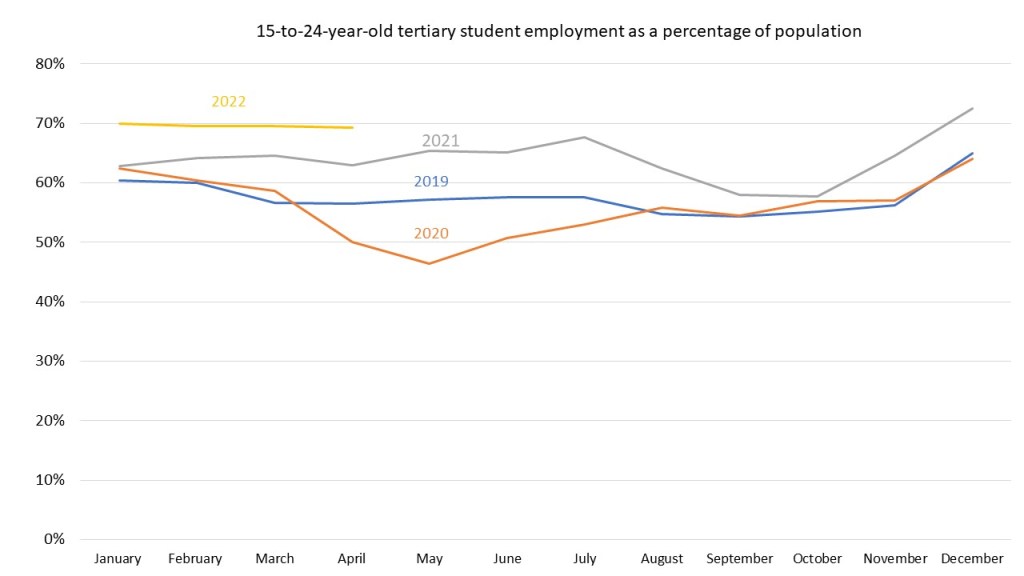
As the chart below shows, employment rates fell sharply in April and May 2020 as lockdowns hit, but by August 2020 student employment rates were back at 2019 levels. In 2021 employment rates were consistently higher than in 2019, despite lockdowns in NSW, Victoria and the ACT causing a significant dip. In early 2022 student employment rates remain 10 percentage points or more above their 2019 levels.
Source: ABS Labour force detailed, table LM3Read More »
Despite a COVID-driven dip to 1.6 million, Australia remains a country with high numbers of long-term migrants without the rights that come with permanent residence or citizenship. In many areas of public policy we are struggling, often unsuccessfully in my opinion, to deal with the social and political implications of this population, of which international students are the second largest category after New Zealanders.
A recent article in The Conversation by election law expert Graeme Orr drew my attention to a further example of unjustifiable, and in his view potentially unconstitutional, treatment of temporary migrants. For some years now the government has been preoccupied with ‘foreign’ (ie Chinese) influence. One response has been stripping temporary migrants of political rights.
Three years ago I wrote a post criticising restrictions on temporary migrants being able to make political donations. Legislation passed this week takes these restrictions much further, covering other kinds of political expenditure and activity.
For international students the 2020 higher education enrolment data released this week is already very out-of-date. The international branch of DESE produces more current aggregate numbers, and has been circulating up-to-date figures to experts and stakeholders. Peter Hurley used these in a recent Conversation article. It’s a model for what, after a recent IT upgrade, could and should be done for domestic enrolments (my long-after-the-fact analysis of the 2020 domestic results is here).
Although more recent current total international enrolment figures are available, a few things in the recently released 2020 enrolment data tell us more than is publicly available elsewhere.
Attrition
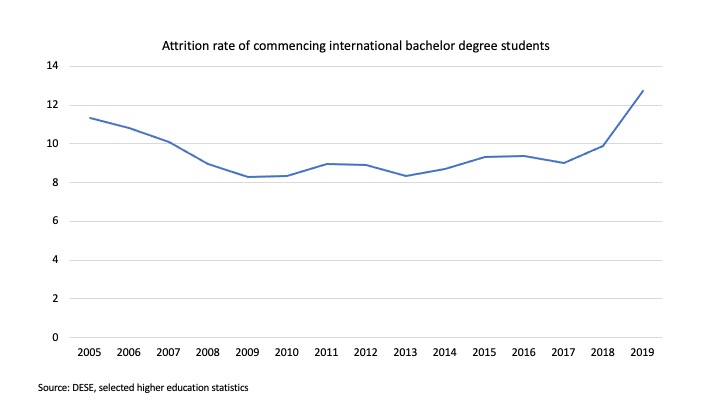
International bachelor degree students have much lower attrition rates after first year than their domestic counterparts. Flying to a foreign country and paying sometimes exorbitant fees is a strong incentive to get the degree. But while attrition for 2019 commencers into 2020 declined for domestic students, the international rate increased nearly 3 percentage points to 12.73 per cent. The most likely reason is that some international students could not get back to Australia due to travel bans.
Commencing and continuing students
Increased attrition meant fewer continuing students than would have been the case without COVID-19. But the prior boom years for commencing students meant that continuing students still increased in 2020 on 2019 figures. This is one reason why the overall decline in international students was contained to 6.6 per cent, despite an 18.2 per cent decrease in commencing numbers.
In March 2020, as Australians realised that COVID was a major problem, I wrote a pessimistic post about student employment. For a while during 2020 that pessimism was justified. But not in 2021. Tertiary student employment is at an all-time high, driven by more jobs and less labour market competition.
Retrenchment
For the ABS Participation, Job Search and Mobility survey the sample is full-time students who have completed Year 12 but have no post-school qualifications. For this group retrenchments were high in 2020. Of the people who were students in February 2021, and had been employed in February 2020, 6.5 per cent had been retrenched over the previous 12 months. This compares to retrenchment rates of about 2 per cent a year in the 2016-2020 period.
The ABS monthly and quarterly labour market reports do not include retrenchments by student status, but do provide a time series for 15-24 year old workers. About 24 per cent of those workers were full-time tertiary students in 2020. As the chart below shows, retrenchments for 15-24 year olds spiked in the May and August quarters. In the May 2020 quarter they were 31 per cent of all retrenchments. JobKeeper slowed overall job losses from the end of March, but this demographic is relatively high on people not meeting its personal eligibility criteria. Temporary migrants such as an international students were not included in JobKeeper and casuals needed to have been in their job for 12 months.
Employment to population ratio
The main analysis supported by the labour force statistics is full-time tertiary students aged 15-24 years. The chart below shows that just between March and April 2020 the proportion of tertiary students in employment fell significantly, down nearly 9 percentage points. Student employment levels were already coming off their summer peak, with employment rates declining from 65 per cent in December 2019 to 46 per cent in May 2020.
A Grattan Institute report released last night calls for big changes to the criteria for gaining permanent residence. While recognising that migration and higher education links may have benefits for Australia, the report questions giving permanent migration preference to former international students through points for Australian and regional university degrees, the professional year, and use of skills shortage lists. Instead they recommend permanent residence priority for employer-sponsored people earning more than $80,000 a year.
Major changes to PR rules would make international students nervous. And whatever the general merits of Grattan’s proposal, after Job-ready Graduates and border closures now probably isn’t the time to inflict another big problem on the higher education sector.
But reading the Grattan report (which I saw in draft) highlighted to me that I did not know how many former international students eventually achieve PR. The work for this post was an only partially successful attempt to remedy this situation. I’m not a migration expert and I may have missed or misunderstood things, but FWIW my key findings are below.
Total numbers of former international students with permanent residence
Counting former international students with PR is not a straightforward exercise, since there are many direct and indirect routes to permanent residence. A 2018 Treasury paper based on detailed immigration data identified 5,500 routes from a temporary visa, of which student visas are the largest category, to a permanent visa.
Taking all of these routes into account, of the 1.6 million people who had arrived on a student visa between 2000-01 and 2013-14 the Treasury paper calculated that 16 per cent, or about a quarter of a million, had achieved PR.
This number, however, is not consistent with an earlier Productivity Commission analysis, which on my reading of the relevant chart gets us to 300,000 international student conversions to PR just counting arrivals between 2000-01 and 2005-06.
The ABS Characteristics of Recent Migrants survey estimates how many people who first arrived on a student visa in the last 10 years have achieved PR or citizenship (a further step on from PR). The 2013 and 2016 surveys show growing numbers of former international students with PR or citizenship. By 2019, however, the numbers had fallen back below the 2013 level.
All the ABS numbers in the chart are below what we might expect from the Treasury or Productivity Commission figures. Policy changes a decade ago made it harder to transition from a student visa to PR just by holding a qualification in an area of alleged skills shortage. So an underlying downward trend is quite possible. There are, however, important differences between the ABS numbers and earlier statistics.
Suppose annual Commonwealth research spending was 50 per higher across the last few decades, all of it paid through block grants rather than generating additional costs via competitive grants. Up until the year 2000, as the chart below shows, a 50 per cent increase in public funding would have covered all research spending. But in 2018 Commonwealth funding 50 per cent higher than it was would still have left over 40 per cent of research spending unfunded (although there is about $1.9 billion in non-Commonwealth research income).
Profits on international students have been used to help finance a massive increase in university research expenditure this century.* Growth on this scale was something universities chose to do, not a change forced on them by government policy.
In my previous post in this series, I argued that international student fees help pay for under-funded government-sponsored research grants. But these research projects are not the only partially-funded research universities are trying to finance. They also have many teaching staff on contracts that include research time, but who do not attract equivalent research income.
For academics, the expected and preferred academic career is generally to have a teaching and research or research only role. For most academics, however, teaching is not their top priority. A survey about a decade ago found that, among teaching-research academics, nearly two-thirds leaned towards or were primarily interested in research.
This bias is reinforced by the academic recruitment process, which favours people with PhDs. In 1987 less than a quarter of academics in the Colleges of Advanced Education, which by then taught the majority of higher education students, had PhDs, and 69 per cent of university academics. In 2018, across the now unified system, nearly 74 per cent of academics have a PhD.
Not surprisingly, most people who do PhDs are interested in research. In a 2010 survey, only six per cent of research students planning an academic career nominated a ‘mainly teaching’ role as their ideal job.
In a previous post, I doubted that inadequate public funding for Commonwealth supported students could, with a few exceptions, explain why universities have enrolled so many fee-paying international students. For publicly-funded research, however, structural changes in how funding is delivered have changed its economics.
In the 1990s, as the chart below shows, competitive grants made up less than a quarter of Commonwealth research spending on universities (counting Department of Education plus NHMRC). By the middle of the 2010s nearly half of Commonwealth funding was delivered through competitive grants, though with an easing off recently as ARC funding was cut.


 Andrew Norton