The 2026 higher education funding agreements, the legal basis of Commonwealth Grant Scheme funding, were published recently. This post examines public university funding for ‘higher education courses’.
‘Higher education courses’ has a specific legal meaning. It includes FEE-FREE Uni Ready (enabling) courses and coursework programs other than medicine, except for Indigenous students in bachelor degree courses, who are funded separately. Each public university receives a maximum basic grant amount (MBGA) for higher education courses. This funding is intended to be a flexible block grant. Universities can move money between qualification levels and disciplines, except for medicine.
Policy change
For 2026 the government has changed its policy on setting university MBGAs, as part of a transition to a new funding system under the proposed Australian Tertiary Education Commission. For 2023-2025 Labor retained the Coalition policy of indexing MBGAs to inflation and adding regional-campus-biased increments for population change. This policy led to many universities not using all their MBGA, known as ‘under-enrolment’. Coalition policies to compensate higher education providers for under-enrolment cost taxpayers $844 million between 2020 and 2023.
The government has, sensibly enough, decided not to keep increasing MBGAs for universities that cannot utilise the funds. The new policy, as summarised in the funding agreements, is:
- For universities that significantly under-enrolled in 2024, the last year with ‘verified’ data, the provider will receive no increase in higher education courses MBGA between 2025 and 2026. Section 30-27(3) of the Higher Education Support Act 2003 prevents the government from lowering a MBGA between years.
- Universities with enrolments valued at or near their MBGA will receive inflation indexation.
- Universities with significant over-enrolment ‘may’ also receive a share of an over-enrolment fund.
In a document distributed to universities in 2025, significant over-enrolment was defined as delivering places valued at 5% or more above their MBGA.
MBGA funding by university 2025 to 2026
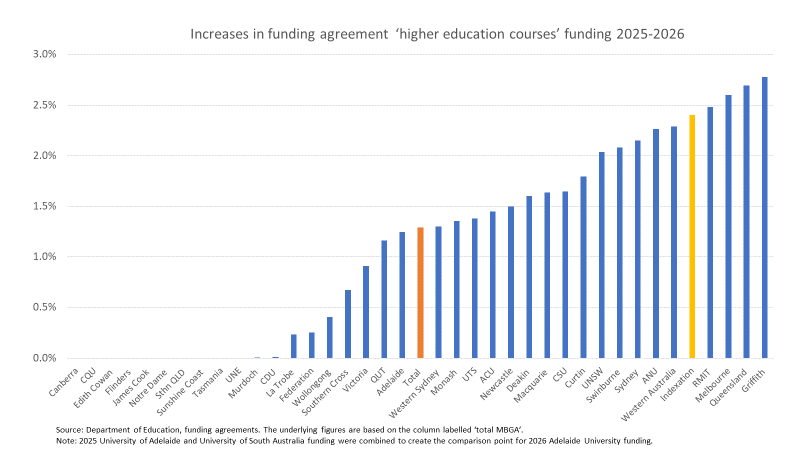
In the actual funding agreements the first part of the policy – no extra funding for under-enrolled universities – is easy to see in the chart below, but not the two other policies. Only four universities get even the 2.4% indexation amount, and the overall increase is 1.3%, a cut in real terms. Griffith University is a surprise winner, as it was significantly under-enrolled in 2023. Unfortunately the government has not released 2024 under-enrolment data.
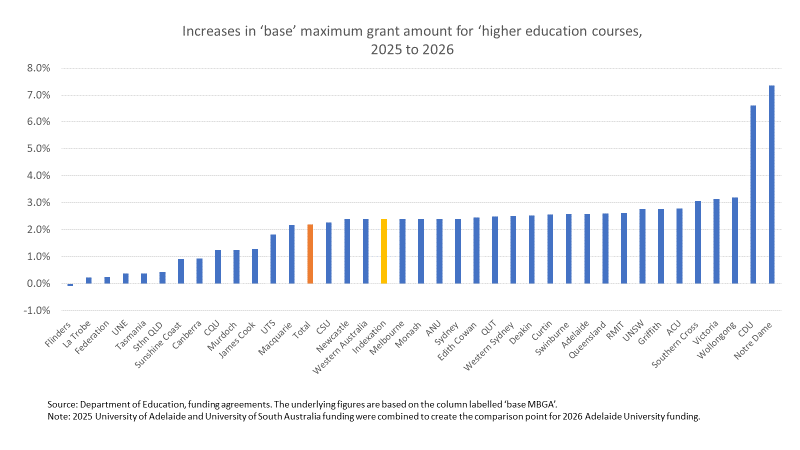
Things look more like what I would expect in the chart below. This uses a category the Department of Education calls ‘base MBGA’. This has no legislative basis. ‘Base MBGA’ is the MBGA minus ad hoc allocations of places, such as the 20,000 [sic] equity places and the nuclear submarine places. These ad hoc allocations have declined over the last two years.
Using ‘base MBGA’ we see, in the chart below, that most universities get at least indexation with a couple getting large increases. CDU is one of only four universities never to receive an under-enrolment handout, so a likely history of over-enrolment. Notre Dame was under-enrolled in 2023 but since then has experienced major increases in student contribution revenue, suggesting strong enrolment growth. But we are still left with a total increase in MBGA that is slightly below indexation levels.
Although total funding agreement allocations are down in real terms, this does not necessarily mean that effective system capacity is down. Due to previous MBGA misallocation, total higher education courses CGS funding 2021-2025 included significant resources that could not be used.
For people interested in funding per university download this file. Future blog posts will report other CGS funding.
Under-enrolment in future
The funding agreement changes should reduce under-enrolment. But a new program will compensate universities if under-enrolment occurs. Here the terminology gets a little confusing. A program called the Transitional Funding Floor Guarantee deals with under-enrolments. It has to be distinguished from another program, the Transitional Fund Loading.* The legal detail is here.
The Transitional Funding Floor Guarantee has parallels with the Higher Education Continuity Guarantee as it was 2021-2023, before the government took the Accord panel’s poor advice to divert MBGA underspends to ‘equity plans’. The goal will return to ensuring that ‘Table A providers can continue to operate, employ staff and provide quality education services’, with transition to the new ATEC funding system an added rationale.
For 2026 in simple terms this will be calculated as:
Transitional Funding Floor Guarantee = (2025 actual CGS + equity plan money) – 2026 actual CGS.**
Where the result of this calculation is above zero the university will receive this amount.
The Transitional Funding Floor Guarantee is less generous than the previous Continuity Guarantee. The benchmark is no longer the theoretical maximum in a year versus the actual value of places delivered the same year, but the actual value of places delivered compared between two years. Due to indexation of the underlying Commonwealth contribution rates – 2.4% between 2025 and 2026 – a university could have slightly falling EFTSL enrolments but not qualify for the Transitional Funding Floor Guarantee.
Given the large amounts of money paid in recent years to universities for not delivering student places it is hard to oppose less generous funding guarantees.
Conclusion
Despite government claims last year about additional student places for 2026, if this happens it won’t be due to increases in Commonwealth Grant Scheme higher education courses funding for public universities. This will fall slightly in real terms.
Instead, the government is trying to use the CGS resources it already provides more effectively. It is steering funding away from universities that have not fully used their MBGAs and directing less funding through ad hoc allocations of student places. Every condition added to a student place – specific university, specific course, specific type of student – reduces the chance a person can be found to take the place.
*The Transitional Fund Loading, for those who want or need to know, is any positive difference between:
The total value for 2025 of: Delivered designated medical places + demand driven Indigenous bachelor places + higher education courses places (places valued on an EFTSL * relevant Commonwealth contribution formula) + equity plan money + HEPPP money + regional loading + disability support funding + NPILF funding.
The total value for 2026 of delivered designated medical places + demand driven Indigenous bachelor places + demand driven Indigenous medical places + higher education courses places + disability support funding + needs-based funding + outreach funding + Transitional Funding Floor Guarantee money.
The point of this is to compensate universities that are worse off due to the conversion of exiting equity programs to needs-based funding.
**Transitional Funding Floor Guarantee in more detail:
The total value for 2025 of: Delivered designated medical places + demand driven Indigenous bachelor places + higher education courses places + equity plan money. The places are valued on an EFTSL * relevant Commonwealth contribution formula.
MINUS
The total value for 2026 of : Delivered designated medical places + demand driven Indigenous bachelor places + demand driven Indigenous medical places + higher education courses places.
 Andrew Norton