Last month I wrote about the new equity and regional needs based funding programs. Back then I had the funding formulas but not total funding amounts. The Department’s funding determinations now show that $425.7 million has been allocated for equity needs based funding and $118.6 million for regional needs based funding. There is also $43.7 million for outreach programs. The total is $588.1 million, including $1.3 million in equity needs based funding going to NUHEPs and private universities.
These new programs were principally funded from abolishing the old HEPPP equity program, the old regional loading, and the NPILF program, which supported internships and other engagement with industry. The predecessor programs were allocated $515.9 million, so the increase is more than indexation. Real cuts to the Commonwealth Grant Scheme may have funded the gap.
Funding by university
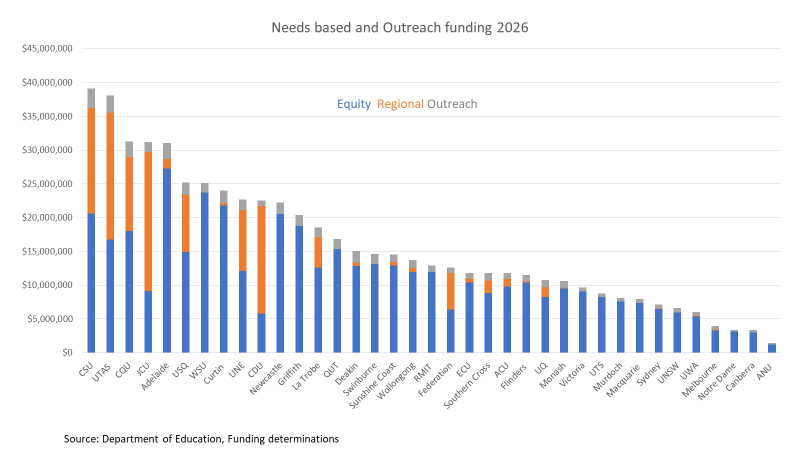
The chart below shows funding by university. Charles Sturt University and the University of Tasmania get the most money while the two Canberra universities get the least funding. They suffer from a lack of official ‘low SES’ areas in the ACT; as I noted earlier this month the low SES definition is not fit for funding purposes.
A spreadsheet of public university funding levels is available here.
Winners and losers
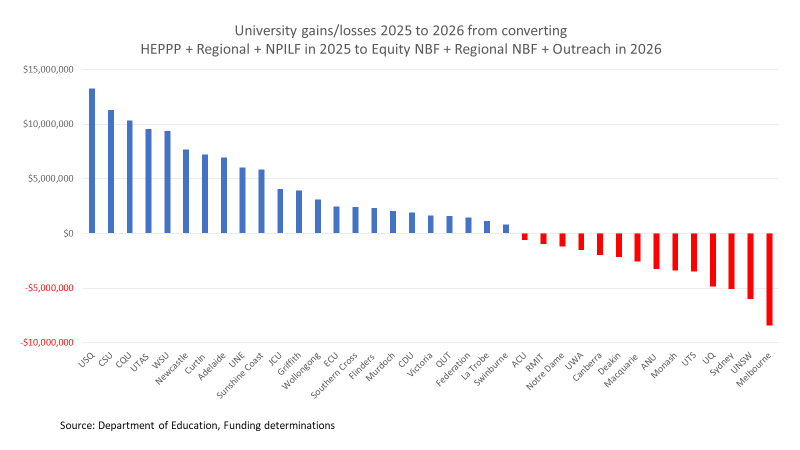
The chart below shows that some universities gain significant funding compared to the predecessor programs while others lose it.
Several policy changes explain why the new system produces winner and loser universities. The biggest cause is the loss of NPILF, $262.5 million in 2025, which was paid without regard to student equity status. Universities with high numbers of low SES and Indigenous students benefit from this change.
The old HEPPP program included low SES, Indigenous and regional background students in its funding formula. Needs based funding kicked the regional background students out unless they study at regional campuses; even then the funding is to offset campus costs rather than to support student needs beyond having a local campus. Regional needs based funding of $118.6 million exceeds the old regional loading of $89.5 million. City-based universities with significant regional student enrolments are the losers.
For 2026 at least, the Transition Fund Loading will give universities some protection against institution-level losses in student related funding, including the loss of HEPPP and NPILF, compared to 2025 funding levels. That may not, however, protect spending on predecessor programs within the university. Presumably engagement with industry activities will need to be reduced.
Winner’s curse?
While a significant number of universities – 14 of 37 – get less money in total due to this program reorganisation, all of them have more resources that must be spent primarily to benefit low SES and Indigenous students. In most cases, a university’s equity NBF + outreach funding is more than double the amount they previously received under HEPPP.
Unless these universities can rebadge money they already spend on these equity groups, scaling up at speed may not be easy or prudent. As I noted in my original post on equity NBF, the funding exists entirely at the minister’s whim. It would not be wise to create ongoing programs based on a weak government commitment. Legislation is promised, but it may end up being like the Prac Payment – a short mention in the Act but with the minister retaining complete discretion over funding and regulatory detail.
ENDS
 Andrew Norton