Needs based funding – the regional campus component

This post examines the regional campus component of needs based funding, which starts this year. I looked at the low SES and Indigenous component last week.

The regional component funds students at regional campuses rather than regional students. It assumes higher average costs at regional campuses. A longstanding ‘regional loading’ served a similar purpose. Just under $90 million was spent on the regional loading in 2025. Universities have been notified of their needs based funding amounts, but as of 23 February 2026 I cannot find a public record of them.

The research on cost by campus

The Deloitte Access Economics costing work used by the Morrison government to reset funding rates found that regional universities had higher costs per EFTSL after controlling for other factors affecting costs, such as discipline.

Later work by the U of M’s Centre for the Study of Higher Education, using Pilbara Group data, also found that regional campuses had higher average costs per EFTSL (chart below). This partly reflects a general feature of university costs – higher education is an economies of scale enterprise, but regional campuses on average have lower enrolments than major city campuses. However, higher regional costs were found to be still present after controlling for subject size.
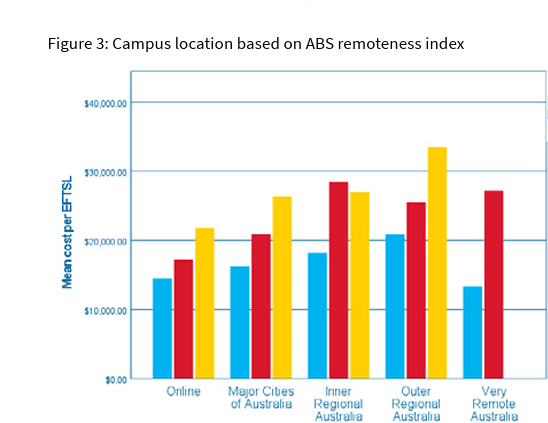
Assuming that higher education should, ideally, be taken to where the students are – a proposition I agree with – the basic policy idea behind the regional loading/regional component of needs based funding is sound.

Read More »

Needs based funding – the low SES and Indigenous component

Directing some university funding based on student, rather than just course, characteristics was one good idea coming from the Universities Accord. Students arrive in higher education with varying academic abilities. Other personal attributes and circumstances present potential obstacles to successful study. In a mass higher education system these are routine issues. But some universities enrol more students needing help to succeed than others, a fact only indirectly recognised to date, through equity group funding.

In 2024 I argued that needs based funding should go beyond equity group membership and use more reliable needs indicators, including admissions information. Policy should stop prioritising niche targeted programs over larger-scale initiatives that would benefit many students but higher-needs students the most. Broader changes to pedagogy or student services, for example.

But the needs based funding system as introduced for 2026, for which we now have additional administrative detail, is for the most part not genuine needs based funding. It is an update of old equity programs. In this post I will examine the ‘equity component’ of the new program. A later post will look at the ‘regional component’.

The legal framework

The current legal basis of needs based funding is intended to be temporary. Like previous equity programs it is authorised under section 41-10 (item 1) of the Higher Education Support Act 2003, under which the minister makes ‘grants to promote equality of opportunity in higher education’. It is one of the ‘other grants’ in the Act, that is other than the Commonwealth Grant Scheme (CGS). All ‘other grants’, and the amounts paid under them, are at the discretion of the minister. The plan, however, is to give needs based funding its own statutory basis in the CGS. We are yet to see the necessary legislation.

While current legal arrangements are temporary they are also unusual and unsatisfactory. The funding amounts and formulas, which I will discuss shortly, are not in the needs based funding legislative instrument. This instrument regulates eligibility for and use of needs based funding, but not how it is calculated. Indeed, it does not require that any money be paid at all.

Section 41-30 of HESA 2003 states that the amount of each ‘other grant’ is based on the guidelines, of which there are none for this matter, or ‘the amount determined in writing by the minister’. So needs based funding depends on this ministerial determination.

Instead of specifying the funding rules in a legislative instrument, the Department of Education has issued a document called Needs-based Funding Guidance v1.0 December 2025. This has no formal legal status, but tells universities how the minister intends to calculate funding per institution under section 41-30.

Funding determined this way without formal guidelines is not unprecedented in higher education policy, for example the national institutes grants. But I can’t think of another example where there is an underlying funding formula but the government has chosen not to put it into legal form. I see this as another example of the decline of the rule of law in higher education, in favour of ministerial or potentially ATEC discretion.

I expect that needs based funding will be paid, but to date there is no public evidence that the necessary funding has been authorised.

Read More »

The 2026 funding agreements, Part 3: New rules on closing courses

In the 2026 university funding agreements the rules on closing courses have changed and now require universities to follow additional processes. These changes are presumably a response to course and subject closures at UTS, at Macquarie, the ANU, the University of Canberra, and other institutions.

Confusingly, however, the agreements differ between universities on the timelines to follow.

Which courses are covered?

The basic threshold for a course being covered by the closure rules is that it must be an undergraduate or postgraduate course in which Commonwealth supported places have been used for at least two years. This includes a major within a course.

A course is not considered closed if it is immediately replaced by another course that leads to the same occupation or provides a similar specialised skill.

A course is considered closed, however, if it suspends intake of students for more than one consecutive academic year.

These criteria are unchanged from last year.

Timing of notification

In 2025 universities had to notify the Commonwealth of potential course closures by 31 July and before information on the closure is made public.

In 2026 the 31 July deadline is gone. Presumably it was unrealistic about university decision making timelines.

In what I will call funding agreement variation A, for 2026 notification of actual or potential course closures should occur at the earlier of (i) as soon as reasonably possible before final decisions to close courses are made or (ii) before any information on the potential course closure is made public.

In what I will call funding agreement variation B, for 2026 notification of potential course closures should occur by the earlier of (i) the finalisation of the provider’s Mission Based Compact for the following year (or where a new Mission Based Compact is not being negotiated, the finalisation of annual allocation of domestic student places for the following year), or (ii) one calendar month before any information on the potential course closure is made public.

Variation B is a bold inclusion, as the ‘annual allocation of domestic student places’ refers to a new funding system that requires legislation. As of early February 2026 it had not been introduced into Parliament, much less passed.

For variation B universities, then, the effective current rule is to notify the Commonwealth at least one month prior to making a course closure public. Variation A universities can wait until closer to the date of public disclosure before telling the government, unless they have made a final decision, as they need to inform the government as soon as possible before that decision.

Read More »

The Australian Tertiary Education Commission legislation, Part 7, The number of ATEC commissioners and their qualifications

Under the bill to create the Australian Tertiary Education Commission there will be three ATEC commissioners: a Chief Commissioner, a First Nations Commissioner, and a Commissioner.

The commissioners will have significant administrative and advisory functions requiring expertise on a wide range of topics. I have covered two of these topics in detail in this series on the ATEC legislation, ATEC’s advice on the Threshold Standards that govern all higher education providers and on per student funding rates. Other subjects on which expertise will be needed include the equity groups, education demand, higher education administration, and research.

It’s not clear, however, that the three commissioners envisaged under the ATEC legislation will have expertise across the full range of fields.

Mapping ATEC functions and advisory roles against statutory selection criteria

In the Universities Accord (Australian Tertiary Education Commission) Bill 2025 sections 56 to 59 set out the qualifications for being a commissioner. All three commissioner roles have a general requirement for appropriate skills, knowledge and experience. Section 59 sets out specific required domains of knowledge and experience that they must collectively have. The table below maps these against the responsibilities of ATEC, as indicated across section 3 of the bill (Objects), section 11 (Functions) and section 41 (Advice and recommendations). 

Read More »

The Australian Tertiary Education Commission legislation, Part 5, ATEC, TEQSA and the Threshold Standards

Under the legislation to establish the Australian Tertiary Education Commission, introduced into Parliament late last month, ATEC would advise the minister on the Higher Education Threshold Standards. All higher education providers must meet these standards as a condition of registration. The enforcement agency is the Tertiary Education Quality and Standards Agency.

This post compares the current system for setting the Threshold Standards with how this would happen if the ATEC legislation passes unamended.

Current process for setting the Threshold Standards

The Threshold Standards are a legislative instrument – and so disallowable by either the Senate or the House of Representatives – made by the education minister: section 58 of the Tertiary Education Quality and Standards Agency Act 2011. Under the same provision the minister can make other quality-related standards, as part of a Higher Education Standards Framework.

The minister must not make a standard unless a draft has been developed by the Higher Education Standards Panel (discussed shortly): section 58(3)(a) TEQSA Act 2011.

The minister must consult with the state and territory education ministers: section 58(3(b)(i) TEQSA Act 2011.

The minister must consult with the research minister if that is a separate role (not currently): section 58(3(b)(ii) TEQSA Act 2011.

The minister must consult with TEQSA: section 58(3(b)(iii) TEQSA Act 2011.

The minister must have regard to any advice or recommendations given by the Panel or the consultation parties: section 58(4) TEQSA Act 2011.

Read More »

The Australian Tertiary Education Commission legislation, Part 4, ATEC’s independence from the government

The Universities Accord Final Report recommended that ATEC be an ‘independent statutory authority … to enable it to provide robust advice and support evidence-based decision making and planning’ (p. 234). This post explores the relationship between ATEC and the government, as set out in the ATEC bill introduced into Parliament last week.

I should say at the start that unelected bodies with significant powers (‘independent’) are not necessarily good things. Government agencies should work within clear goals and rules established by democratic processes.

But independence can be beneficial in ensuring that government (and the broader public) get honest data – the ABS is a model here. Independent bodies can also help governments avoid the temptation to do things that are politically beneficial in the short run but detrimental in the long run – the RBA is a model here. Both the ABS and the RBA make mistakes, but their overall approach is better than letting the government decide whether or not to release vital data or to set interest rates with public opinion in mind.

All legislative references, unless otherwise specified, are to the Universities Accord (Australian Tertiary Education Commission) Bill 2025.

Administration of mission based compacts

The most important ATEC function will be to administer mission based compacts. As noted in a previous post, the content of mission based compacts will be driven by a ministerial statement of short-term and long-term strategic priorities: section 15. However this is not a legislative instrument: section 15(6). This means that neither the Senate nor the House of Representatives can disallow it. I take this as a democratic negative compared to the current system, under which key spending programs, such as equity and research block grants, have their own legislative instruments.

ATEC must prepare its own statement of strategic priorities: section 43. ATEC must take the minister’s priorities into account when performing its functions: section 15(4). Within the limitations of the new framework, this is appropriate in putting ATEC’s direction under the broad control of a person who can be subject to parliamentary questions, even if the ministerial statement of priorities cannot itself be vetoed. ATEC itself will appear before Senate Estimates.

Importantly, the minister will not give directions to ATEC in relation to decisions ATEC makes or in relation to ‘a higher education provider or a class or classes of higher education providers’: section 71(2)(b) & (c). This compares favourably to the current funding agreement system, under which the minister can effectively determine the content: section 30-25 of the Higher Education Support Act 2003. It is also better than the wide power to cancel course registration for international students, including on the basis of the ‘kind of provider’, which was approved by Parliament with modest improvements the same week the ATEC bill was introduced.

Section 71(2) reduces the risk of ministerial discretion being misused to penalise a university or universities in an arbitratry way.

The strongest guard against the misuse of power, however, is having rule-driven programs. On that the ATEC model would be worse than what we have now.

Read More »

The Australian Tertiary Education Commission legislation – Part 2, Mission based compacts

An earlier post looked at the objectives of ATEC, as set out in legislation introduced yesterday. This post looks at mission based compacts, the key instrument of ATEC control over universities.

All legislative references, unless otherwise specified, are to the Universities Accord (Australian Tertiary Education Commission) Bill 2025.

Entering into mission based compacts is a function of ATEC: section 11(b).

Purpose of mission based compacts

Since the Universities Accord Final Report the term ‘mission based compact’ has been ambiguous. Whose mission will the compacts implement, the government’s mission or the university’s mission?

The ATEC bill tries to have it both ways. Section 28 describes the purpose of compacts as giving the ‘provider flexibility to pursue their goals and mission’ while also contributing to an ATEC statement of priorities for the sector, diversity in the system, and meeting the needs of the provider’s students and community.

The bill’s explanatory memorandum offers this passage of doublethink:

“Compacts will enable providers to demonstrate how their unique mission – the institution’s core purpose, values, and goals – aligns with national, state and local priorities, planning, and strategy, as well as industry engagement and innovations in learning and teaching. Informed by strategic priorities identified in the Statement of Strategic Priorities…”

How is a mission unique if it aligns with national priorities? All section 28 means, I think, is that universities can still pursue objectives not specified by ATEC, provided that these do not conflict with any requirements ATEC imposes. The extensiveness of those requirements will determine how much scope for independent action remains.

Read More »

The Australian Tertiary Education Commission legislation – Part 1, Objectives

Today the government introduced legislation to establish the Australian Tertiary Education Commission, which currently operates in an interim capacity without any direct legal power.

This bill is mainly about ATEC’s structures, objectives and functions with the critical funding legislation to follow next year.

The ATEC legislation will take a few posts to describe. Due to other commitments I may not cover it all this week. I am likely to revise parts of what I write after discussing the bill with others.

All legislative references, unless otherwise specified, are to the Universities Accord (Australian Tertiary Education Commission) Bill 2025.

Basic structure of ATEC

As previously announced, there will be three commissioners – a full-time Chief Commissioner, a full-time First Nations Commissioner, and a third part-time Commissioner: sections 9, 56(1), 57(1) & 58(1). All will be appointed by the minister for education for up to five years: sections 56(4), 57(4) & 58(4).

High level objectives

Section 13 of the bill sets out a ‘National Tertiary Education Objective’ to which ATEC must have reference when exercising its powers. At first glance it oddly does not directly refer to anything educational. The objectives are to

  • promote a strong, equitable and resilient democracy &
  • drive national, economic, and social development and environmental sustainability

In exercising its powers, ATEC must have regard to the objective of improving outcomes for persons facing systemic barriers to education. The current main equity groups are mentioned: ATSI, persons with disability, low SES, and people living in regional areas: section 14.

The lack of direct reference to education is less surprising in the broader context of this bill. With the Universities Accord final report, which recommended ATEC, higher education policy hit peak instrumentalism. This bill reflects that cultural and political change. Apart from the bill’s not very convincing references to university missions, higher education no longer has policy backing for its own academic purposes. It is just there as another policy tool to achieve government objectives. (The strategic examination of research and development will try to clean out the last remaining funds for research not aligned to government goals.)

The national, economic and social development goals are reflected in the detail of the ATEC bill. But it is unclear how ATEC will contribute to democracy, strong or otherwise, unless we define ‘democracy’ as universities implementing the policies of the elected government.

Read More »

The review of TEQSA’s powers – my submission

The government is reviewing the Tertiary Education Quality and Standards Agency (TEQSA) legislation. The government consultation paper is here. Submissions closed at the end of October.

Although my submission points out areas of over-regulation, it also concludes that TEQSA should have greater enforcement powers.

Multi-regulation

As I have pointed out before, higher education suffers from the same or overlapping areas of activity being regulated in multiple contexts and by different regulators.

One area where this is now particularly intense is student complaints. Both the Higher Education Provider Guidelines 2023 grievance and review procedures (for non-Table A providers) and since October 2025 TEQSA’s new Statement of Regulatory Expectations on Student Grievance and Complaint Mechanisms (all providers) regulate overall complaint procedures. My submission includes a table showing how, in many areas, these two sets of rules regulate the same topic in at least slightly different ways. This is confusing. The Higher Education Provider Guidelines complaints section should go if TEQSA continues with detailed regulation.

On top of these two general complaints processes are specific ESOS rules for complaints on certain matters by international students, the extremely detailed rules for gender-based violence cases that come into effect on 1 January 2026, and the National Student Ombudsman that started operations on 1 February 2025, and provides students with a chance to re-prosecute unresolved complaints.

On multiple agencies covering the same topic more broadly, one important point I read in other submissions, too late to include in mine, is the need to clearly define and distinguish the roles of TEQSA and the new Australian Tertiary Education Commission.

Read More »

Senate inquiry submission on mass cancelling courses for international students, banning new higher education providers, and Indigenous demand driven funding for medical courses

Update 28/11/2025: The Senate passed some amendments to this bill. These are noted in the original posts.

————————————————————————————————-

Senate inquiry submissions are due on Friday for the Education Legislation Amendment (Integrity and Other Measures) Bill 2025.

I am releasing my late draft submission in case it helps people finalising their own submissions and to identify any errors or omissions on my part.

Update 17/11/25: Final submission on the Senate committee website.

It builds on my three prior blog posts on the subject – on mass cancelling courses for international students, on a de facto ban on new higher education providers, and on extending Indigenous demand driven funding to medical courses.

Mass cancelling CRICOS course registrations

The main new content in the submission is description of existing legislative powers that can achieve the same claimed policy goals as the course cancellation proposal.

The practical effect of the bill, if it passes, would be to enable the suspension of the rule of law. It would allow the minister to make decisions according to vague criteria, without consulting anyone or considering other relevant laws. Due process would be abolished; providers could be penalised with course cancellation even if they have followed the law and acted ethically at all times.

It shocks me that this Trump-style bid to rule by executive order has even been introduced into Parliament. It’s staggering that, given nearly a year to think again since its original defeat last year, the government has brought back a bill that is, in some places, even more defective than their first attempt. I am referring here to removing the requirement to consult TEQSA or ASQA before cancelling a course on ‘standard of delivery’ grounds.

Read More »