The revised support for students policy

The draft support for students guidelines received significant negative feedback from the higher education sector. As I wrote in a couple of blog posts, the guidelines interfered in matters of academic judgment and interacted with existing regulations in ways that create duplication and confusion.

Academic judgment

I’m glad to say that the interference in academic judgment provisions have been removed in the enacted support for students guidelines.

Regulatory overlap

The support guidelines explanatory statement discusses their relationship with the higher education threshold standards, which are administered by TEQSA. It says that the threshold standards set the ‘minimum’ requirements while the support for students policy, which is administered by the Department of Education, sets ‘additional, complementary requirements on providers to support their students.’

Read More »

The complex rules around admitting, funding and supporting higher education students

[Update 18/12/2023: Some parts of this post have been revised as the enacted student support guidelines replaced the draft guidelines. The revisions are noted in the text.]

The support for students policy discussed in a previous post adds to an already complex system for admitting, funding and supporting higher education students. Universities have strongly argued against additional bureaucratic processes in areas covered by existing regulation. This is a positive sign – a much better strategy than taking under-funded nuclear submarine student places – and I hear that the final support for students guidelines will be at least somewhat better than the draft guidelines.

The content below is my attempt to understand how all the different rules in this space overlap, interact and potentially contradict each other. While the support for students parts may change soon (the legislation operates from 1 January 2024 [Update 18/12/2023: Now delayed until 1 April 2024]), some existing rules look redundant to me. A warning: this post contains mind-numbing details and distinctions.

Initial admission to a course

The most general rules apply on admission to a course, with TEQSA responsible for enforcement. These protect high-risk students and appear in the higher education threshold standards. They require that:

“Admissions policies, requirements and procedures are … designed to ensure that admitted students have the academic preparation and proficiency in English needed to participate in their intended study, and no known limitations that would be expected to impede their progression and completion”: Part A, section 1.1.

Order of funding priority

For Commonwealth supported students selection decisions must, in the “provider’s reasonable view” be made on “merit”: section 19-35(2) of the Higher Education Support Act 2003. The provider can, however, take into account “educational disadvantages that a particular student has experienced”: section 19-35(3).

As I noted last year, this requirement is in tension with university practices and government policies on admitting members of equity groups in preference to other applicants. The equity group categories are only proxies for educational disadvantage; membership does not say anything certain about a “particular student”.

Read More »
The growing threats to academic decision making

Update 18/12/2023: The enacted student support guidelines remove the interference in academic judgment discussed in this post. The changes are highlighted in the relevant parts of the text.

——————————————————————————————————————–

The current government, and the Accord review that it commissioned, have – with the exception of ministerial approval of ARC grants – taken an interventionist approach to higher education policy.

My commentary has focused on micromanaged allocations of student places (eg here and here). While these policies are misguided, the allocation of funding is within the historical scope of the Commonwealth’s higher education powers. However there is also a pattern of actual or proposed interference in matters previously left to academic or university judgment. This is unusual in a country where university autonomy over academic matters has mostly been respected.

Curriculum matters

Next year a new loan scheme will begin for business start-up programs, STARTUP-HELP. Unusually, its legal guidelines include detail about required course content. Normally universities are self-accrediting within standards enforced by TEQSA, an organisation deliberately designed to be at arms length from government.

The content requirements (below) don’t seem unreasonable in themselves, and were perhaps necessary to identify what exactly STARTUP- HELP was supposed to cover. The bigger practical problem here is that this loan scheme is unnecessary. But the precedent of the government directly regulating course content is not one I like being set.

Read More »

The dangers of single point of failure higher education systems

When the entire Optus network went down last week – knocking out mobiles, landlines and internet connections – my new paper Job-ready Graduates 2.0: The Universities Accord and centralised control of universities and courses was in the late stages of production. If the Optus incident had happened earlier I might have included more on the risks of the Accord interim report’s proposed Tertiary Education Commission as a single point of failure.

A Tertiary Education Commission’s role in allocating student places

My new report builds on my earlier explainer of the Accord interim report’s proposals for distributing student places, focusing on how this would affect the relationship between higher education and skills needs.

Read More »

The Accord equity target that cannot, and perhaps should not, be achieved

The Universities Accord terms of reference asked the review panel to recommend higher education equity and attainment targets, and in their interim report they offer suggestions.

The general goal is equity group parity in higher education participation by 2035 (pp. 18, 20). There is some ambiguity about whether this applies for all equity groups. A few times only three of the main four – low SES, regional, and disability – are specifically mentioned for the 2035 target (pp. 9, 42, 43). For Indigenous students a target is referred to but not specified on p.43. The Indigenous contribution to the 2035 target is however, mentioned at pp. 40-41.*

Other potential equity groups such as first in family, care leavers, people from single parent families and children of asylum seekers may be added (p. 42)

The equity targets interact with an overall target of 55 per cent attainment by 2050. It is unclear whether this target is for people aged 25 to 34 years (pp. 9 & 36), employed persons (p. 33, distinguished from the 25 to 34 cohort), or all people/unspecified base (p. 22).

Whatever the exact 2050 target, it is well above current levels. Equity group parity is not just achieving the overall population participation and attainment rate now. It is chasing a rate that will, if other Accord policies work, be moving up.

This post discusses the practical obstacles to equity group targets that apply regardless of the precise targets set. It also questions whether a large increase in higher education participation would reliably be in the best interests of the additional students.

Read More »

Should funding be partly based on student characteristics?

Australia’s higher education teaching funding system is primarily based on subjects rather than students. Subjects taken are converted into ‘equivalent full-time student load’ (EFTSL), the amount of study a full-time student does in an academic year. The funding rate per EFTSL varies by field of education, assuming that subject characteristics drive costs.

Various supplementary programs calculate funding on headcount equity students, but with trivial resources compared to the subject-driven funding programs, the Commonwealth Grant Scheme and HELP.

Funding on headcount?

One interesting idea in submissions to the Universities Accord review, especially suggested by regional universities, was to base more funding on the student. For part-time study one EFTSL could be two or more individual students. While their combined classroom time matches one full-time student, a student with 50 per cent of an EFTSL could put similar or even greater demands on other university services as a student at 100 per cent of an EFTSL.

In RUN’s submission they report a member university’s finding that, on average, their part-time students utilised eleven services compared to five for full-time students.

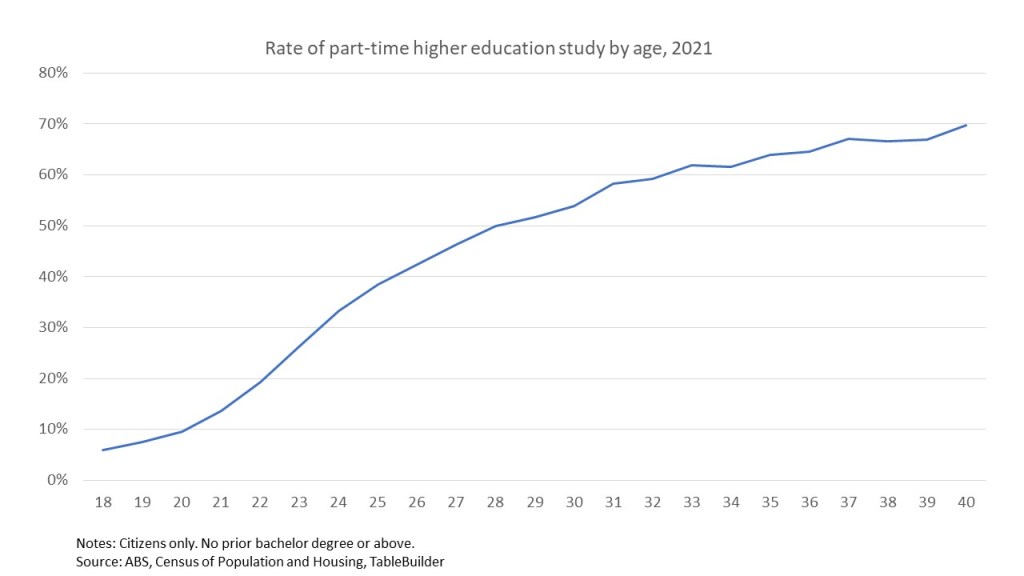
Older students are more likely to enrol part-time (chart below). Given the high rates of upper ATAR students going to university soon after school older first-time students must disproportionately be people with weaker school results. They plausibly have above-average needs for academic support to complete their courses successfully.

Read More »

How would student places be allocated under the Universities Accord?

The task of interpreting the Universities Accord interim report is like that of a biblical scholar trying to extract meaning from fragmentary and sometimes contradictory texts. But building on my post on a universal learning entitlement, in this post I try to understand what kind of student places allocative system the report proposes.

Existing and possible Accord allocative systems

All funding systems need methods for determining total resources and then allocating them between institutions, courses and students. The chart below has the three allocative models currently in use – what I call technocratic, block grant, and demand driven – and the Accord model, which on my reading has elements of the technocratic and demand driven models. However these models are in tension with each other – technocracy puts experts in charge while demand driven funding is based on decentralised decision making.

DecisionTechnocratic (current system for medical students)Block grant (current system for most students)Demand driven (current system for bachelor degree regional Indigenous students with likely extension to all Indigenous students)Accord model?
Total number of places/dollars for each year (system level)Government decisionGovernment decisionUniversity and student decision. Aggregate outcome of student decisions (especially if universities have less control over who they admit).
Or aggregate of Tertiary Education Commission university allocations.
Total number of places /dollars for each universityGovernment decisionGovernment decisionUniversity and student decision.Aggregate of student decisions with full learning entitlement model, possible voucher system.
Or as negotiated/allocated by the Tertiary Education Commission.
Total number of places/dollars for each course or disciplineGovernment decisionUniversity and student decision.University and student decision.Target allocations for courses determined by Tertiary Education Commission.
Possible caps via aggregate voucher allocations/university-level enrolment caps on low priority courses.
Student-level allocative criteria, such as academic results or equity group status.Can be a government decision, but for medical students a university and student decision.University and student decision.University and student decision.Possibly a government decision through Tertiary Education Commission/national admission centre. Or keep current system but use targets to push unis to enrol more students, in general and from priority groups.
Read More »

Will demand driven funding for all Indigenous students make much of a difference?

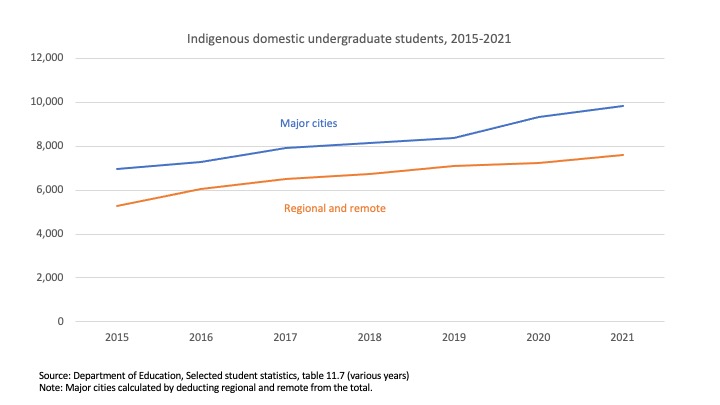
Yesterday the government introduced legislation to extend demand driven funding from regional and remote to all Indigenous students. Currently Indigenous students from major cities are funded from within each university’s capped maximum basic grant amount for higher education courses. If the legislation passes universities will get the full Commonwealth contribution value of all enrolled Indigenous students in demand driven funding eligible courses, with no funding cap.

What are current Indigenous enrolments by geographic category?

Demand driven funding only applies to bachelor degree students – of which more later – which makes it a funding category that is not also a publicly-reported statistics category. However a table in the annual equity statistics lets us calculate the number of undergraduate (ie bachelor + diploma + associate degree) Indigenous students by home geographic location. It shows that Indigenous students from the major cities outnumber regional and remote students. Enrolments from both groups have increased in recent years.

Read More »

The Universities Accord universal learning entitlement – how might it work?

One Universities Accord interim report suggestion is a ‘universal learning entitlement’. But what would this mean, and how would it differ from what we have now?

The first part of this entitlement is to support Australians in obtaining a tertiary qualification. But it aims to go beyond ‘traditional targets’, such as for higher education or VET, to meet ‘a range of skills and other objectives’.

The interim report defines entitlement funding as ‘an appropriate combination of a public subsidy, a student contribution that would be paid through an income contingent loan … and, for some lifelong learning, an appropriate employer contribution’.

Current limits on higher education enrolments

While no Australian citizen is specifically disqualified from accessing a funded place in higher education, in practice three admissions-related obstacles can stand in their way.

Read More »

For universities the Accord interim report proposes a more extreme version of Job-Ready Graduates

The Australian Universities Accord interim report recommends overturning the most controversial Job-ready Graduates policy, using student contribution price signals to guide student course choices.

But overall the Accord interim report and Job-ready Graduates have strong parallels. They both take a utilitarian view of higher education, that its purpose is to provide benefits to others rather than being of any intrinsic value. Universities exist to meet skills needs, find practical uses for research, contribute to their local communities, and promote equity. The main difference is the interim report proposals are, with student contributions the main exception, more extreme and interventionist than Job-ready Graduates.

Substantially reduced university autonomy

Historically universities in Australia and other western countries have operated with a significant degree of autonomy from government. But despite using the word ‘autonomy’ a few times the Accord interim report shows little interest in this idea.

On my count at least 25 interim report proposals would reduce the scope of university-level decision making or are new reporting requirements that set universities up for future regulation. In my list these cover general mission direction, student admissions, the mix of disciplines and courses, curriculum and teaching, use of funds, and accountability.

Read More »