Late last year the Greens introduced the Higher Education Support Amendment (Reverse Job-Ready Graduates Fee Hikes and End 50k Arts Degrees) Bill into the Senate. Submissions for the Senate inquiry into this bill close on Friday.
Under the bill, the student contribution for most arts students would go down from $17,399 a year to $8,164, what it would have been if Job-ready Graduates had never happened. For business and law the student contribution would go down from $17,399 to $13,624, similarly what it would have been without Job-ready Graduates. Creative arts students contributions would go down from $9,537 to $8,164.
My submission to the inquiry is here.
Constitutional problems
While I agree with the broad direction of the Reverse Job-ready Graduates bill on student contributions, it cannot fix the JRG problem. Under section 53 of the Australian Constitution, a bill appropriating money cannot originate in the Senate. Offsetting reduced student contributions with higher Commonwealth contributions, as needed to maintain university funding, would require an appropriation. Due to this legal limitation, the bill contains only lower student contributions, without any changes to Commonwealth contributions.
If the bill passed we would be left with JRG Commonwealth contributions and pre-JRG student contributions. Total funding for a full-time arts student would halve, from $18,715 to $9,480.
Ending $50,000 arts degrees by ending arts degrees is too radical a measure.
Sharing the political cost of change
JRG cannot be fixed without the government’s cooperation. The government’s position is a not very satisfactory – they agree it is a problem but refuse to do anything about it. They are paralysed by the cost to the budget if reduced student contributions were offset by higher Commonwealth contributions and/or the political cost of increasing student contributions in other courses in a budget-neutral fix.
Labor has made a judgment that they can get away with an unfair student contribution system and so do not want to spend either financial or political capital to reform it.
But the political calculation could be changed if the higher education sector and other political parties shared some of the political cost of moving to a fairer system overall.
And that means supporting increases in some student contributions so that others can go down.
A compromise measure
My submission has a first go at a compromise, including costings based on 2024 Commonwealth supported places.
To reduce the savings needed, I suggest postponing change to business and law student contributions.
Instead, I propose focusing on the fields in the table below that I think have relatively poor repayment prospects. The submission examines likely repayments for arts graduates owing $50,000 (reflecting the bill’s title). The interaction of a high initial balance, compound indexation and the new HELP repayment system mean that an arts graduate consistently earning the median income for an arts graduate would never repay in full. With the reduced student contribution in the table (matching the Reverse Job-ready Graduates bill) they would repay in full, albeit still taking a long time.
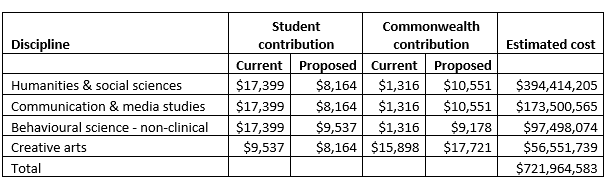
The cost of these student contribution reductions would, on 2024 EFTSL, be around $720 million. More than 90% of that cost could be offset with the student contribution increases in the table below. Most of the work is done by lifting IT and engineering to the top student contribution band. The other changes make student contributions more consistent for students doing the same degree.
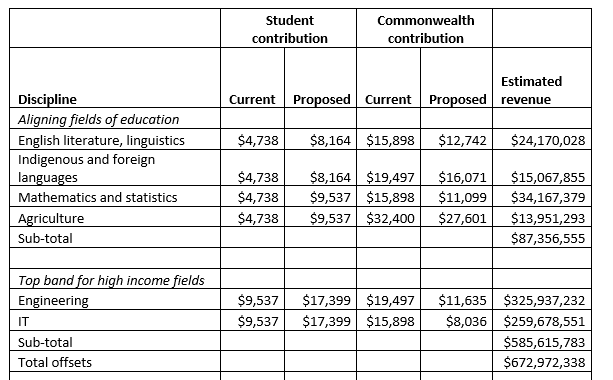
Moving nursing and teaching up from their current $4,738 student contribution to $8,164 would raise $382 million on 2024 Commonwealth supported place EFTSL. I assume, however, that fear of dealing with nursing and teaching student contributions is one reason the government refuses to reform student contributions. I therefore propose postponing this issue.
ENDS
 Andrew Norton