Total 2026 Commonwealth supported places funding for public universities

This post looks at estimated 2026 funding for Commonwealth supported students in public universities. Compared to my earlier post on block grants it adds public funding for medical students, demand driven funding for Indigenous students in bachelor degrees, and student contribution revenue. Total expected public university revenue for Commonwealth supported students, as of February 2026, is $15.5 billion. This is 3.4% more than in 2025.

The 2026 figures by university can be downloaded here.

Commonwealth Grant Scheme

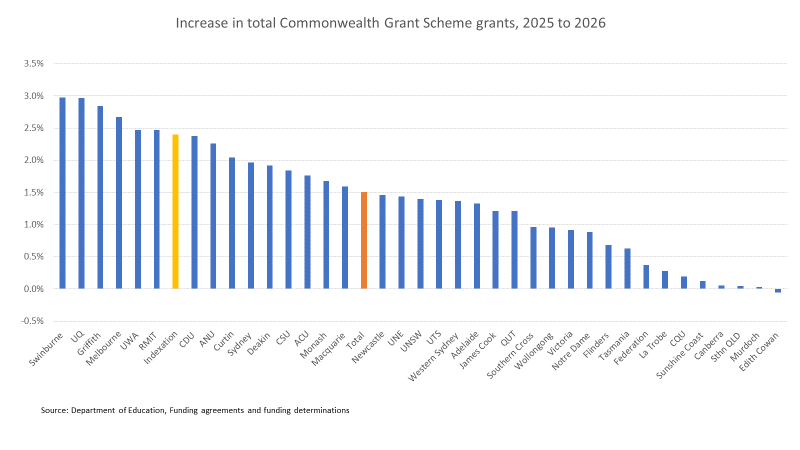
Adding medical and Indigenous places to the block grant ‘higher education courses’ figures, which were discussed in the earlier post, significantly increases Commonwealth Grant Scheme (CGS) totals for some universities. But it does not greatly change overall conclusions about trends in the CGS. CGS funding is down in real terms, with an overall increase of 1.5%, compared to the previous CPI increase policy, which would have delivered a 2.4% increase. Only six universities receive a 2026 CGS increase of 2.4% or more on 2025.

From publicly available information I can partly explain the reasons for university-level changes. As noted in the earlier post some ad hoc places programs (e.g. the equity 20,000 places) are being phased out. The government is not indexing higher education courses grants of universities that were not fully using their ‘higher education courses’ allocation. Seven universities expect to earn less in 2026 than in 2025 from the Indigenous bachelor degree demand driven program. Some universities have increased funding for nuclear submarine places, $15.4 million in total.

One university shows a 2026 CGS decline on 2025, but if this happens the Transition Funding Floor Guarantee will return it to a neutral position.

Since I wrote the block grant post I have been informed of two other factors affecting CGS figures that are not yet shown in my data sources, the funding agreements and the funding determinations. First, current allocations do not include the 100 new medical places announced last November. That will add $3.2 million to the ‘designated medical’ category. Second, there is not yet any money converting some over-enrolments (i.e. student contribution only places) to fully funded places. If this turns out to be the $50 million mentioned in briefings to universities, over-enrolment money and the extra medical places will lift the 2026 total CGS increase on 2025 to 2.2%.

Although most universities are, in CPI adjusted terms, facing lower CGS funding for 2026 their total subsidies for Commonwealth supported students may nevertheless go up. One possible reason for CGS stinginess is that the government is increasing expenditure on equity students through needs based funding. In future needs based funding will be a CGS sub-program. As an interim measure, until the necessarily legislation is passed, the government is repurposing the non-CGS statutory basis of pre-2026 equity programs for needs based funding.
Read More »

The 2026 funding agreements, Part 3: New rules on closing courses

In the 2026 university funding agreements the rules on closing courses have changed and now require universities to follow additional processes. These changes are presumably a response to course and subject closures at UTS, at Macquarie, the ANU, the University of Canberra, and other institutions.

Confusingly, however, the agreements differ between universities on the timelines to follow.

Which courses are covered?

The basic threshold for a course being covered by the closure rules is that it must be an undergraduate or postgraduate course in which Commonwealth supported places have been used for at least two years. This includes a major within a course.

A course is not considered closed if it is immediately replaced by another course that leads to the same occupation or provides a similar specialised skill.

A course is considered closed, however, if it suspends intake of students for more than one consecutive academic year.

These criteria are unchanged from last year.

Timing of notification

In 2025 universities had to notify the Commonwealth of potential course closures by 31 July and before information on the closure is made public.

In 2026 the 31 July deadline is gone. Presumably it was unrealistic about university decision making timelines.

In what I will call funding agreement variation A, for 2026 notification of actual or potential course closures should occur at the earlier of (i) as soon as reasonably possible before final decisions to close courses are made or (ii) before any information on the potential course closure is made public.

In what I will call funding agreement variation B, for 2026 notification of potential course closures should occur by the earlier of (i) the finalisation of the provider’s Mission Based Compact for the following year (or where a new Mission Based Compact is not being negotiated, the finalisation of annual allocation of domestic student places for the following year), or (ii) one calendar month before any information on the potential course closure is made public.

Variation B is a bold inclusion, as the ‘annual allocation of domestic student places’ refers to a new funding system that requires legislation. As of early February 2026 it had not been introduced into Parliament, much less passed.

For variation B universities, then, the effective current rule is to notify the Commonwealth at least one month prior to making a course closure public. Variation A universities can wait until closer to the date of public disclosure before telling the government, unless they have made a final decision, as they need to inform the government as soon as possible before that decision.

Read More »

The 2026 funding agreements, Part 2: Sorting out the medical student policy mess

Last year the Parliament passed legislation making Commonwealth supported places demand driven for Indigenous students enrolled in medical courses. It sounded good, we need more Indigenous doctors. But as I pointed out, the policy as legislated risked reducing non-Indigenous medical student enrolments without increasing Indigenous medical students enrolments.

The 2026 funding agreements reveal that the Department of Education has been quite inventive in finding a workaround to prevent this perverse outcome. The price, however, is yet more complexity in higher education policy.

The problem

A demand driven funding policy for Indigenous medical students assumes that fixed total funding holds Indigenous enrolments down. Student places are indeed unusually restricted in medicine. Medicine is the only ‘designated’ course, meaning that the government sets a specific number of student places. While designation does not prohibit over-enrolments (i.e. student contribution only places), medicine also has a completions cap. A standard funding agreement clause specifies that a university must not change its medical enrolments in ways that will change annual completions from the capped level.

While medical student numbers are restricted it is not clear that this prevents increased Indigenous enrolments. As I argued in my original post, universities already try hard to recruit Indigenous medical students, with special entry schemes and quotas in some cases. On the available data (below) these schemes are delivering Indigenous enrolments, a source of pride for the medical deans association. 3% of domestic medical students are Indigenous, compared to 2.3% of the overall domestic student population.

The main obstacle to further enrolment increases is unlikely to be funding. It is finding potential students who are not being set up to fail.

Read More »

The 2026 funding agreements, Part 1: Public university block grants

The 2026 higher education funding agreements, the legal basis of Commonwealth Grant Scheme funding, were published recently. This post examines public university funding for ‘higher education courses’.

‘Higher education courses’ has a specific legal meaning. It includes FEE-FREE Uni Ready (enabling) courses and coursework programs other than medicine, except for Indigenous students in bachelor degree courses, who are funded separately. Each public university receives a maximum basic grant amount (MBGA) for higher education courses. This funding is intended to be a flexible block grant. Universities can move money between qualification levels and disciplines, except for medicine.

Policy change

For 2026 the government has changed its policy on setting university MBGAs, as part of a transition to a new funding system under the proposed Australian Tertiary Education Commission. For 2023-2025 Labor retained the Coalition policy of indexing MBGAs to inflation and adding regional-campus-biased increments for population change. This policy led to many universities not using all their MBGA, known as ‘under-enrolment’. Coalition policies to compensate higher education providers for under-enrolment cost taxpayers $844 million between 2020 and 2023.

The government has, sensibly enough, decided not to keep increasing MBGAs for universities that cannot utilise the funds. The new policy, as summarised in the funding agreements, is:

  • For universities that significantly under-enrolled in 2024, the last year with ‘verified’ data, the provider will receive no increase in higher education courses MBGA between 2025 and 2026. Section 30-27(3) of the Higher Education Support Act 2003 prevents the government from lowering a MBGA between years.
  • Universities with enrolments valued at or near their MBGA will receive inflation indexation.
  • Universities with significant over-enrolment ‘may’ also receive a share of an over-enrolment fund.

In a document distributed to universities in 2025, significant over-enrolment was defined as delivering places valued at 5% or more above their MBGA.

Read More »

What’s in the 2025 funding agreements? – ‘Higher education courses’ block grants

In February I reported on preliminary university-level 2025 allocations under the Commonwealth Grant Scheme and estimates of student contributions.* These have since been updated to add money for FEE-FREE Uni Ready places and regional university study hubs. The revised funding summary is here.

This post looks at the underlying funding agreements for more detail on the ‘higher education courses’ part of CGS funding. As usual in funding agreements since 2021, the detail reveals a range of legal and policy problems.

A spreadsheet summary of higher education courses funding for 2025 is here.

The role of higher education courses funding

Higher education courses funding is intended, by the Higher Education Support Act 2003, to be a flexible block grant. Within their total funding envelope, expressed as the ‘maximum basic grant amount’ (MBGA), universities can move resources across coursework AQF levels and between fields of education, other than medicine.

Although higher education courses funding is supposed to be flexible, both Coalition and Labor governments have used ad hoc funding agreement conditions to restrict use of higher education courses money to purposes chosen by the government.

This has in turn led to the unlegislated concepts of ‘base MBGA’ and ‘total MBGA’. Total MBGA is actual MBGA under HESA 2003. Base MBGA excludes most ad hoc programs. Its purpose is to reduce expenditure on the higher education continuity guarantee and the current equity plan funding. If universities don’t meet the ad hoc criteria they get $0 for those non-delivered places.

Overall trend in higher education courses funding

To the surprise of universities the first-term Albanese government often treated them harshly. But Labor kept the former government’s promise to index higher education courses funding to CPI. That was 4.1% for 2025. They also kept the Coalition’s region-based funding increases. While there are complex financial flows in and out of higher education courses funding – discussed further in this post – it is up 6.1% between 2024 and 2025 to a total of $7,687,211,975.

Read More »

What’s new in the funding agreements, part 4: revised equity plan rules

As discussed in a blog post last week, the revised 2024-25 Commonwealth-university funding agreements add new restrictions on early offers. The revised agreements also rewrite the rules on a novel feature of the original December 2023 2024-25 funding agreements. These rules cover a new policy to spend unused Commonwealth Grant Scheme allocations on activities set out in equity plans.

The May funding agreements improve on their December 2023 versions by potentially making the equity plan requirement optional. However a change to how the equity plan amounts are calculated reduces how much money universities could receive.

The revised funding agreements also include some minor funding increases.

Read More »

What’s new in the university funding agreements, part 3: new rules on early offers

Earlier this year I wrote a couple of blog posts on the 2024 university-Commonwealth funding agreements signed late last year. Revised agreements were signed in May 2024. These agreements include new rules on early offers. This post argues that early offers rules should be legislated separately and not included as a condition of Commonwealth Grant Scheme funding.

Restrictions on school leaver early offers

As foreshadowed by the minister in February, university funding agreements now restrict school leaver early offers. The basic rules are 1) No offers to Year 11 students; 2) No offers to Year 12 students prior to September; and 3) Offers must be conditional on successful completion of a senior secondary certificate of education.

Read More »

What’s new in university and NUHEP funding agreements, part 2: Inappropriate use of the agreements to create a new equity program

In a previous post on the new funding agreements, I looked at the 2024 Commonwealth Grant Scheme funding for higher education courses and designated courses, along with the amended rules for course closures. In this post I look at a novel funding agreement section, which creates a new equity program financed by under-spends on the Commonwealth Grant Scheme. This program has legal and policy flaws. I also examine some paperwork problems with the agreements for non-university higher education providers and private universities.

What usually happens if universities under-enrol?

Due to weak student demand some, quite possibly many, higher education institutions will under-enrol in 2024 – that is, take Commonwealth-supported students valued at less than the maximum funding they can receive for higher education courses according to the funding agreements – this year a $7.24 billion pot of money.

By law, under-enrolment results in CGS grants being reduced – higher education providers are paid the lesser of the value of student places (on an EFTSL * relevant Commonwealth contribution formula) or their higher education courses maximum basic grant amount: section 33-5(2) of the Higher Education Support Act 2003 for Table A institutions and section 33-5(7), using the terminology of ‘total basic grant amount’ for other higher education providers receiving CGS funding.

Under section 164-10(1A) of HESA 2003 any overpayment is recovered by reducing grants paid to the under-enrolled provider or as a debt to the Commonwealth. Clause 4 of the funding agreements reiterates this requirement.

Read More »

What’s new in university funding agreements, part 1: Commonwealth Grant Scheme funding and course closure rules

The 2024 university and NUHEP funding agreements were released earlier this month. These documents are the legal basis of most funding from the Commonwealth Grant Scheme, the main tuition support program. I have created a spreadsheet with institution-level funding, available here.

Overall funding levels

Any total CGS comparison with 2023 is approximate at this point, as we don’t yet have estimated payments for demand driven funding – 2024 is the first year that metropolitan as well as regional Indigenous bachelor-degree students are financed on this basis. This creates disruptions to the time series for two of the three main CGS pots of money – demand driven and ‘higher education courses’, which covers all Commonwealth supported students except Indigenous bachelor-degree students and medical students.

Higher education courses are by far the largest CGS category. In 2024 maximum higher education courses funding will be $7.24 billion, $452.2 million or 6.7% more than in 2023.

Table A providers (i.e. each government-created university plus ACU and Notre Dame) get 99.5% of this money, while nine other providers get the remaining $34.3 million.

For designated courses, currently medicine only, the 2024 total is $413.97 million up 8.1% on 2023.

Read More »

How much the government paid for Centre Alliance’s Senate vote, and other updates from the funding agreements

This post updates one I wrote in April, including new information from revised university funding agreements posted on DESE’s website.

South Australian university Senate special deals

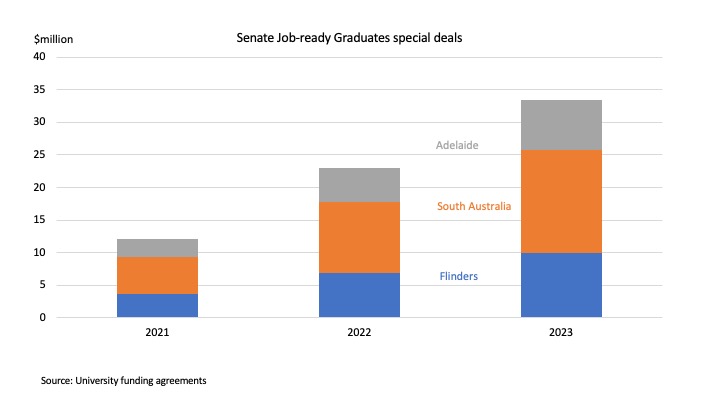
The updated funding agreements let us see how much the government paid to get Centre Alliance Senator Stirling Griff to vote for Job-ready Graduates, which is $68.6 million for South Australian universities over the 2021-2023 funding agreement period. Unlike much of the other additional money in the funding agreements, these increases are ongoing rather than temporary.

I am not sure what criteria were used in dividing the money between the South Australian universities. In 2021 Adelaide gets 1.9 per cent more than it presumably would have otherwise, Flinders 2.7 per cent, and the University of South Australia 3.1 per cent.

More short course places allocated

In my earlier post the allocated short courses fell short of the announced budget value of $252 million. Now they slightly exceed it at $258.7 million, divided between 256 undergraduate certificates valued at $102.9 million and 491 graduate certificates worth $155.8 million. My updated spreadsheet of short courses is here.

Read More »