Mapping Australian higher education 2023 – official release

Update 20/12/2025: More recent data here.

Mapping Australian higher education 2023 is now available from the ANU Centre for Social Research and Methods website.

Update 30/10/2024: There is a later version of Mapping 2023’s data here.

Update 26/10/23: A reader has pointed out that list of FEE-HELP NUHEPs is incomplete. A column of names from the original Excel file was omitted during production. The full list is available here. This list also includes three non-FEE-HELP providers registered by TEQSA since the pdf version was finalised. A corrected version of Mapping with the full list of NUHEPs, as of mid-2023, is here.

If anyone has noticed other errors please let me know.

The Accord equity target that cannot, and perhaps should not, be achieved

The Universities Accord terms of reference asked the review panel to recommend higher education equity and attainment targets, and in their interim report they offer suggestions.

The general goal is equity group parity in higher education participation by 2035 (pp. 18, 20). There is some ambiguity about whether this applies for all equity groups. A few times only three of the main four – low SES, regional, and disability – are specifically mentioned for the 2035 target (pp. 9, 42, 43). For Indigenous students a target is referred to but not specified on p.43. The Indigenous contribution to the 2035 target is however, mentioned at pp. 40-41.*

Other potential equity groups such as first in family, care leavers, people from single parent families and children of asylum seekers may be added (p. 42)

The equity targets interact with an overall target of 55 per cent attainment by 2050. It is unclear whether this target is for people aged 25 to 34 years (pp. 9 & 36), employed persons (p. 33, distinguished from the 25 to 34 cohort), or all people/unspecified base (p. 22).

Whatever the exact 2050 target, it is well above current levels. Equity group parity is not just achieving the overall population participation and attainment rate now. It is chasing a rate that will, if other Accord policies work, be moving up.

This post discusses the practical obstacles to equity group targets that apply regardless of the precise targets set. It also questions whether a large increase in higher education participation would reliably be in the best interests of the additional students.

Read More »
Should funding be partly based on student characteristics?

Australia’s higher education teaching funding system is primarily based on subjects rather than students. Subjects taken are converted into ‘equivalent full-time student load’ (EFTSL), the amount of study a full-time student does in an academic year. The funding rate per EFTSL varies by field of education, assuming that subject characteristics drive costs.

Various supplementary programs calculate funding on headcount equity students, but with trivial resources compared to the subject-driven funding programs, the Commonwealth Grant Scheme and HELP.

Funding on headcount?

One interesting idea in submissions to the Universities Accord review, especially suggested by regional universities, was to base more funding on the student. For part-time study one EFTSL could be two or more individual students. While their combined classroom time matches one full-time student, a student with 50 per cent of an EFTSL could put similar or even greater demands on other university services as a student at 100 per cent of an EFTSL.

In RUN’s submission they report a member university’s finding that, on average, their part-time students utilised eleven services compared to five for full-time students.

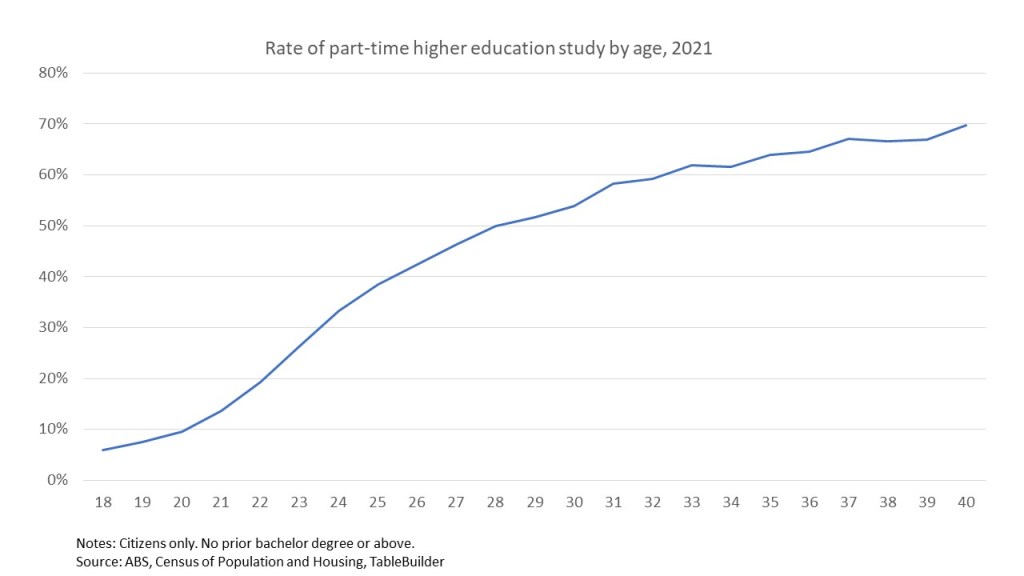
Older students are more likely to enrol part-time (chart below). Given the high rates of upper ATAR students going to university soon after school older first-time students must disproportionately be people with weaker school results. They plausibly have above-average needs for academic support to complete their courses successfully.

Read More »

How would student places be allocated under the Universities Accord?

The task of interpreting the Universities Accord interim report is like that of a biblical scholar trying to extract meaning from fragmentary and sometimes contradictory texts. But building on my post on a universal learning entitlement, in this post I try to understand what kind of student places allocative system the report proposes.

Existing and possible Accord allocative systems

All funding systems need methods for determining total resources and then allocating them between institutions, courses and students. The chart below has the three allocative models currently in use – what I call technocratic, block grant, and demand driven – and the Accord model, which on my reading has elements of the technocratic and demand driven models. However these models are in tension with each other – technocracy puts experts in charge while demand driven funding is based on decentralised decision making.

DecisionTechnocratic (current system for medical students)Block grant (current system for most students)Demand driven (current system for bachelor degree regional Indigenous students with likely extension to all Indigenous students)Accord model?
Total number of places/dollars for each year (system level)Government decisionGovernment decisionUniversity and student decision. Aggregate outcome of student decisions (especially if universities have less control over who they admit).
Or aggregate of Tertiary Education Commission university allocations.
Total number of places /dollars for each universityGovernment decisionGovernment decisionUniversity and student decision.Aggregate of student decisions with full learning entitlement model, possible voucher system.
Or as negotiated/allocated by the Tertiary Education Commission.
Total number of places/dollars for each course or disciplineGovernment decisionUniversity and student decision.University and student decision.Target allocations for courses determined by Tertiary Education Commission.
Possible caps via aggregate voucher allocations/university-level enrolment caps on low priority courses.
Student-level allocative criteria, such as academic results or equity group status.Can be a government decision, but for medical students a university and student decision.University and student decision.University and student decision.Possibly a government decision through Tertiary Education Commission/national admission centre. Or keep current system but use targets to push unis to enrol more students, in general and from priority groups.
Read More »

Will demand driven funding for all Indigenous students make much of a difference?

Yesterday the government introduced legislation to extend demand driven funding from regional and remote to all Indigenous students. Currently Indigenous students from major cities are funded from within each university’s capped maximum basic grant amount for higher education courses. If the legislation passes universities will get the full Commonwealth contribution value of all enrolled Indigenous students in demand driven funding eligible courses, with no funding cap.

What are current Indigenous enrolments by geographic category?

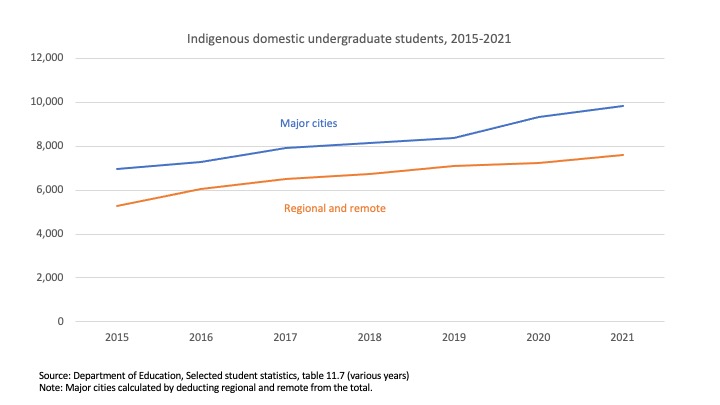
Demand driven funding only applies to bachelor degree students – of which more later – which makes it a funding category that is not also a publicly-reported statistics category. However a table in the annual equity statistics lets us calculate the number of undergraduate (ie bachelor + diploma + associate degree) Indigenous students by home geographic location. It shows that Indigenous students from the major cities outnumber regional and remote students. Enrolments from both groups have increased in recent years.

Read More »

The Universities Accord universal learning entitlement – how might it work?

One Universities Accord interim report suggestion is a ‘universal learning entitlement’. But what would this mean, and how would it differ from what we have now?

The first part of this entitlement is to support Australians in obtaining a tertiary qualification. But it aims to go beyond ‘traditional targets’, such as for higher education or VET, to meet ‘a range of skills and other objectives’.

The interim report defines entitlement funding as ‘an appropriate combination of a public subsidy, a student contribution that would be paid through an income contingent loan … and, for some lifelong learning, an appropriate employer contribution’.

Current limits on higher education enrolments

While no Australian citizen is specifically disqualified from accessing a funded place in higher education, in practice three admissions-related obstacles can stand in their way.

Read More »

For universities the Accord interim report proposes a more extreme version of Job-Ready Graduates

The Australian Universities Accord interim report recommends overturning the most controversial Job-ready Graduates policy, using student contribution price signals to guide student course choices.

But overall the Accord interim report and Job-ready Graduates have strong parallels. They both take a utilitarian view of higher education, that its purpose is to provide benefits to others rather than being of any intrinsic value. Universities exist to meet skills needs, find practical uses for research, contribute to their local communities, and promote equity. The main difference is the interim report proposals are, with student contributions the main exception, more extreme and interventionist than Job-ready Graduates.

Substantially reduced university autonomy

Historically universities in Australia and other western countries have operated with a significant degree of autonomy from government. But despite using the word ‘autonomy’ a few times the Accord interim report shows little interest in this idea.

On my count at least 25 interim report proposals would reduce the scope of university-level decision making or are new reporting requirements that set universities up for future regulation. In my list these cover general mission direction, student admissions, the mix of disciplines and courses, curriculum and teaching, use of funds, and accountability.

Read More »

The decline of the humanities

A couple of days ago the Sydney Morning Herald published an article on falling enrolments in university humanities subjects, with a focus on history and English.

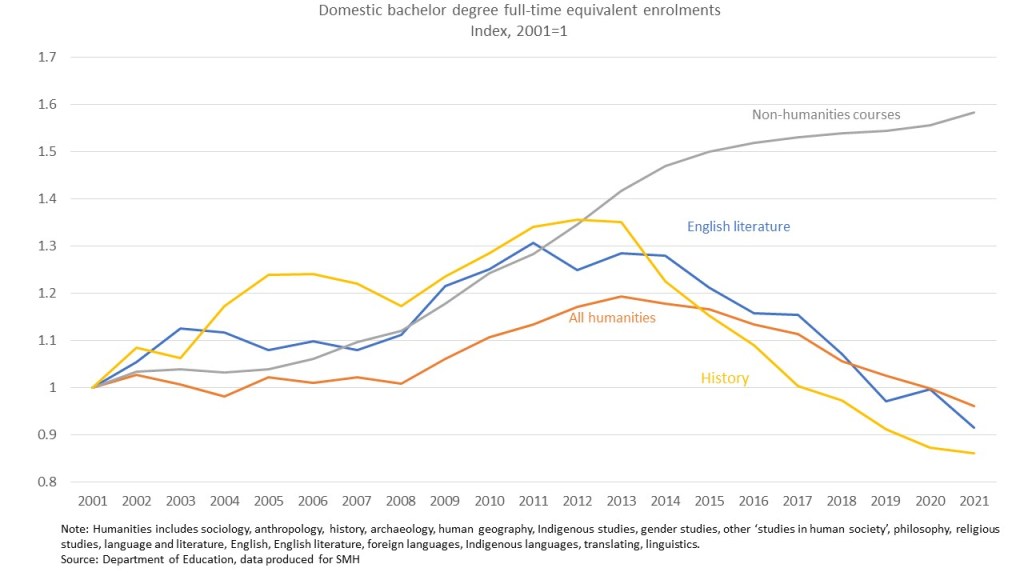
I’ve converted the data into an index to make it easier to see the trends in fields with different absolute numbers of full-time equivalent enrolments. In the late 2000s and early 2010s the humanities shared in general enrolment growth, but after that went into decline. History’s growth and decline were greater than the humanities in general.

Read More »

Conflicting visions of higher education’s purposes

I blurbed Mind of the Nation, Michael Wesley’s new book on universities in Australian life, with the statement that it ‘shows how rising and conflicting expectations of universities create controversies that will not go away’. His book is about the cultural and political position of universities rather than higher education policy as such, although policy provides evidence of how politicians and voters see universities.

University administrators – Wesley is a deputy vice-chancellor – are at the centre of these controversies, blamed by all sides for whatever is wrong with universities. Mind of the Nation explores why universities receive so much critique and so little love or (from a university perspective) public funding, despite many successes and contributions: life-changing experiences for students, moving from an elite to a mass higher education system, creating a new export industry, large increases in research aimed at solving practical problems, and engagement with local communities.

Wesley asks why Australians admire the successes of their sporting teams, musicians and actors but not universities.

Read More »

Free higher education as income and consumption smoothing

The argument that free higher education would create additional higher education opportunities is empirically weak. History and international comparisons show that participation rates increase without it, and indeed due to budget constraints free higher education can lead to lower participation rates.

However there is another argument for free higher education which, while still contentious, has goals and likely outcomes that are consistent with each other.

Free higher education and income/consumption smoothing

The strongest argument for free (or cheaper) higher education is a better balancing of income and consumption over the life cycle. Needs are more consistent through life than income. Most people consume more than they earn when young and old and a large proportion earn more than they consume during their full-time working years. Smoothing these out is one of the principal functions of welfare states.

Compared to upfront fees or mortgage style student loans paid in instalments the HELP repayment system already has strong smoothing effects. It pushes the expense of higher education away from the years when full-time study limits scope for paid work. On low incomes no HELP repayment is required or repayments that are less than the minimum likely mortgage style loan repayment amount. On high incomes HELP repayments are more than the likely mortgage style loan repayment amount.

And higher education is already free for HELP debtors who persistently earn less than the first repayment threshold.

Read More »