Changing the HELP indexation date – 30 November?

A common HELP indexation complaint over the last couple of years is that compulsory repayments during the financial year are not deducted prior to indexation. I explained the current system in this post last year.

In that post, I noted that one reason for not taking compulsory HELP repayments out prior to the current 1 June indexation date is that their exact amount is not yet known by the ATO. The repayment amount is calculated after the financial year ends, on 30 June, and during tax return processing. There are many reasons why HELP repayments sent via the PAYG system could be less or more than the final repayment amount.

The ATO has raised another administrative obstacle, which is that HELP repayments are not separately identified in the PAYG information it receives from employers. As the ATO collects salary information, and already knows who is a HELP debtor, it perhaps would not be that hard to infer why the amount withheld from an employee is higher than income tax rates require. But clarity on what is intended as a HELP repayment would require system re-designs for the ATO and employers. HELP PAYG information would still often vary from the final correct amount, so the system would need a reconciliation after 30 June, with corresponding adjustment of indexation up or down. This would add complexity and administrative costs. These practical issues rule out real-time reduction of HELP balances.

The Accord final report instead recommends another option, changing the date of HELP indexation. They do not, however, suggest a date.

Read More »
HELP debt indexation at the lower of CPI or a fixed maximum rate – giving HELP borrowers more certainty than the Universities Accord final report lower of CPI or WPI recommendation

Over the last two years high CPI-driven HELP debt indexation – 3.9% in 2022, 7.1% in 2023, probably in the vicinity of 5% this year – has been a major issue. It has brought to public attention HELP debt issues that had been waiting for their trigger.

The last time HELP debt indexation exceeded 5% was in 2001, as the the new GST flowed through into prices and an indexation rate of 5.3%. At that time 1.1 million people had HECS (as it then was) debts of about $7.2 billion. A Factiva search shows that this unusually high indexation was newsworthy at the time. But with much lower HELP balances per person than now the average debt increase was only $350. The indexation issue then went quiet for two decades, except when the government wanted to charge more than CPI.

The reason for HELP indexation’s long low media profile was that between 2002 and 2021 it averaged 2.4%. It was below 2% between 2016 and 2021. This extended period of low inflation left HELP indexation as a latent issue, as increases in HELP debtor numbers and average debts gave it far more potential to cause significant personal cost and political trouble than it had in 2001.

Read More »

Creating a better integrated education system – some notes on Rethinking Tertiary Education, a book building on the work of Peter Noonan

Peter Noonan was a rare person with expertise across vocational and higher education, and an even rarer person who made significant policy contributions to both. Sadly he passed away in 2022 at the age of 67.

Rethinking Tertiary Education, co-edited by Peter Dawkins, Megan Lilly and Robert Pascoe, with sixteen others as co-authors, is billed as ‘building on the work of Peter Noonan’, and does so by exploring ways of making the component parts of Australia’s formal education sector – especially higher education and vocational education, but also schools – work together more smoothly than now. Pascoe also contributes an interesting biographical chapter on Noonan.

For historical and political reasons the vocational and higher education systems in Australia have quite sharp dividing lines in the nature of the qualifications they deliver, how they are funded, how they are taught, and with some exceptions the occupations they support. The book also looks at school credentials, especially the idea that they don’t measure all they should.

Read More »

The 2003 Cabinet papers and Brendan Nelson’s higher education reforms

In the history of Australian higher education policy Brendan Nelson, the Liberal minister for education from 2001 to 2006, is perhaps under-rated. Several student funding structural changes he legislated 20 years ago are still in place. These include:

  • Student contributions set by universities up to a legislated maximum and going to universities (previously HECS was a fixed government charge);
  • A per full-time equivalent student Commonwealth contribution based on subject field of education (previously universities received an overall operating grant, which although informed by an early 1990s costing exercise did not directly tie money paid to discipline-level enrolments);
  • Commonwealth-university funding agreements as a method of allocating student funding to institutions, which made funding arrangements more transparent (but also turned into a backdoor instrument of policy and regulation that bypasses Parliament);
  • Through FEE-HELP, extension of student loans to full-fee undergraduates and students in private higher education institutions (the more limited Postgraduate Education Loan Scheme, PELS, was already supporting university full-fee postgraduates).

The 2003 Cabinet papers

The annual National Archives release of 20-year-old Cabinet papers, with the 2003 papers released earlier this week, gives us a look behind the scenes as Nelson’s reform package was developed and debated. Three digitised Cabinet documents record proposals and decisions, but not the Cabinet discussion. Sometimes, however, Cabinet thinking can be inferred from requests for further work and contextual material in the submissions.

This post focuses on changes to income contingent student loans.

The loan scheme that did not make it through Cabinet

Read More »

Mapping Australian higher education 2023 – official release

Update 20/12/2025: More recent data here.

Mapping Australian higher education 2023 is now available from the ANU Centre for Social Research and Methods website.

Update 30/10/2024: There is a later version of Mapping 2023’s data here.

Update 26/10/23: A reader has pointed out that list of FEE-HELP NUHEPs is incomplete. A column of names from the original Excel file was omitted during production. The full list is available here. This list also includes three non-FEE-HELP providers registered by TEQSA since the pdf version was finalised. A corrected version of Mapping with the full list of NUHEPs, as of mid-2023, is here.

If anyone has noticed other errors please let me know.

The Universities Accord universal learning entitlement – how might it work?

One Universities Accord interim report suggestion is a ‘universal learning entitlement’. But what would this mean, and how would it differ from what we have now?

The first part of this entitlement is to support Australians in obtaining a tertiary qualification. But it aims to go beyond ‘traditional targets’, such as for higher education or VET, to meet ‘a range of skills and other objectives’.

The interim report defines entitlement funding as ‘an appropriate combination of a public subsidy, a student contribution that would be paid through an income contingent loan … and, for some lifelong learning, an appropriate employer contribution’.

Current limits on higher education enrolments

While no Australian citizen is specifically disqualified from accessing a funded place in higher education, in practice three admissions-related obstacles can stand in their way.

Read More »

Free higher education as income and consumption smoothing

The argument that free higher education would create additional higher education opportunities is empirically weak. History and international comparisons show that participation rates increase without it, and indeed due to budget constraints free higher education can lead to lower participation rates.

However there is another argument for free higher education which, while still contentious, has goals and likely outcomes that are consistent with each other.

Free higher education and income/consumption smoothing

The strongest argument for free (or cheaper) higher education is a better balancing of income and consumption over the life cycle. Needs are more consistent through life than income. Most people consume more than they earn when young and old and a large proportion earn more than they consume during their full-time working years. Smoothing these out is one of the principal functions of welfare states.

Compared to upfront fees or mortgage style student loans paid in instalments the HELP repayment system already has strong smoothing effects. It pushes the expense of higher education away from the years when full-time study limits scope for paid work. On low incomes no HELP repayment is required or repayments that are less than the minimum likely mortgage style loan repayment amount. On high incomes HELP repayments are more than the likely mortgage style loan repayment amount.

And higher education is already free for HELP debtors who persistently earn less than the first repayment threshold.

Read More »

Would free university increase or decrease higher education participation rates in Australia?

In a previous post I argued that Australia’s practice of charging fees for higher education reflects its broader patterns of taxation and public funding of social services.

But we have had free higher education before, 1974-1988. For a government already spending over $600 billion a year the cost of free higher education is not beyond the feasible range. I estimate costs at $4.6 to $5.9 billion a year on status quo numbers of student places in public universities. The range reflects uncertainties about how domestic students currently paying full fees would be handled. The $4.6 billion transitions currently Commonwealth supported students to free, while the $5.9 billion fully compensates universities for lost fee revenue.

Of the arguments for free higher education the one that people find most intuitive is that it would increase higher education participation. People consume more when prices go down. But somebody is paying – the government on behalf of taxpayers – and so how they would respond is the key variable in whether the number of students would go up or down.

Debt aversion

Supporters of free higher education often make demand-side arguments, that fees or loans are a deterrent to higher education participation, especially to people from disadvantaged backgrounds.

As someone with working class origins free higher education advocate Duncan Maskell says he would not have gone to university if he had to take out a loan. Occasional school student surveys have picked up similar sentiments. But the ‘debt aversion’ hypothesis has always had trouble distinguishing between sensible prudence around taking out debt that probably is not worth it (good debt aversion), and over-caution in taking out debts that would probably lead to significant long-term benefits (bad debt aversion).

Read More »

Is the NTEU exaggerating student debt repayment times?

The NTEU has a new report out today forecasting some alarmingly long HELP debt repayment times, including over 40 years in some high student contribution courses. While I agree that this issue needs attention – and have proposed linking student contributions with expected repayment times to narrow the course-linked differences between them – I think the NTEU forecasts are much longer than will typically happen in practice.

The key problem is how the NTEU models expected graduate income. In their report they take starting salaries and then increase them each year by average wage growth over the last decade, 2.3 per cent on their figures.

However graduate incomes usually increase by much more than that. Indeed, the financial value of a degree is opportunities for continuing income growth when the wages of people without degrees tend to plateau after a decade or so in the labour force.

Graduate career wages

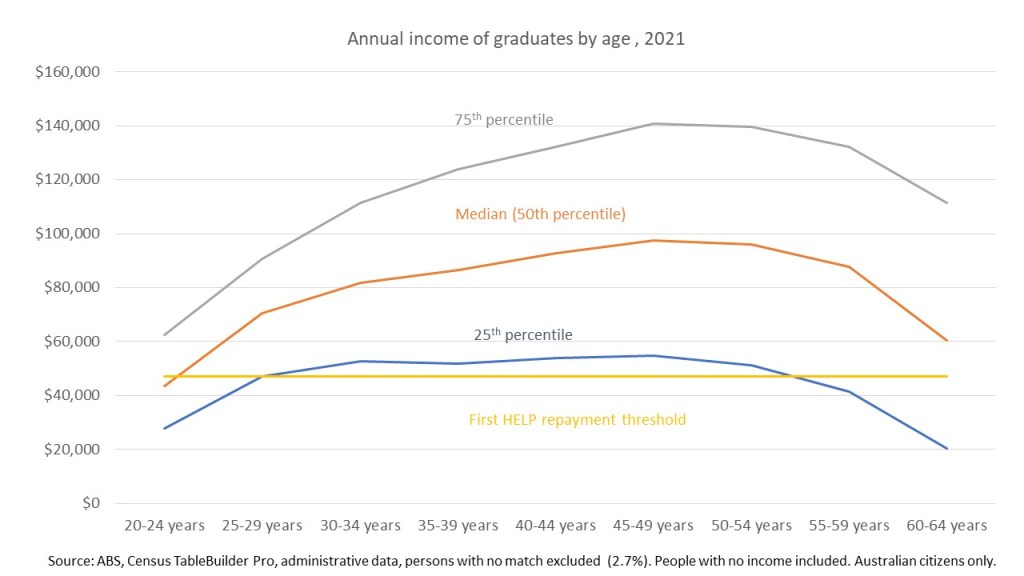
Recently the ABS added ATO and DSS derived income data to the Census dataset, allowing more detailed analysis of income than was previously possible. As the chart below shows for graduates at the median and 75th percentile income does not peak until age 45-49 years, after doubling between the early 20s and late 30s.

The next chart looks at median income by single year of age in the early career period when most HELP debt is repaid. Initial income levels look affected by people in jobs that don’t require degrees, but as professional careers start and graduates are promoted or switch to better jobs income increases rapidly.

Read More »

Time to change the timing of HELP debt indexation?

HELP debt indexation media attention has highlighted arcane aspects of student loan administration. One of these is that HELP debtors in repayment mode are indexed on debt they have already repaid.

To simplify – the processes outlined in division 140 of the Higher Education Support Act 2003 are convoluted – I will give the example of a graduate with no new HELP debt.

How HELP debt is indexed

HELP indexation occurs on 1 June each year, so it will next happen on 1 June 2023 at the controversially high rate of 7.1 per cent (see this earlier post on possible alternative ways of setting the indexation rate).

To calculate the amount to be indexed on 1 June 2023 the ATO:

i) takes the person’s HELP debt for the ‘immediately preceding financial year’, ie 1 July 2021-30 June 2022;

ii) subtracts any voluntary repayments made between 1 June in the immediately preceding financial year, ie 1 June 2022 and ending immediately before the next 1 June, ie 31 May 2023;

iii) subtracts any compulsory repayment amounts ‘assessed during that period’, ie between 1 June 2022 and 31 May 2023.

The trap is that HELP compulsory repayments for 2022-2023 will not be ‘assessed’ between 1 June 2022 and 31 May 2023, because the 2022-23 tax year does not finish until 30 June 2023. Instead, compulsory repayments for the 2021-22 tax year will be deducted.

The issue here is that by 1 June 2023 HELP debtors in the PAYG system will, in cash terms, already have paid about 90 per cent of what they will eventually owe for the 2022-23 tax year. Effectively, HELP debtors will be indexed on debt they have already repaid.

Read More »