Can universities just close loss-making courses?

As international student fee revenues fall universities are closing loss-making subjects and courses. Musicology at Monash. Maths and gender studies at Macquarie. Arts and social science subjects at Sydney. Neuropsychology at La Trobe.

Generally, universities have significant autonomy over what they teach. Changes in courses and subjects occur every year, in good as well as bad economic times.

But the funding agreements universities sign with the government impose some controls over course closures.

For courses leading to occupations deemed to be experiencing a skills shortage, and subjects teaching ‘nationally strategic’ languages, universities have to get government approval prior to closure.

Read More »

What are the academic freedom laws that Pauline Hanson wants?

As a condition of her vote for the Job-ready Graduates bill, One Nation Senator Pauline Hanson wants to add a new academic freedom provision to higher education legislation. According to yesterday’s media reports, the amendment would be in line with the wording recommended by the French review of freedom of speech in Australian higher education providers.

This change was already on the political agenda in early 2020, with consultations on the draft amendments. However, COVID-19 and perhaps Job-ready Graduates intervened and little has been heard of the issue recently, other than ex-Deakin VC Sally Walker being asked to look into implementation of the model code on university free speech proposed by Robert French.

I put in a submission to the legislation consultation, which recommended various amendments to the draft provisions, along with strengthening academic freedom to ensure that it was protected from government decisions.

This post is a slightly modified extract from the submission that explains the proposed amendments, with the aim of informing discussion if the Hanson amendment is introduced.

Read More »

Notes on the Job-ready Graduates bill, as introduced

The Job-ready-Graduates bill was introduced in the House of Representatives this morning. A couple of points on the funding floor and the social work/mental health deal with the National Party:

Funding floor

One unpleasant surprise in the draft Job-ready Graduates bill of earlier this month was that, with each funding agreement, the minister could reduce a university’s funding without parliamentary scrutiny or approval.

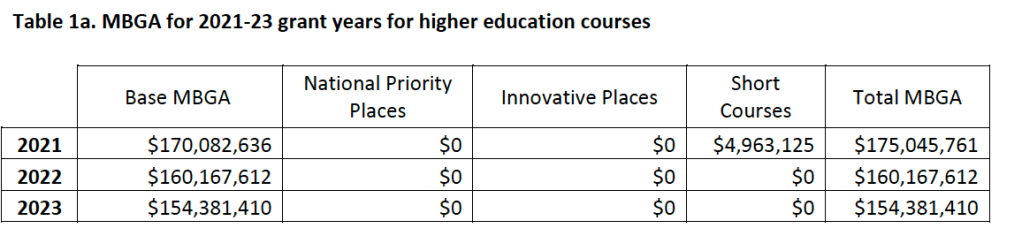
The bill as introduced has a clear fix of this problem – but from 2025: amending section 30-27(3)(b) of the Higher Education Support Act 2003 (HESA 2003). From then, the minister cannot reduce the university’s maximum basic Commonwealth Grant Scheme funding for higher education courses below what it was the previous year.

Read More »

Universities should have a Commonwealth funding floor

Update 27/8/20: A funding floor has now been inserted in the Job-ready Graduates bill, albeit with some remaining issues.

———————————————————————————————————–

As expected, the legislation for Dan Tehan’s higher education policy would formally repeal the Higher Education Support Acts bachelor-degree demand driven funding provisions, with a small exception for regional Indigenous students.

Funding for Commonwealth supported bachelor degree students has been capped since the end of 2017, so this might seem like just a formality. But in reality the repeal involves a major structural change, one that could undermine important higher education policy objectives.

Even though section 30-27(1) of HESA 2003 created a power to cap, section 30-27(3) required that the capped amount be at least the previous year’s funding level. The only way that a university could get less money than the previous year was by enrolling too few students, reducing their payment under the demand driven funding formula (section 33-5(5)). In effect, the link to previous Commonwealth payments created a funding floor that the government could only lower with parliamentary approval.

Read More »

Should students lose Commonwealth support for failing to complete subjects?

Update: As of 2024 the failed subjects policy no longer applies.

Post updated 1/01/22: Clarifying that the rules apply to non-completion of subjects as well as academic fails, updating to take account of amendments, and removing now irrelevant 2020 content.

—————————-

On 1 January 2022 a further element of the Job-ready Graduates package commenced, which restricts Commonwealth support for students who fail to complete at least half the subjects they have taken.

General rule – failing to successfully complete more than half of subjects leads to loss of funding entitlements for that course

The general rule is that students who fail to successfully complete more than half their subjects in a course will lose their entitlement to Commonwealth support: section 36-13 of the Higher Education Support Act 2003 (HESA 2003) for Commonwealth supported students, for FEE-HELP students section 104-1A . At public universities, FEE-HELP borrowers are mainly postgraduates, as they cannot offer undergraduate full-fee places except in narrow circumstances.

Read More »

Checking that students are on track to pass – the government’s proposal

My previous post argued that some university students needlessly incur HELP debts and fails on their academic record. This post looks in more detail at several measures proposed in new legislation to alleviate this problem.

Although these measures arrived without warning they have a history. With some amendment and addition, they extend to public universities rules applying to non-university higher education institutions since the 2017 provider integrity legislation. In turn the 2017 non-university provider legislation imported vocational sector rules intended to avoid a repeat of the VET-FEE HELP debacle.

Provider marketing and student motivations

The issues in VET FEE-HELP and higher education are, however, quite different. The offering of inducements, misleading statements about HELP, and cold calling that would be restricted or banned for public universities by the new legislation never or rarely happen in higher education.*

Read More »

The legal paperwork for undergraduate certificates

Update 24/07/20: The Commonwealth Grant Scheme Guidelines discussed below have now been amended, including 16 NUHEPs that did not previously receive Commonwealth supported places.

—————————————————————————————————————–

Back in May, I posted on concerns about the legal issues surrounding the new ‘undergraduate certificates’, the half-diplomas announced as part of the Easter Sunday COVID-19 measures. One issue, listing on the Australian Qualifications Framework, was being remedied as I wrote.

Earlier this month, the government ‘designated’ the undergraduate certificates under secton 30-12 the Higher Education Support Act 2003. This has two practical implications.

First, it means that the source of Commonwealth Grant Scheme funding (if any, more soon) for undergraduate certificates moves from the bachelor degree to the sub-bachelor and enabling fund.

Read More »

Should ‘undergraduate certificates’ be added permanently to the AQF?

As of this morning eight universities are offering 43 ‘undergraduate certificates’ in the government’s university short courses program. Last week I outlined the then multiple legal and funding difficulties of ‘undergraduate certificates’.

But as I was writing that blog post a band aid legal fix was being applied. Undergraduate certificates have been temporarily added to the Australian Qualifications Framework. They can be awarded between this month and December 2021. This gets universities, and the Department, which otherwise lacked legal authority to pay Commonwealth Grant Scheme or HELP money to universities, off the legal hook.

Apart from highlighting AQF governance weaknesses  – it is just an agreement between education ministers – this leaves the question of what happens to undergraduate certificates after December 2021.

The links between short courses and qualifications

In answering this question we are not starting with a blank sheet of paper. The AQF recently had a major review, which reported in October last year. The review was sympathetic, as I am in general, to helping students build towards a credential. Students don’t necessarily want or need a formal qualification, but where they do we should, where we can do so efficiently with low integrity risks, help them achieve their goals incrementally and cost effectively.Read More »

The legal problems of ‘undergraduate certificates’

Update 4/5/20: It seems that State education ministers have agreed to temporarily putting ‘undergraduate certificates’ on the AQF.

Update 5/5/20: My take on whether ‘undergraduate certificates’ should stay on the AQF.

————————————————————————————————————————————

The COVID-19 higher education ‘short courses’ – four subjects at discount student contributions – are now appearing on CourseSeeker. As of this morning, there are 64 courses from eleven universities.

Most of them are graduate certificate courses. While letting the minister announce lower student contributions sets a bad precedent, these courses are not otherwise problematic. A graduate certificate is a credential listed in both the funding legislation and the Australian Qualifications Framework.  The university can legally receive Commonwealth Grant Scheme payments and the student is eligible for HECS-HELP.

The same cannot confidently be said for the other short courses. Although the minister’s early terminology of a ‘diploma certificate’ is not used, as of this morning there are 17 ‘undergraduate certificates’ (such as an Undergraduate Certificate in Information and Communication Technology) from three universities and a Professional Certificate in Aged Care from a fourth institution. Read More »

Some universities might still get JobKeeper, despite a planned second change of the rules to stop them being eligible

Update 2/5/20: The government has further changed the rules so that university income must be assessed over the six months from 1 January 2020.

———————————————————————————————————————————–

When I first wrote about universities and JobKeeper, at the end of March, I concluded that although they were included they were unlikely to meet the required revenue falls. Especially for the universities with $1 billion plus annual revenue, the required 50 per cent fall in revenue seemed like a financial disaster beyond what COVID-19 issues could trigger.

Since then, the universities and JobKeeper story has had many twists and turns. In early April, universities briefly hoped that they would only have to meet the 15 per cent decline in revenue required of charities (they are educational charities). But the JobKeeper legislative instrument specifically excludes institutions listed in Tables A and B of the Higher Education Support Act 2003, which cover all public and private universities.

This flips the normal funding biases of higher education. Generally, educational organisations that were publicly-funded before 1989 have privileged access to government subsidies. Now, for a brief time, the educational charities that are not in the pre-1989 group have easier access to public funding. They only have to show a 15 per cent decline in revenue, instead of 30 or 50 per cent for Table A and B institutions, depending on their revenue. In 2018, 41 non-university higher education providers were registered educational charities.*Read More »