The five student contribution rationales since 1989

In a new paper published by the U of M’s Centre for the Study of Higher Education I chronicle the history of student contribution rationales – the reasons the government gave for HECS rates and then student contributions.

I argue that five rationales have been used: private benefits, course costs, increasing resources per student place, incentivising course choices and public benefits.

A key turning point is the 1996 Budget, when the government abandoned a flat HECS charge across all disciplines and introduced differential HECS. This required a more complex set of justifications than previously. The government’s arguments had to explain not just why students should pay compared to the previous free higher education system, but also why they should pay more for some courses than others.

The Wran report

The HECS system was recommended in a 1988 review chaired by former NSW Premier Neville Wran. It introduced four concepts that were subsequently influential in thinking about how to charge for higher education: private benefits, public benefits, a balance between private and public benefits, and course costs.

Read More »
Higher education participation rates by time of migration and language spoken at home

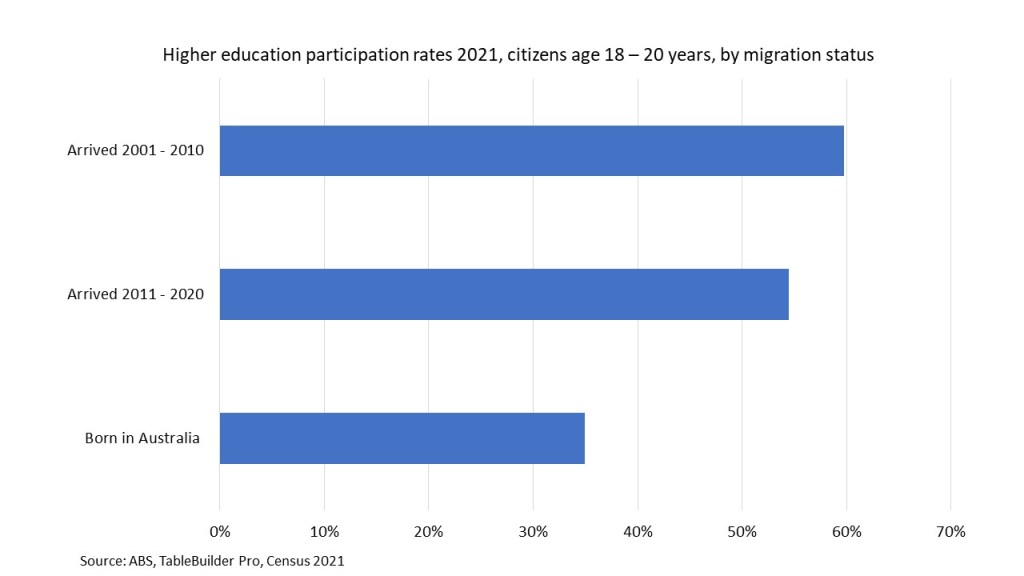
Some 2021 Census is now available on the ABS TableBuilder site, allowing additional analysis of the social and personal characteristics of higher education students. This posts looks at migration status and language spoken at home, previous strong predictors of higher education participation rates.

Year of arrival

In 2021 migrants who had taken out citizenship were significantly more likely than people born in Australia to be enrolled in university in the post-school 18 to 20 years old age bracket. The participation gap was 19 percentage points for migrants in the decade prior to the 2021 census, 54 per cent participation compared to 35 per cent for young adults who were born in Australia. Migrants who arrived as younger children have a higher participation rate again, at 59 per cent.

Language spoken at home

Read More »

Bonded scholarships for nursing students in Victoria

The Victorian government has announced an incentive program for nursing and midwifery students. For 2023 and 2024, students enrolling in nursing and midwifery ‘will receive $9,000 while they study and the remaining $7,500 if they work in Victorian public health services for two years.’

In a quote provided to the media, Premier Daniel Andrews says “If you’re in Year 12 and you’ve been thinking about studying nursing or midwifery – go for it. We’ve got your HECS fees covered.”

Are student contributions covered?

Student contributions (‘HECS fees’) for a 3 year nursing course are about $12,000 on current student contributions, so the initial $9,000 assistance while studying will not cover them in full.

Student contribution reform may start in 2024. Increasing the current $4,000 student contribution band that includes nursing is a plausible outcome, to reduce the debt burden of arts students. If so, that will increase the gap between the scholarship and student contributions.

On any scenario, nursing students who complete their degree will need to pay student contributions upfront or incur a HELP debt.

Read More »

The legal and bureaucratic problems of the government’s 20,000 additional student places policy

Last week the government’s announced the details of how it will meet its election promise of 20,000 additional student places. Many of these details create legal and bureaucratic problems for the government and universities.

General lack of statutory authority

The program guidelines, unsurprisingly given Labor’s election promise, refer explicitly to the allocation of the 20,000 places. While unexceptional in historical policy terms this is not how things work for public universities (‘Table A providers’) under the Job-ready Graduates version of the Higher Education Support Act 2003.

Section 30-10 of HESA 2003, as cut-and-pasted below, does not give the minister the power to allocate student places to Table A institutions except in the case of designation. Only medicine is currently designated. For higher education courses, covering every course except medicine, the unit of allocation is dollars rather than student places.

Read More »

How can the government steer teaching enrolments to ‘quality’ courses? And what could go wrong?

The communique from last Friday’s education ministers meeting stated, in part, that:

The Teacher Education Expert Panelwill focus on strengthening the link between performance and funding of ITE [Initial Teacher Education]. This will include but not be limited to advising on how Commonwealth supported places for teaching should be allocated based on quality and other relevant factors. [Emphasis added.]

This post examines how the government might go about doing this and the problems it would face.

Discipline-level funding under Job-ready Graduates

An initial problem is that the government does not allocate Commonwealth supported places to teaching.

Under section 30-10 of the Higher Education Support Act 2003 the government has no power to allocate student places except for ‘designated courses’, of which more below.

Education is not designated. It is funded under a block grant for ‘higher education courses’. Dollars rather than places are the unit of allocation and the entity that receives the allocation is a higher education institution, not a course or discipline. Recipient universities are free to distribute these dollars between courses according to their own priorities.

With its COVID-19 short courses the previous government bypassed the restriction on allocating student places by allocating dollars to specific courses instead. Using the funding agreements to quarantine dollars for education would, however, be a bad move. It is inconsistent with the apparent legislative intent, which is for university flexibility except in the case of designation. We need to restore full operation of the rule of law in higher education policy. Without amending HESA 2003 that means designation.

Read More »

More than a million people are now repaying HELP debt, but the average repayment is down

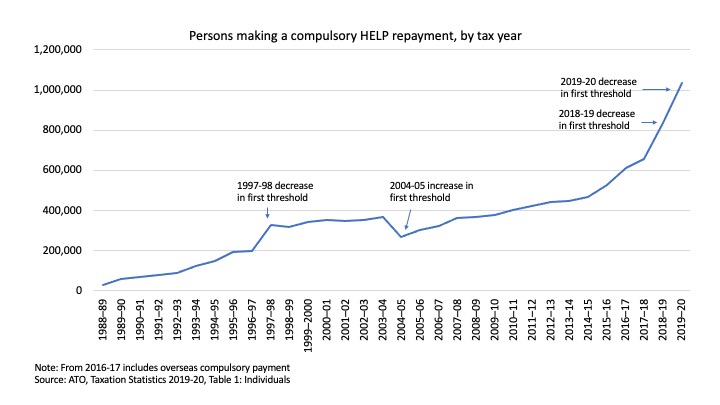
The ATO’s annual taxation statistics release shows that in 2019-20 the number of repaying HELP debtors continued its strong growth, up 23 per cent on 2018-19 and exceeding 1 million for the first time. However, compulsory repayments are not growing as strongly, up 8 per cent on 2018-19 to $3.6 billion.

This post offers a few explanations for overall growth and why repayers are increasing more rapidly than repayments.

Read More »

Inflation and higher education

The return of inflation has led to questions about what this means for students, graduates and higher education institutions. This post lists some of the implications.

Indexation of HELP debt

HELP debt is indexed each 1 June. It is based on a two year period of CPI data ending in the March quarter of 2022 (I am not sure why it is two years). Because inflation March 2020 to March 2021 was lower than inflation March 2021 to March 2022 indexation for 2022 was 3.9 per cent, rather than the 5.1 per cent it would have been on a one year CPI cycle. The downside of this reprieve is that after inflation comes down again indexation will still exceed the recent average.

I said at last week’s Universities Australia conference that increased indexation will affect the politics of HELP debt. The big increase in the number of HELP debtors and total HELP debt over the last 15 years occurred at a time of mostly low inflation. Annual indexation rarely attracted much comment. This year there was much more media and social media coverage.

CPI is well above bank interest rates, giving people who can afford to repay early an incentive to do so. Indeed, low bank interest rates may help explain why voluntary HELP repayments have grown in recent years.

Read More »

A few notes on the future of higher education policy

Labor went to the 2022 election with few specific policies on higher education, but with general plans for a different style of policymaking. The teal MPs have a few things to say about higher education. If Labor gets a clear House of Representatives majority, however, the opinions of the yet-to-be-determined Senate crossbench will be more important than those of lower-house teals in the passage of higher education legislation.

Additional student places

Labor’s main specific election promise was ‘up to’ 20,000 more student places. As I wrote when the policy was announced, the ‘up to’ is an important caveat, because under Job-ready Graduates the government allocates dollars rather than places. The same number of dollars can convert into lots of places in arts or business courses with low Commonwealth contributions, or relatively few places in courses with high Commonwealth contributions.

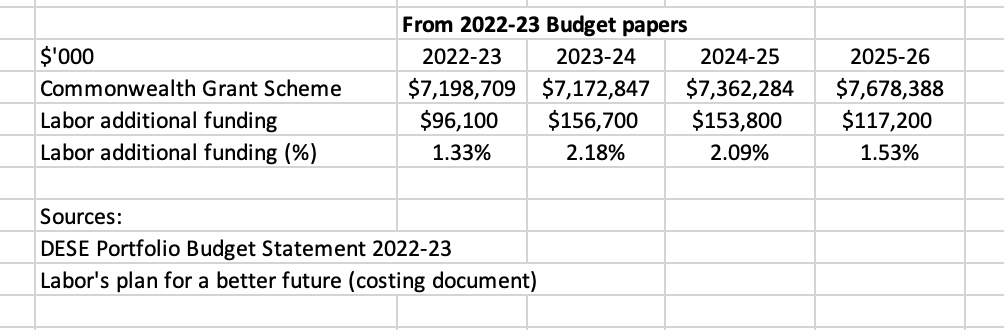
Labor’s costings document also indicates that this money for extra places appears to be temporary, starting to decline before the full impact of demand from the ‘Costello baby boom’ cohort is felt. It may also be too little to offset the inflation impact on Commonwealth-supported places. Commonwealth contributions are indexed to CPI, so as contribution values go up universities need to deliver fewer student places to get each $1 million of Commonwealth Grant Scheme funding.

Read More »

Patterns of international student enrolment decline in the first year of COVID-19

For international students the 2020 higher education enrolment data released this week is already very out-of-date. The international branch of DESE produces more current aggregate numbers, and has been circulating up-to-date figures to experts and stakeholders. Peter Hurley used these in a recent Conversation article. It’s a model for what, after a recent IT upgrade, could and should be done for domestic enrolments (my long-after-the-fact analysis of the 2020 domestic results is here).

Although more recent current total international enrolment figures are available, a few things in the recently released 2020 enrolment data tell us more than is publicly available elsewhere.

Attrition

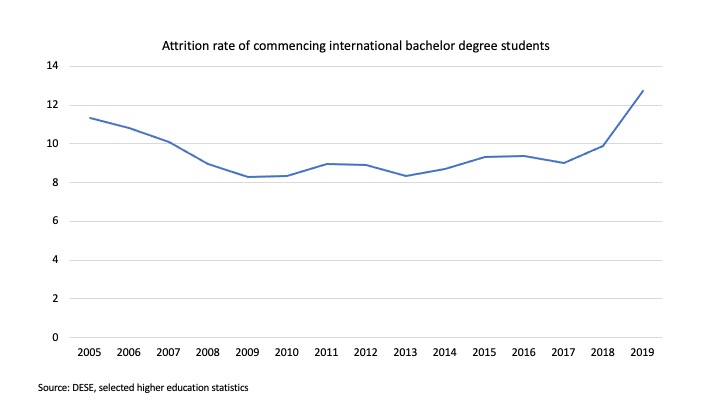
International bachelor degree students have much lower attrition rates after first year than their domestic counterparts. Flying to a foreign country and paying sometimes exorbitant fees is a strong incentive to get the degree. But while attrition for 2019 commencers into 2020 declined for domestic students, the international rate increased nearly 3 percentage points to 12.73 per cent. The most likely reason is that some international students could not get back to Australia due to travel bans.


Commencing and continuing students

Increased attrition meant fewer continuing students than would have been the case without COVID-19. But the prior boom years for commencing students meant that continuing students still increased in 2020 on 2019 figures. This is one reason why the overall decline in international students was contained to 6.6 per cent, despite an 18.2 per cent decrease in commencing numbers.

Read More »

Domestic student enrolment increases in the first year of COVID-19

The 2020 higher education student data has finally been released, giving us the first detailed look at potential COVID-19 influences on enrolments. This post is on domestic students. Another post examines international students.

Aggregate trends

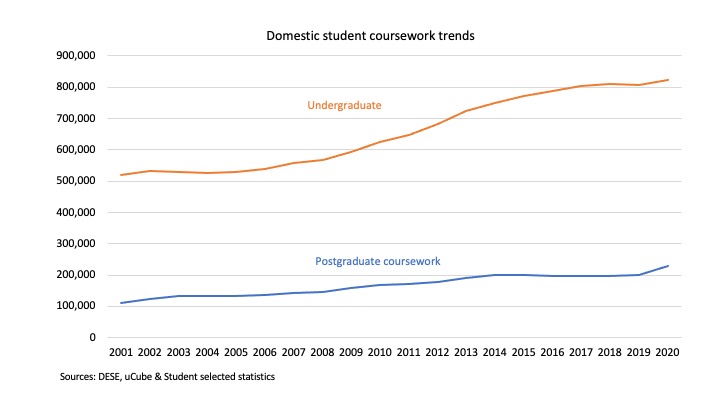
Overall domestic student trends were positive for both undergraduates, up 2 per cent after a decline between 2018 and 2019, and postgraduate coursework, up 14 per cent after six years of stagnation or low growth. Postgraduate research was an exception, down by 577 enrolments or 1.3 per cent. Including enabling and non-award students total domestic enrolments were 1,133,519, 4.4 per cent up on 2019.*

Student ‘load’ – full-time equivalent enrolments – was up by less, 2.6 per cent. The headcount share of part-time students, defined as less than 75 per cent of a full-time equivalent study load, is only up by .7 of a percentage point, suggesting more part-time students with light study loads and/or more full-time students not at a 100 per cent study load.

Read More »