Rule by email in higher education policy – over-enrolment and governance

This post is about unlegislated higher education policies. The story starts last year with reports that the government was imposing caps on commencing Commonwealth supported places, which reached the media in November 2025. This sparked my interest, as the current funding legislation does not specifically authorise it.

By the end of the Universities Australia conference in February 2026 I was also hearing that governance conditions were being imposed on universities getting additional funds to reduce over-enrolment (taking students on the student contribution only). The policies were implemented via emails to vice-chancellors.

I decided to file a Freedom of Information request on the emails. I paid a $150 processing charge. This week the request was granted.

The minister’s letter

The FoI release shows that this process started with a letter from Jason Clare to the ‘interim ATEC’ dated 28 August 2025.

The letter reiterates the minister’s views on the impact of over-enrolments for the universities left with too few students. Its solution is to get over-enrolled universities to do three things:

  • ‘Agree’ to a plan to reduce or not further grow commencing Commonwealth supported students
  • Report on plans to support staff and students during this transition period (an implicit acknowledgement that fewer CSPs = fewer staff)
  • Early adoption of agreed actions from the Education Ministers’ consideration of recommendations from the Expert Council on University Governance

To do these things, universities were to be given two incentives and one threat.

  • A share of a $50 million over-enrolment fund for 2026, which would convert some over-enrolled places to fully-funded places (i.e. Commonwealth + student contribution)
  • A more attractive transition phase to a capped system, under which they could keep student contributions for over-enrolments while trending down to the caps (the ‘glidepath’)
  • And the threat that ‘actions they take now will be considered by ATEC when allocating growth places through mission based compacts for 2027’.

Emails to vice-chancellors of over-enrolled universities, dated 11 December 2025, mentioned that they had already agreed to ‘pursue a more modest growth strategy in 2026’ and told them that they had until 14 January 2026 to confirm student and staff support plans and agreement to governance actions.

Read More »
TEQSA’s response to the Australian National University’s governance issues

Julie Bishop quit as ANU Chancellor last Friday, but not without a parting shot:

“Following unprecedented and co-ordinated interference, the ANU Council is no longer able to discharge its legal and ethical obligations,” she said. “The higher education sector is at a crossroads of regulatory overreach in the governance of our institutions or autonomy and academic freedom.”

The ANU needs to move on from the last few years of drama and disruption. The departure of controversial figures, including Julie Bishop, will help with that process. But her parting shot made a valid point. A TEQSA decision that Bishop is alluding to, while at least in part a by-product of weaknesses in TEQSA’s enforcement mechanisms, was an odd one. It was at most a partial solution to the ANU governance problems identified by TEQSA. Compared to other options it raised more serious legal compliance issues for members of the ANU Council.

The voluntary undertaking

The most prominent “unprecedented interference” is a voluntary undertaking the ANU made to TEQSA about the appointment of a new Chancellor. This was to happen in the lead up to Bishop’s term expiring on 31 December 2026, but will now be brought forward.

What the voluntary undertaking does is set a process by which the Council will accept or reject a recommendation for the new Chancellor.

The recommendation will come from a panel of TEQSA-approved members. The panel will have an independent chair nominated by TEQSA (announced as Peter Coaldrake), two TEQSA-nominated people with experience and expertise in higher education and university governance, an Indigenous person if neither of the earlier two nominees are Indigenous (who appoints this person is not stated, by inference TEQSA) and two members nominated by ANU Council who are “accepted by TEQSA in writing.”

So TEQSA will either appoint or have veto power over all five or six members of the panel.

Read More »

ATEC’s interim statement of strategic priorities

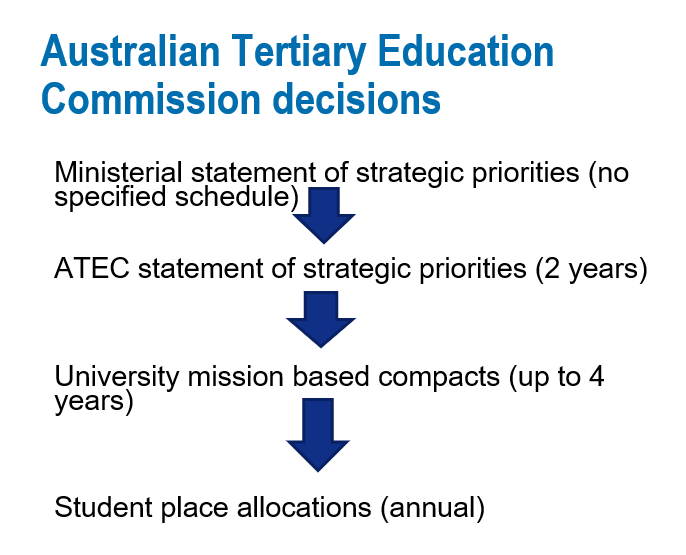
Yesterday the Australian Tertiary Education Commission issued an interim statement of strategic priorities. This statement will guide university mission based compacts for 2027. This post covers the legal status of the statement, its apparent approach to management of the sector via compacts, and what it proposes in the areas of skills, First Nations, equity, teaching quality, VET-higher education relations, and research.

Decision-making under the ATEC system

When fully operational the ATEC decision-making process will operate in the sequence shown in the chart below.

Despite the ATEC Act 2026 officially coming into force on 29 April 2026, ATEC’s interim statement seems to be operating in the legal limbo the organisation has been in since being established as the ‘interim ATEC’ in July 2025.

Read More »

Treasury’s take on student debt repayment times under Job-ready Graduates

Thanks to a Guardian story based on a FoI request we now know that Treasury has modelled changes to HELP debt repayment times under Job-ready Graduates. They are six years too late to influence the original policy, but better that than never as JRG remains a live issue.

Treasury used much more sophisticated methods than my own recent analysis of arts graduate repayment prospects. However, Treasury does not use the new student debt repayment system introduced in 2025-26, and so under-estimates current repayment times. I will return to this, but Treasury has produced a helpful conceptual and empirical guide to what the Morrison government should have considered prior to Job-ready Graduates being proposed, and the Albanese government should think about when redesigning the system.

Debt and income data

Instead of just using debt levels based on three years of the relevant student contributions for each course, Treasury put into their model actual subjects taken, with data from the Department of Education included in PLIDA. So the model captures extra debts caused by double degrees, changing courses or failing and repeating subjects. It also captures lower debts of people who never complete a course.

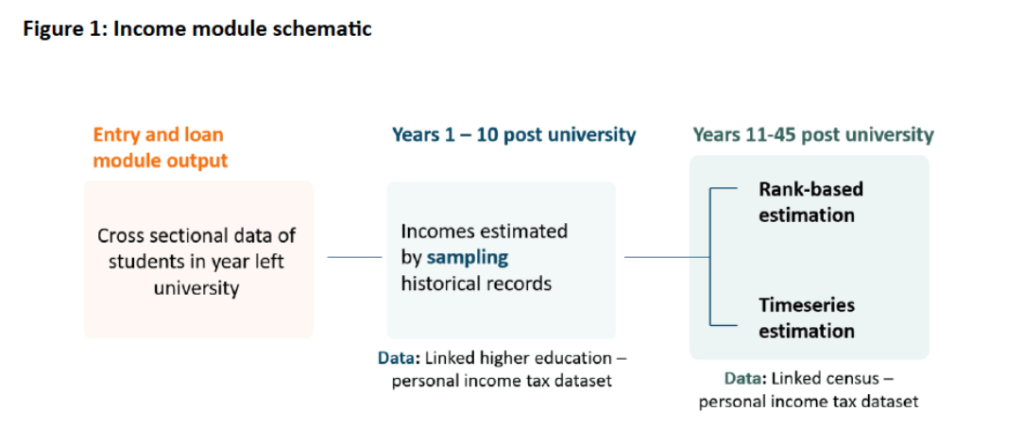
My analysis used Australian citizen median income by single year of age, as recorded using ATO and DSS income linked to Census records. For years 1 to 10 after university Treasury used a model based on actual debtor income in PLIDA (which also has ATO and DSS data). These are critical years for repayment for most debtors, so this is important. Treasury’s model uses Census data to estimate repayments after 10 years.

Read More »

The $1 billion spent on undelivered student places

Last year I wrote about payments to universities under the Higher Education Continuity Guarantee, a Morrison-era program to compensate universities for ‘under-enrolment’. I then had data up to 2022. This can now be updated to 2024. Total expenditure on the Guarantee and its 2020 predecessor, the Higher Education Relief Program, now exceeds $1 billion.

How the Higher Education Continuity Guarantee worked

In simplified terms, the Higher Education Continuity Guarantee offset reduced payments to universities from the Commonwealth Grant Scheme.

Under the funding legislation, universities are supposed to receive the lesser of 1) The value of Commonwealth supported places delivered, calculated on a full-time equivalent place multiplied by the relevant Commonwealth contribution amount, or 2) the maximum grant amount that universities were entitled to receive under their funding agreement (how this maximum was calculated varied in the life of the Guarantee).

For universities entitled to receive only the amount calculated in option (1), the Guarantee topped them up to the amount in (2).

This is called ‘under-enrolment’ because universities did not deliver sufficient Commonwealth supported places to receive their maximum grant amount.

The cost of the Higher Education Continuity Guarantee

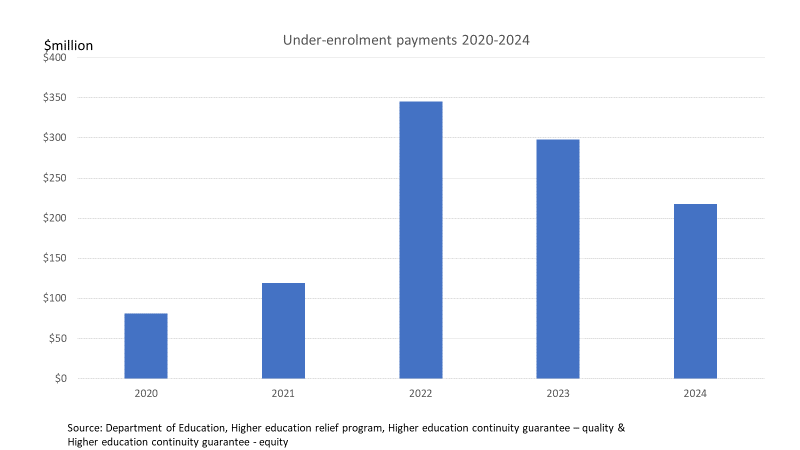
Guarantee funding peaked in 2022, at $346 million, before dropping to $298 million in 2023 and $218 million in 2024. Total cost since 2020 is $1.056 billion.

Read More »

Political compromise to end the worst of Job-ready Graduates

Late last year the Greens introduced the Higher Education Support Amendment (Reverse Job-Ready Graduates Fee Hikes and End 50k Arts Degrees) Bill  into the Senate. Submissions for the Senate inquiry into this bill close on Friday.

Under the bill, the student contribution for most arts students would go down from $17,399 a year to $8,164, what it would have been if Job-ready Graduates had never happened. For business and law the student contribution would go down from $17,399 to $13,624, similarly what it would have been without Job-ready Graduates. Creative arts students contributions would go down from $9,537 to $8,164.

My submission to the inquiry is here.

Constitutional problems

While I agree with the broad direction of the Reverse Job-ready Graduates bill on student contributions, it cannot fix the JRG problem. Under section 53 of the Australian Constitution, a bill appropriating money cannot originate in the Senate. Offsetting reduced student contributions with higher Commonwealth contributions, as needed to maintain university funding, would require an appropriation. Due to this legal limitation, the bill contains only lower student contributions, without any changes to Commonwealth contributions.

If the bill passed we would be left with JRG Commonwealth contributions and pre-JRG student contributions. Total funding for a full-time arts student would halve, from $18,715 to $9,480.

Ending $50,000 arts degrees by ending arts degrees is too radical a measure.

Read More »

ATEC legislation amended in the Senate

The ATEC legislation passed the Senate yesterday, after the government accepted amendments from the Greens and David Pocock. It now needs to be rubber-stamped by the House of Representatives [update 9pm 31/3 – done] and the Governor-General [update 3/4 -done]. Once that is done, it will become law after 28 days [update – 29 April].

The amendments improve the legislation while still in my view leaving major flaws.

This previous post of mine links to my ATEC Senate inquiry submission and earlier posts on aspects of the legislation.

Objects of the Act

One of my criticisms was the entirely utilitarian and philistine set of ‘objects’ in the Act. While arguably no government since the 1970s has genuinely cared much about the broader functions of universities, they at least nodded to them in legislative objects. Not this government.

But the Senate amendment improves things:

Research

The ATEC bill read like a rushed committee job with nobody in enough control to ensure internal coherence. One example of this was research appearing in the objects of the bill but then disappearing from ATEC’s functions and matters on which it can give advice.

This is now fixed.

Read More »

Needs based funding winners and losers

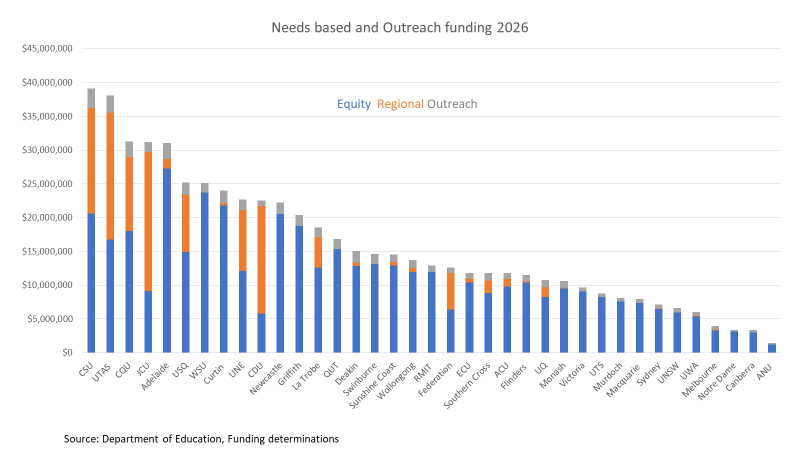
Last month I wrote about the new equity and regional needs based funding programs. Back then I had the funding formulas but not total funding amounts. The Department’s funding determinations now show that $425.7 million has been allocated for equity needs based funding and $118.6 million for regional needs based funding. There is also $43.7 million for outreach programs. The total is $588.1 million, including $1.3 million in equity needs based funding going to NUHEPs and private universities.

These new programs were principally funded from abolishing the old HEPPP equity program, the old regional loading, and the NPILF program, which supported internships and other engagement with industry. The predecessor programs were allocated $515.9 million, so the increase is more than indexation. Real cuts to the Commonwealth Grant Scheme may have funded the gap.

Funding by university

The chart below shows funding by university. Charles Sturt University and the University of Tasmania get the most money while the two Canberra universities get the least funding. They suffer from a lack of official ‘low SES’ areas in the ACT; as I noted earlier this month the low SES definition is not fit for funding purposes.

A spreadsheet of public university funding levels is available here.

Read More »

What is going on with low SES higher education numbers?

In his speech to the Universities Australia conference last month Jason Clare complained that the low SES share of enrolments ‘hasn’t changed that much in the last 30 years.’ He is overly pessimistic about long run trends in low SES higher education participation. But after 2017 key indicators went backwards, until a recent stabilisation with signs of partial recovery. This post explores trends and speculates on causes.

School leaver participation

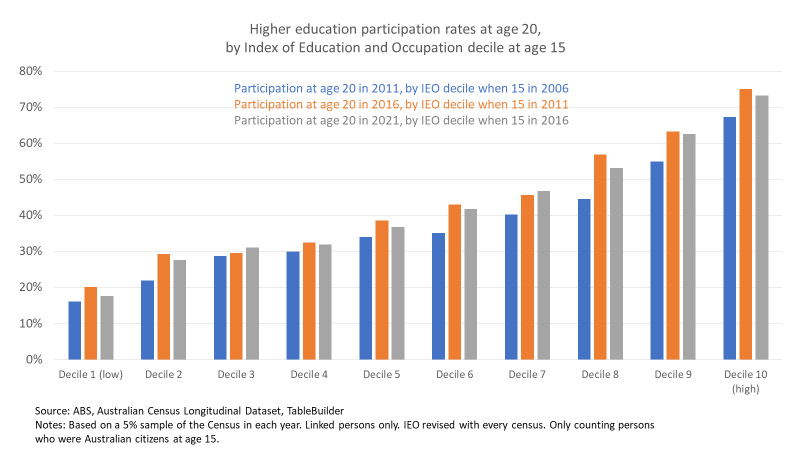
One issue with measuring trends in low SES enrolments is correctly identifying low SES students. In higher education statistics a person is low SES if from an area in the lowest 25% by the ABS Index of Education and Occupation. As charts below will show, this IEO geographic proxy shows a distinctive lowest 10% for higher education participation. Above that, however, we see modest participation and attainment increments between deciles 2-6, with differences then speeding up to a distinctive top 20%.

The participation rate similarity between deciles 2-6 makes the current low SES definition unsuitable for funding purposes, but a reasonable rough guide to overall trends. Because deciles 2-6 are sociologically similar, they probably respond in similar ways to economic, educational and policy trends affecting higher education enrolments.

In his speech, the minister referred to an enrolment share metric, low SES students/all domestic students. That’s administratively convenient but analytically weak, as low SES results depend as much on movements in middle and high SES as low SES enrolments. Participation rates are better measures, low SES higher education students/low SES population.

The chart below uses census longitudinal data for school leavers, taking as their SES the IEO ranking of where they lived when they were 15 years old, to better capture the social context of their secondary school years. The orange bars show that in 2016 all deciles had increased their participation rates since 2011, facilitated by the demand driven funding system. But in 2021, shown in grey bars, the participation rate in most deciles was lower than in 2016. There may be some statistical noise. This dataset takes a 5% sample of the census and my results omit unlinked census records – meaning the ABS could not track the same person from census to census or the necessary data was missing. But other data reported in this post confirms that the overall trend is real, even if some decile results are not 100% accurate.

Read More »

Needs based funding – the regional campus component

This post examines the regional campus component of needs based funding, which starts this year. I looked at the low SES and Indigenous component last week.

The regional component funds students at regional campuses rather than regional students. It assumes higher average costs at regional campuses. A longstanding ‘regional loading’ served a similar purpose. Just under $90 million was spent on the regional loading in 2025. Universities have been notified of their needs based funding amounts, but as of 23 February 2026 I cannot find a public record of them.

The research on cost by campus

The Deloitte Access Economics costing work used by the Morrison government to reset funding rates found that regional universities had higher costs per EFTSL after controlling for other factors affecting costs, such as discipline.

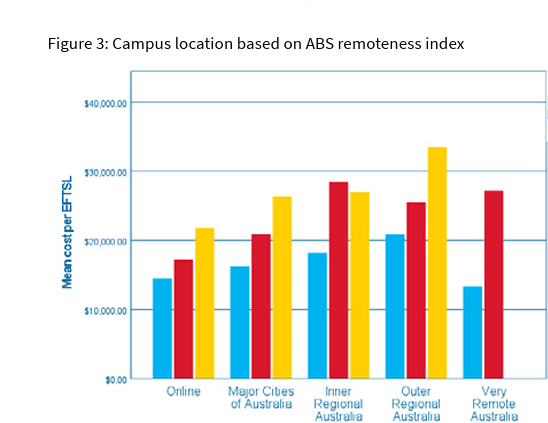
Later work by the U of M’s Centre for the Study of Higher Education, using Pilbara Group data, also found that regional campuses had higher average costs per EFTSL (chart below). This partly reflects a general feature of university costs – higher education is an economies of scale enterprise, but regional campuses on average have lower enrolments than major city campuses. However, higher regional costs were found to be still present after controlling for subject size.

Assuming that higher education should, ideally, be taken to where the students are – a proposition I agree with – the basic policy idea behind the regional loading/regional component of needs based funding is sound.

Read More »