After Tony Burke gave his National Press Club address on migration I wrote a blog post on new limits on secondary visa holders, the partners and children of the primary visa holders. Not much detail was available at the time. This post draws on the since enacted legislative instruments to provide this detail.
The new rules on student secondary visa holders interact with new restrictions on onshore student visa applications. So it is not just who can apply for a secondary visa, it is where they can be when they do so.
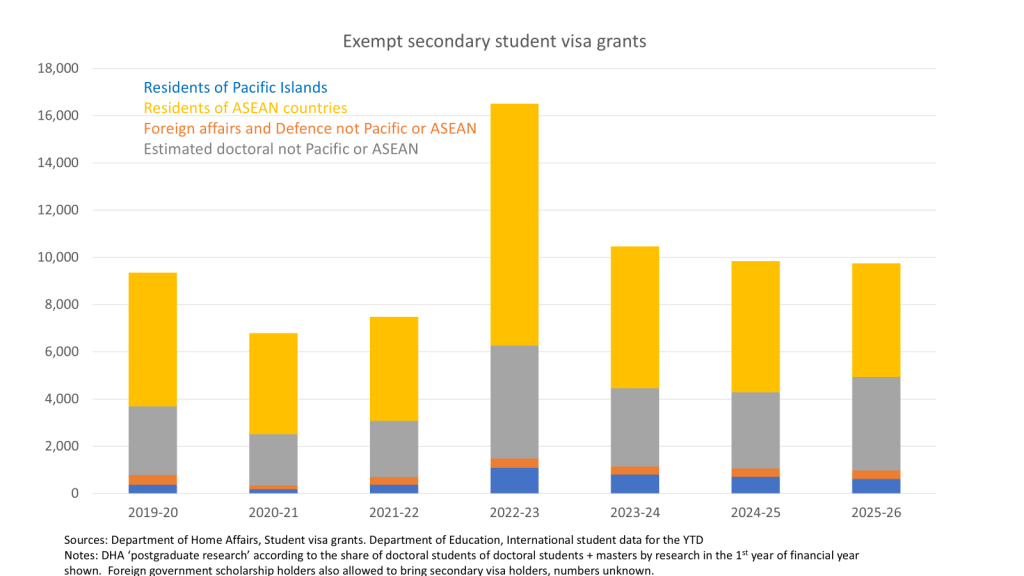
The main categories of students who can bring partners and children are: students from the Pacific region or ASEAN countries, doctoral students, students sponsored by the Department of Foreign Affairs and Trade or the Department of Defence, and students with fully-funded scholarships from a foreign government. Data on foreign scholarships is not available, but based on recent history the other categories would support about 10,000 secondary visa holders per year.
In addition to this 10,000, transitional categories of current secondary student visa holders already in Australia can remain while their primary visa holder gets another visa for a higher AQF course or due to delays in completing their course.
New restrictions on secondary student visa holders
The default position is now that secondary applicants are not permitted unless they fall into an exempt category.
DFAT and Defence sponsored students
Primary applicants sponsored by the Department of Defence or Department of Foreign Affairs and Trade can bring their partner and/or children: new paragraph 1222(3)(da)(i) of the Migration Regulations 1994.
In 2025-26 3,397 primary student visas were granted to Defence and Foreign Affairs students, accompanied by 1,066 secondary visa applicants.
Exempt countries
Students from Pacific-regional countries can bring partners and children as secondary applicants: new paragraph 1222(3)(da)(i) of the Migration Regulations 1994.
A Pacific-regional country is, in turn, defined in the Migration Regulations 1994 as the following:
a) Federated States of Micronesia;
(b) Fiji;
(c) Kiribati; (d) Nauru;
(e) Palau;
(f) Papua New Guinea;
(g) Republic of the Marshall Islands;
(h) Samoa;
(i) Solomon Islands;
(j) Timor-Leste;
(k) Tonga;
(l) Tuvalu;
(m) Vanuatu.
In 2025-26, 3,276 primary and 607 secondary student visas were granted to citizens of these countries. Of these, 1,172 primary and 257 secondary visa holders were also Defence or Foreign Affairs sponsored students.
The list of Pacific locations for secondary visas is not identical to the list for priority one (fastest) visa processing, which also includes French Polynesia and New Caledonia. The omission blocks these places as workarounds for French passport holders.
Another set of countries listed in existing subregulation (5A) is permitted under new paragraph 1222(3)(da)(i):
(a) Brunei;
(b) Cambodia;
(c) Indonesia;
(d) Laos;
(e) Malaysia; (f) Myanmar;
(g) Philippines;
(h) Singapore;
(i) Thailand;
(j) Vietnam.
These are the ASEAN member states other than Timor-Leste, which is already covered in the Pacific-regional list. This is a more commercially significant group than the Pacific-regional states, with a total of 43,626 primary and 4,817 secondary visa holders in 2025-26. All countries have Defence or Foreign Affairs students, with the largest group from Indonesia. The Philippines is the most significant for secondary visa holders, with 1,960 in total.
The Coalition says that it would restrict ‘most’ secondary visa holders, suggesting that it also plans exemptions. It remains to be seen if it has a country list and, if so, whether it will be shorter than Labor’s list. Given the relatively low number of non-sponsored ‘Pacific regional’ visa holders it would seem like an unnecessary diplomatic own goal to not exempt them. But the numbers from ASEAN countries are higher and the political imperatives weaker. (I have more on the Coalition’s policy here.)
Existing student visa holders
Primary student visa holders are now restricted in what onshore student visa categories they can apply for. But if their application is for an eligible category of student visa they can include secondary applicants who were in Australia for the earlier visa, prior to the new rules coming into effect on 2 October 2026. This also applies to applications currently in the system: new paragraph 1222(3)(da)(ii) & (iii) of the Migration Regulations 1994.
This does, however, preclude adding subsequent temporary visa holders who are not already in Australia as secondary visa holders. With one exception mentioned immediately below, secondary visa applications must be made at the same time as the primary applicant: amendment to current paragraph 1222(3)(e). Under the previous system, existing partners or children could be added later, provided they were declared in the original application.
Children of the primary applicant born in Australia can be added if born on or after the commencement of these restrictions: new paragraphs 1222(3)(da)(iv) & (v). The amendment’s explanatory statement notes that, under section 78 of the Migration Act 1958, children born in Australia get the same visa as their parents.
Doctoral students
Migration law can take readers on circuitous routes to the rules. A person can be a student visa secondary applicant if listed in new paragraph 1222(3)(da) of the Migration Regulations 1994. The specifically listed categories are described above. But paragraph 1222(3)(da)(vi) also allows a ‘class of persons’ specified in paragraph 1222(5)(c). That in turn says – after last week’s amendments – that the minister may, by legislative instrument, specify ‘classes of persons for the purposes of subparagraph (3)(da)(vi)’. And so we finally get to this separate legislative instrument, the Migration (LIN 20/158: Class of Persons for Student (Temporary) (Class TU) Visa Applications) Amendment Instrument 2026.
Section 21 of this instrument allows the partners and children of doctoral students to be secondary applicants. As noted in my post on permitted onshore student visa applications, this includes doctorates by coursework. Masters by research, an emerging visa hopping category, is not included.
The migration statistics use the category of ‘postgraduate research’, excluding doctorate by coursework but including masters by research. The enrolment data reports 6,131 international student doctoral commencements in 2025.
Foreign government scholarships
Under section 20 of the LIN 20/158 legislative instrument, students in a course fully funded by a foreign government can bring partners and children.
This has parallels in the current non-counting, for the purposes of the national planning level international commencing student soft caps, students with foreign scholarships. The planning level definition includes foreign state-owned entities and scholarship students from multilateral or regional organisations.
Does a ‘foreign government’ include a state or provincial government in federated countries? It would under the foreign arrangements laws that govern university collaborations, but I am not sure how it relates to migration law. I could not find a migration law definition of ‘foreign government’, but this may reflect my novice status in this area.
This is another potential instance of something now common in higher education, of different agencies regulating similar activities in different ways. The Department of Education defines foreign scholarships more broadly than the Department of Home Affairs, leaving students and universities to work out who fits into the different categories.
This rule also seems to create an anomaly where a student with a fully-funded foreign government scholarship can bring their family, but not a student with a fully-funded non-Defence, non-DFAT Australian government scholarship, such as the Department of Education’s Research Training Program. In 2024, there were 860 international RTP scholarship holders.
Unfortunately there is no public data on non-Australian government scholarship holders. The Department of Education must have this data as part of its national planning level work, and should publish it.
Course delays
As noted in my post on onshore student visa applications, these are still permitted when education providers cannot deliver courses or when students need more time to complete their degree, for example to repeat failed subjects. Parallel provisions let secondary visa holders remain in Australia while primary visa holders complete their courses: sections 22 & 23 of LIN 20/158.
This is another category for which there is no data on primary or secondary visa applicants.
Course progression
Under the paragraph 1222(3)(da)(ii) & (iii) rules, described under ‘Existing student visa holders’ above, current secondary student visa holders accompanying primary visa holders applying onshore for a visa for a higher AQF level course can remain in Australia.
These provisions apply only to applicants who were in Australia before the the relevant sub-paragraphs commencemed, that is before 2 October 2026.
No equivalent exemption exists for secondary applicants who applied after this date, unless they fall into one of the categories discussed above: certain countries, some scholarship holders, doctoral students, and students who need more time to complete their courses.
As new secondary applicants are not permitted in most cases this should not cause major issues. But current students whose partners are not in Australia, or who find non-Australian partners after 1 October 2026, are not covered by the transitional arrangements.
Revised estimates of allowed secondary visa holders
My initial estimates of still-allowed secondary visa holders assumed that all research students were included, when the exemption is not research students but doctoral students. A recent surge in masters by research enrolments therefore needs to be excluded; to do this I produced estimates adapted from calendar year data. This change brings recent year totals down to around 10,000 secondary visa holders who would be permitted under the new rules.
The major unknown is how many foreign government scholarship holders are not already permitted via the doctoral, ASEAN or Pacific-regional exemptions.
In the short term, significant numbers of current secondary visa holders will secure second visas via the course delay and course progression categories.
ENDS


[…] 9/10/2026: More up-to-date detail on this subject is now available at this post on the legal detail of the secondary student visa […]
LikeLike